Weekly Couple Planning Meeting? 6 Myths That Keep It From Working
Maybe someone suggested a weekly couple planning meeting, and you thought: we've tried versions of that. A Sunday talk that turned into a to-do list. A shared app that went quiet by Wednesday. A "let's get organized" conversation that ended with you holding the list anyway.
If that sounds familiar, here's the part no one told you. Those attempts didn't fall short because you did something wrong. Every system you tried was built for tasks. None of them was built for the invisible work you're carrying underneath the tasks: the noticing, the planning, the deciding, the following up. You didn't fail the systems. The systems missed what you were carrying.
A weekly check-in can help. But a few common beliefs about it quietly set it up to fail before it starts. Here are six of them, and what's actually true.

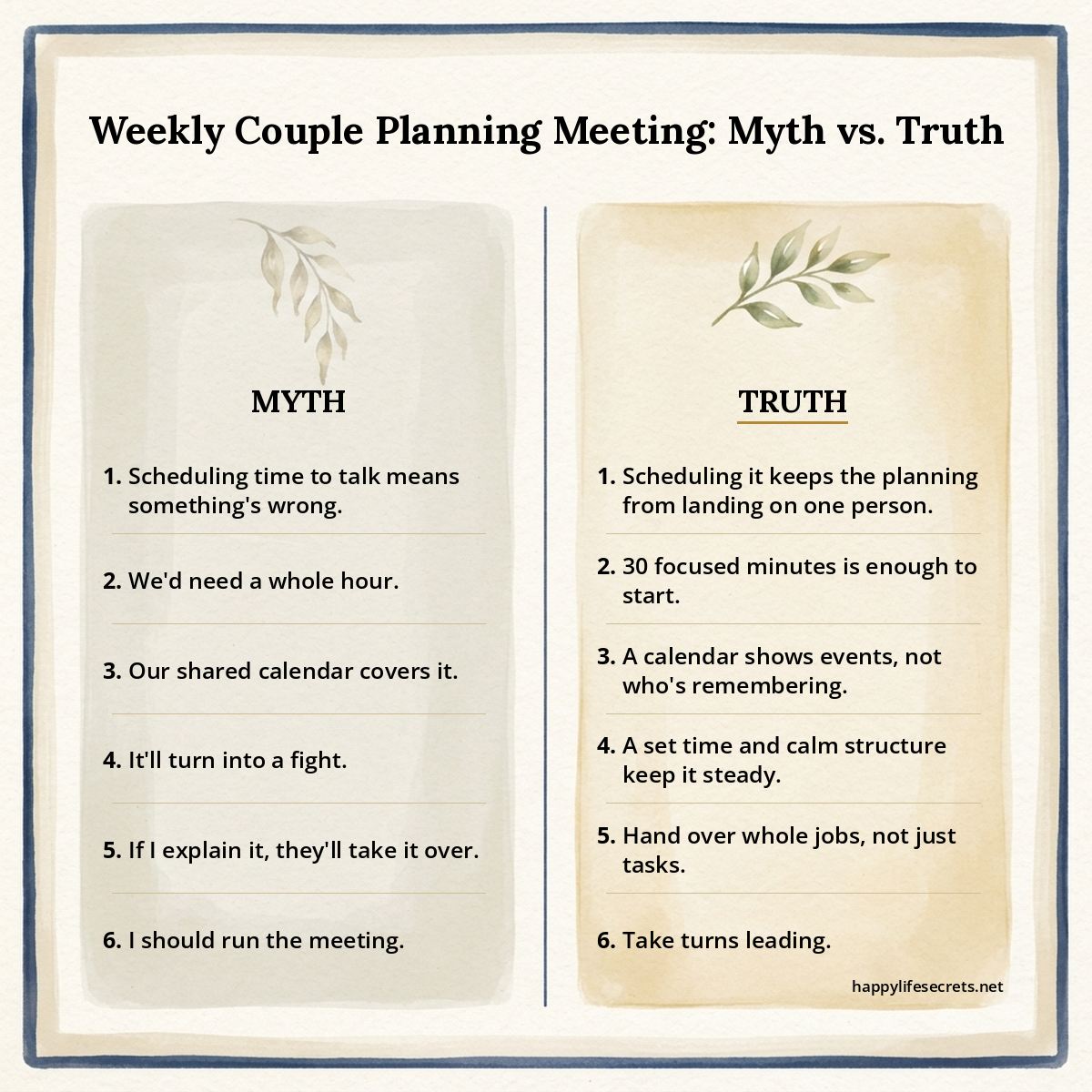
Myth 1: "If we have to schedule time to talk, something's wrong with us."
You hear it from friends, from movies, maybe from your own head: good couples just talk. They don't need an agenda.
Why it sounds right: Early on, conversation probably did flow on its own. There were fewer moving parts, and talking was the fun part. Putting your relationship on a calendar can feel cold, almost corporate, like admitting the spark now needs a meeting invite.
But life got fuller. Jobs, kids, aging parents, bills. When nothing is scheduled, the planning doesn't disappear. It lands, by default, on whoever notices first. Very often that's you.
The truth: Scheduling time to plan together isn't a sign something is broken. It's how you stop leaving the Planning Load to chance, and to one person.
Couples therapists have recommended a regular check-in for years. The Gottman Institute's guide to the weekly State of the Union meeting describes a structured weekly talk that opens with appreciation, and presents regular check-ins as a way to feel heard and keep issues from piling up.
Myth 2: "We don't have an hour a week for this."
Why it sounds right: Most weeks really don't have a spare hour. When your days are already full, another meeting sounds like one more thing to manage. And some well-known versions of the couples weekly check-in are described as hour-long conversations, which can make the whole idea feel out of reach.
The truth: You don't need an hour. A focused 30 minutes, at the same time each week, is enough to move the week's planning out of one head and onto the table.
How to plan the week together in 30 minutes
Here's a simple shape to start with. Adjust it as you go.
- 5 minutes: appreciation. Each of you names one thing the other did this week that helped.
- 10 minutes: the week ahead. Walk through the calendar together and name who owns each item, start to finish.
- 10 minutes: one load to move. Pick one recurring job and decide who carries it now, including the remembering and the follow-up.
- 5 minutes: rest. Each of you names when you'll get real downtime this week. That's the Recovering Load, and it belongs on the agenda too.
Many couples like a Sunday planning routine, but any steady time works. The point is a shared weekly planning habit, not a perfect one.
Myth 3: "We share a calendar. That's our planning."
Why it sounds right: Shared calendars are genuinely useful. Everyone can see the dentist appointment, the school concert, the flight home for the holidays. When the information is shared, it feels like the planning is shared too.
But a calendar only shows events. It doesn't show who remembered to book the appointment, who is already thinking about the gift for Saturday's birthday party, or who will notice that the permission slip never came home.
The truth: A calendar shows what's happening. It doesn't hold the Remembering Load or the Anticipating Load behind each entry. A weekly couple planning meeting is where that hidden part finally gets said out loud.
Myth 4: "It'll just turn into a fight."
Why it sounds right: If past conversations about the household went sideways, it makes sense to be wary. Those talks tend to happen at the worst moment: 9 p.m., dishes in the sink, both of you running on empty. Of course they get tense.
The truth: Many fights about the load happen because the load has nowhere to go, so it spills out when you're most tired. A weekly couple planning meeting gives it a set time and a calm structure, starting with what's going well.
Here's a composite of what many women describe. Dana used to bring up the week's logistics while packing lunches at night, and it almost always ended in a snap from one of them. When she and her partner moved the same conversation to Sunday morning, with coffee and five minutes of appreciation first, the tone changed. The tasks didn't shrink. The fighting about them did.
And if these conversations keep getting stuck, working with a couples therapist is a strong step. A therapist can help you build the skills that make a weekly talk feel safe.
Not sure which parts of the load you carry most? The free 2-minute quiz shows you, and gives you something concrete to bring to your first meeting.
Myth 5: "If I explain everything clearly, my partner will take it from there."
Why it sounds right: It's a reasonable assumption. At work, a clear handoff usually works: you share the details, and the job moves to someone else. So you explain the soccer schedule, the pediatrician's number, the lunch-money rules, and you wait for the relief.
Then you find yourself checking. Did they remember? Did it get done? Did the form get signed?
Research helps explain why. In Daminger's study of cognitive household labor, sociologist Allison Daminger interviewed members of 35 couples and found that household work includes thinking steps: anticipating needs, identifying options, deciding and monitoring progress. In her study, women did more of the cognitive work overall, and more of the anticipating and monitoring in particular.
The truth: Handing over a task isn't the same as handing over the thinking. When a weekly couple planning meeting moves whole jobs, from noticing to follow-up, you stop carrying the Monitoring Load for work that's no longer yours.
One whole job a week is plenty. Small shifts create real change.
Myth 6: "I should run the meeting. I'm the one who knows what's going on."
Why it sounds right: This one comes from competence and care. You hold the most information, so leading seems efficient. You may even worry that things will slip if you don't.
The truth: If you always set the agenda, the meeting becomes one more thing you plan. Take turns running it, and the Planning Load and the Deciding Load start to be shared where they begin.
The first few weeks your partner leads may feel a little clumsy. That's normal, and it's part of the shift. Recent research points the same way many women already feel: a 2026 study on mental load and relationship satisfaction, which surveyed women and couples in the UK and US, found that women reported higher relationship satisfaction when their partners shared more of the mental load. The link was modest, and the study shows an association rather than cause and effect, but it's a hopeful sign.

Your First Weekly Couple Planning Meeting Can Start Small
If any of these myths felt familiar, that isn't a sign you got something wrong. They're beliefs most of us absorbed long before anyone had a name for the invisible work behind a household. You're not lazy. You're overloaded. And you deserve support.
A couples weekly check-in won't fix everything overnight. What it does is give the 6 Types of Mental Load (Remembering, Anticipating, Planning, Deciding, Monitoring and Recovering) a regular place to be seen and shared. Thirty minutes, the same time each week, one whole job moved at a time.
Most women carry two or three of these types heavily without knowing which ones. Take the free 2-minute quiz, "What's Your Mental Load Type?" and bring your result to your first meeting. It's an easy, specific place to begin.
When you're ready to hand a job over,
Mental Load Transfer in Relationships: The Conversation That Finally Works walks you through it.
If a shared chore chart has let you down before, Chore Chart for Couples: Why It Stops Working explains why.
You'll find more on the Mental Load in Partnerships hub.
Relief is possible. Small shifts create real change.
About the author
Herb Ammons is the founder of Happy Life Secrets and the creator of the 6 Types of Mental Load, a framework that names the invisible thinking work women carry at home, at work and in their relationships. Read Herb's story →