Chore Chart for Couples: Why It Stops Working (and What the Research Shows)
It's Sunday night. The chore chart is still on the fridge, color-coded and fair, the one you both agreed on six weeks ago. His column says "groceries," and he went. But you're the one who noticed the milk was low, remembered the birthday party needs a gift by Saturday, and texted him the list.
If a chore chart for couples has ever started strong and then quietly faded, you're not imagining it, and it was never a willpower problem on either side. There's research that explains exactly why this happens. Once you see it, the chart stops being a test you keep failing.
Why a Chore Chart for Couples Feels Fair but Isn't
Most charts are built around tasks: dishes, laundry, trash, bathrooms. That's a good start. A chore chart for couples tracks who does what, which is a fair place to begin. But a task is only the visible end of a longer chain of work.
Before anyone takes out the trash, someone noticed it was full. Before groceries get bought, someone checked what was running low, thought about the week's meals and wrote the list. The chart gives credit for the last step. Everything before it stays off the page.
So the chart can be perfectly even and you can still feel exhausted even on easy days. That isn't you being ungrateful or keeping score. It's the invisible work you're carrying, and a chart was never designed to see it.

What the Research Shows About Splitting Household Chores
The thinking work behind every chore
Sociologist Allison Daminger interviewed 35 couples about how their homes really ran. In Daminger's study of cognitive household labor, published in the American Sociological Review in 2019, she described four steps of "cognitive labor," meaning the mental work of running a home: anticipating needs, identifying options, deciding, and monitoring the results.
She found that women did more of this thinking work, especially anticipating and monitoring. Deciding was the step couples were most likely to share. In plain terms, couples often made the decision together, while one partner did the noticing beforehand and the checking afterward.
What this means for you: a chore chart captures the decision ("you take groceries") but not the noticing or the follow-up. Those two steps can stay with you even after the task moves to his column.
Invisible, boundaryless and hard to hand off
In 2022, researchers Liz Dean, Brendan Churchill and Leah Ruppanner brought years of studies together in a review that defines the mental load. They describe it as cognitive work (thinking and planning) combined with emotional work (caring about how everyone feels). They call it "boundaryless," meaning it has no clock-out time, and "invisible," meaning others rarely see it, and the person carrying it often doesn't count it either.
What this means for you: a chart is built on boundaries: Tuesday, trash, done. The mental load has none. It follows you into your workday and onto your pillow, so a weekly grid can't contain it.
The second shift never made it onto the chart
Long before anyone said "mental load," sociologist Arlie Hochschild documented in The Second Shift (1989) that in many dual-income homes, women came home from paid work to a second shift of housework and care.
She also noticed something gentle and human: some couples kept a story of fairness going that didn't quite match who was doing the work. Not out of bad intent, but because the real conversation felt harder to start than keeping the peace.
What this means for you: a chart can turn into that kind of story. It looks fair on the fridge, so the unequal part becomes harder to talk about. That's not your partner's failure or yours. It's a pattern that has been studied for decades and just never reached you.
When sharing more creates new coordination
A newer study adds an interesting twist. In a January 2026 study of mental labor among Italian mothers in Frontiers in Sociology, nearly all the mothers reported high cognitive engagement. When partners gave more practical help with childcare, mothers saw the gap between them as smaller.
But mothers with more egalitarian views reported somewhat higher cognitive labor, not lower. The authors suggest one reason may be the coordination work that equal sharing itself can require. The study captures one moment in time, so it shows a link rather than a cause.
What this means for you: splitting chores more evenly can quietly create a new job: managing the split. If that job isn't assigned, it usually lands with whoever cares most about it working.
Why the chart becomes one more thing to manage
Here's how a good chart drifts. Someone has to notice when a box is skipped, decide whether to say something, and remember to update it when schedules change. Without meaning to, the chart becomes another project, and it usually has one manager.
Some researchers have proposed that making many decisions in a day may wear down self-control, an idea called "decision fatigue." Large replication studies have found weak or no effect, so it's best held loosely. What's easier to see in daily life is simpler: when every small question defaults to one person, it adds up.
Recovery researchers Sabine Sonnentag and Charlotte Fritz describe "detachment," mentally switching off from demands, as one of four kinds of recovery. It's hard to switch off when you're the backup system for the whole chart.
A gentle next step: if you'd like to see which kinds of mental load you carry most, the free Mental Load Relief Blueprint walks you through it, one step at a time.
The 6 Types of Mental Load: The Missing Column on the Chart
Researchers have documented this work for decades. What's been missing is a way to name it at the kitchen table. The 6 Types of Mental Load put it together this way for the first time, so the thinking layer can finally be seen and shared.
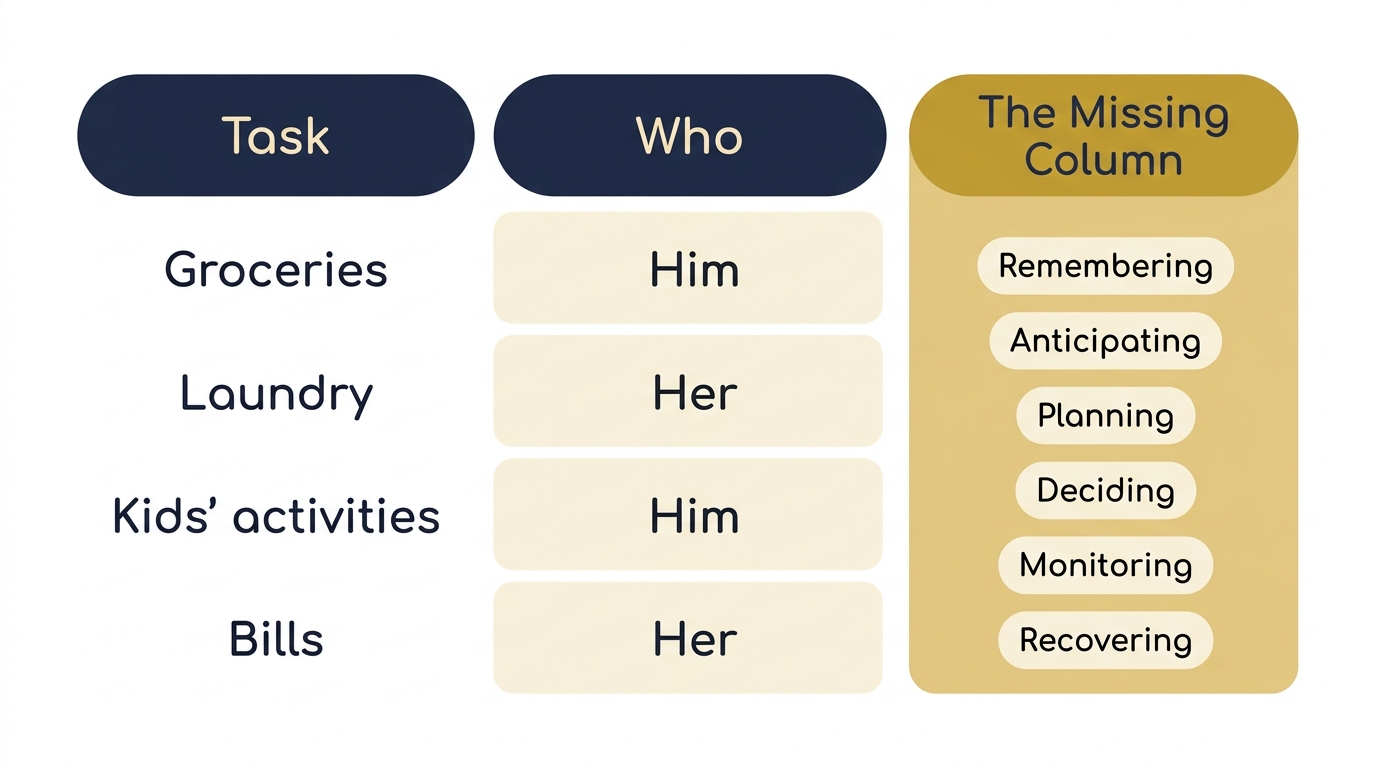
- Remembering Load: holding every detail, deadline, preference and promise in your head, with no backup. Dean and colleagues' "invisible" label fits here: no one sees the remembering, so no box on the chart covers it.
- Anticipating Load: the background vigilance that scans for problems before they become crises. This is Daminger's first step, and the one she found women carried most.
- Planning Load: holding the full coordination map: who goes where, in what order, what depends on what. The 2026 study suggests sharing more can add to this layer if no one owns it.
- Deciding Load: hundreds of micro-decisions a day that default to you. Daminger found couples share big decisions more often; the small daily ones are what pile up.
- Monitoring Load: tracking whether delegated things actually happened. You handed off the task but kept the responsibility. This is Daminger's final step, and it's exactly what a chart quietly asks you to do.
- Recovering Load: never getting space to restore before the next demand. Sonnentag and Fritz's research on detachment shows why rest feels out of reach when part of your mind is always on duty.
Notice that a chore chart lists tasks, while the 6 Types list the work around tasks. You don't have to throw the chart away. It simply needs the column it was missing.
A Fair Division of Chores That Actually Lasts
The research points to one practical shift: share the whole chain, not just the final step. Here’s what that can look like when you rebuild your chore chart for couples.
- Hand off ownership, not tasks. Instead of "you buy groceries," try "you own groceries": noticing what's low, planning, buying and restocking. The Monitoring Load moves with it.
- Add a 6 Types column. Next to each task, note which loads it involves. Seeing "Remembering + Planning" beside "kids' activities" makes the hidden part visible without blame.
- Keep a short weekly check-in. Fifteen minutes to adjust the chart together, so updating it isn't one more job for one person.

What This Means for You
If your chore chart for couples stopped working, the research gives you a kinder explanation than "we just didn't stick with it." The chart counted the tasks. It never counted the anticipating, the remembering, the planning or the follow-up, and that's where much of the weight lives.
That means you can stop asking what's wrong with you, or with your partner. The better question is which of the 6 Types are still sitting with you, and which one you could share first. Small shifts create real change, and naming one load out loud is a real shift.
Ready to see your own pattern? Get the free Mental Load Relief Blueprint and find out which loads you're carrying most, so you can start sharing the work that was never on the chart.
You were never failing. You were carrying work no one had named.
Now it has a name.
About the author
Herb Ammons is the founder of Happy Life Secrets, where he helps women name, organize and share the invisible work of running a home. Read more about Happy Life Secrets →
 3 minutes that change how you see every relationship



-----------
