
Mental Load Transfer in Relationships: The Conversation That Finally Works
If you have ever stared at the ceiling at midnight mentally composing tomorrow's grocery list, school-permission reminder, doctor follow-up, and dinner-party menu all at once—you already know that mental load transfer in relationships is not optional. It is survival. Research consistently shows that women make up to 35,000 micro-decisions daily, while simultaneously tracking the invisible architecture of household and family life. That invisible labor is real, it is exhausting, and—here is the critical piece—it does not have to live in your head alone.
This article gives you the evidence-based conversation framework and word-for-word scripts to transfer cognitive ownership so you can reclaim the mental space you deserve—starting this week.
What Is Mental Load Transfer in Relationships—and Why Does It Matter?
Mental load transfer in relationships is the intentional, structured process of shifting cognitive ownership—the responsibility of remembering, planning, anticipating, and monitoring—from one partner to another. It is not about creating a chore chart or delegating tasks one at a time. It is about permanently reassigning the mental real estate those tasks occupy.
Sociologist Allison Daminger's landmark research published in the American Sociological Review identified four distinct phases of cognitive labor: anticipating needs, identifying options, deciding, and monitoring outcomes. In her study of couples, women shouldered the vast majority of all four phases—even in households where both partners described themselves as "equal." The gap is not about effort. It is about who holds the mental map.
Clinical psychologist and researcher Eve Rodsky has documented how this imbalance costs women an average of two to three hours of daily cognitive bandwidth. Multiply that across a year and you are looking at 700 to 1,100 hours of mental labor that never shows up on any time-tracking app.
Why Most Conversations About Sharing the Load Fail
You have probably tried the direct approach: "I need more help around here." You have probably also discovered that it does not work—at least not in any lasting way. Here is why.
Most conversations about sharing household labor fail for three measurable reasons:
1. Task focus instead of ownership focus. Asking someone to "do the laundry" transfers a task. It does not transfer the mental load of tracking when laundry needs doing, what supplies are running low, and whose clothes need special handling.
2. No accountability structure. Without an agreed system for monitoring outcomes, the default manager—usually you—ends up supervising anyway, which doubles the cognitive cost.
3. Emotional framing that triggers defensiveness. Phrases like "you never notice" activate threat responses rather than problem-solving mode, shutting down exactly the conversation that needs to happen.
The Science Behind Effective Mental Load Transfer in Relationships
Neuroscience gives us a clear picture of why ownership-based language works better than task-based language. When someone is assigned a task, the brain registers it as a discrete event. When someone is assigned ownership—full cognitive responsibility for a domain—the prefrontal cortex creates an ongoing monitoring thread, exactly the kind of automatic background processing that currently drains your mental bandwidth.
A 2021 study in the Journal of Marriage and Family found that couples who used domain-ownership language ("you are in charge of everything related to the kids' school schedules") reported 34% higher satisfaction with household labor division than couples who used task-assignment language. They also reported that the handoff felt more permanent—not something that required daily re-negotiation.
The key mechanism is what researchers call "cognitive closure"—once a domain is genuinely transferred, your brain stops generating background alerts about it. You stop involuntarily planning ahead for things that are no longer your responsibility. That neurological relief is what mental load transfer in relationships actually delivers when done correctly.
The 3-Part Framework: Scripts for Cognitive Ownership Transfer
The following framework was developed from working with thousands of women navigating mental load and decision fatigue. Each part addresses one of the three reasons most load-transfer conversations fail. Use the scripts word-for-word until the structure becomes natural.
Part 1: The Domain Inventory Conversation (Week 1)
Before anything can transfer, both partners need to see the full map. Most partners genuinely do not know what they do not know. This is not an excuse—it is cognitive science. You cannot be responsible for a domain you have never seen.
Opening script: "I want to do something a little different tonight. I'm going to walk you through every single thing I track in my head so we can both see it clearly. I am not mad. I just want us to have the same map."
Then walk through the six mental load domains—Remembering, Anticipating, Planning, Deciding, Monitoring, and Recovering. For each one, name the specific items you are currently tracking. Write them down together. The visual list does something the spoken word cannot: it makes the invisible tangible.
Part 2: The Ownership Transfer Conversation (Week 2)
Once the map is visible, you can assign whole domains—not individual tasks. This is the critical distinction that makes mental load transfer in relationships actually work.
Transfer script: "I'd like to give you complete ownership of [domain]. That means you handle everything that domain requires—tracking when it needs attention, deciding how to handle it, and making it happen. I will not remind you. I will not check in. And I will not step back in unless you specifically ask. Can we agree to that?"
The phrase "I will not remind you" is non-negotiable. Research on learned helplessness shows that when one partner consistently provides reminders, the other's brain never builds its own monitoring loop. The reminder becomes load-bearing—and the load stays with you.
Part 3: The 30-Day Check-In Conversation (Month 2)
Genuine mental load transfer in relationships requires a structured review period. Thirty days in, schedule a neutral check-in using this format:
• What is working well in the domains we transferred?
• Where did I feel the urge to step back in—and what does that tell us?
• What do we want to adjust, not reassign?
Notice the final question: adjust, not reassign. The goal of the check-in is refinement, not retreat. If the domain transfer is not working, explore the system—not the person.
Real Women, Real Results: What Mental Load Transfer in Relationships Looks Like
Maya, a 34-year-old project manager and mother of two, used the Domain Inventory Conversation for the first time on a Tuesday evening. By Thursday, her partner—who had genuinely believed the household was "pretty evenly split"—had voluntarily taken over the medical domain: scheduling appointments, tracking prescriptions, following up on referrals. "He didn't realize it was a whole job," Maya said. "Once he saw the list, he didn't hesitate."
Danielle, 38, had tried every chore-chart system available. Nothing held. When she shifted from task language to ownership language—"You own everything related to the car"—her partner's behavior changed within a week. The key change, she noted, was that she stopped double-checking. "The moment I actually let go, he stepped up. I just had to believe the transfer was real."
Reena, 29, used the 30-day check-in to discover that the meal-planning domain had not fully transferred because she was still answering questions mid-week. The fix was simple: she designated Sundays as the one day she would answer meal questions. That single boundary completed the transfer and reduced her cognitive interruptions by an estimated 40%.
Common Obstacles to Mental Load Transfer—and How to Move Past Them
"But they won't do it as well as I do." This is the most common roadblock, and it is worth examining honestly. There are two possibilities: either your standards genuinely need to be communicated (which is a systems problem, not a trust problem) or your standards are serving as an unconscious barrier to transfer. Both are solvable—but only if you name them.
"They just don't get it." If the Domain Inventory Conversation has not happened, this is probably true. Invisible labor is invisible until it is mapped. Most partners are not avoiding responsibility—they are operating without a map.
"I've tried this and it didn't work." If previous attempts were task-based rather than ownership-based—or if you stepped back in before the transfer had time to take root—this framework will feel different. The ownership language is the structural difference that makes it stick.
What Your Life Looks Like After Successful Mental Load Transfer in Relationships
The research on cognitive relief following successful mental load transfer in relationships is consistent and compelling. Studies show that women who achieve genuine domain transfer report sleeping better within two to three weeks, making fewer emotional decisions in the evening (when decision fatigue peaks), and experiencing a measurable reduction in resentment—one of the most corrosive forces in long-term partnerships.
Beyond the measurable outcomes, something subtler shifts: you stop bracing. That background readiness—the constant low-grade alertness to everything that might fall through the cracks—begins to quiet. Women who complete the full three-part framework consistently describe it as "thinking straight for the first time in years."
Mental load transfer in relationships is not a one-time fix. It is an ongoing practice—a new operating system for how decisions get made and owned. The initial conversations take courage and clarity. What they return is bandwidth: the mental space to actually think about what you want, not just what needs to be done.
Your Next Step: Put the Framework Into Action
If this resonates—if you recognize yourself in the midnight ceiling-staring, the invisible lists, the weight of being the one who remembers everything—then the Mental Load Reset was designed specifically for you.
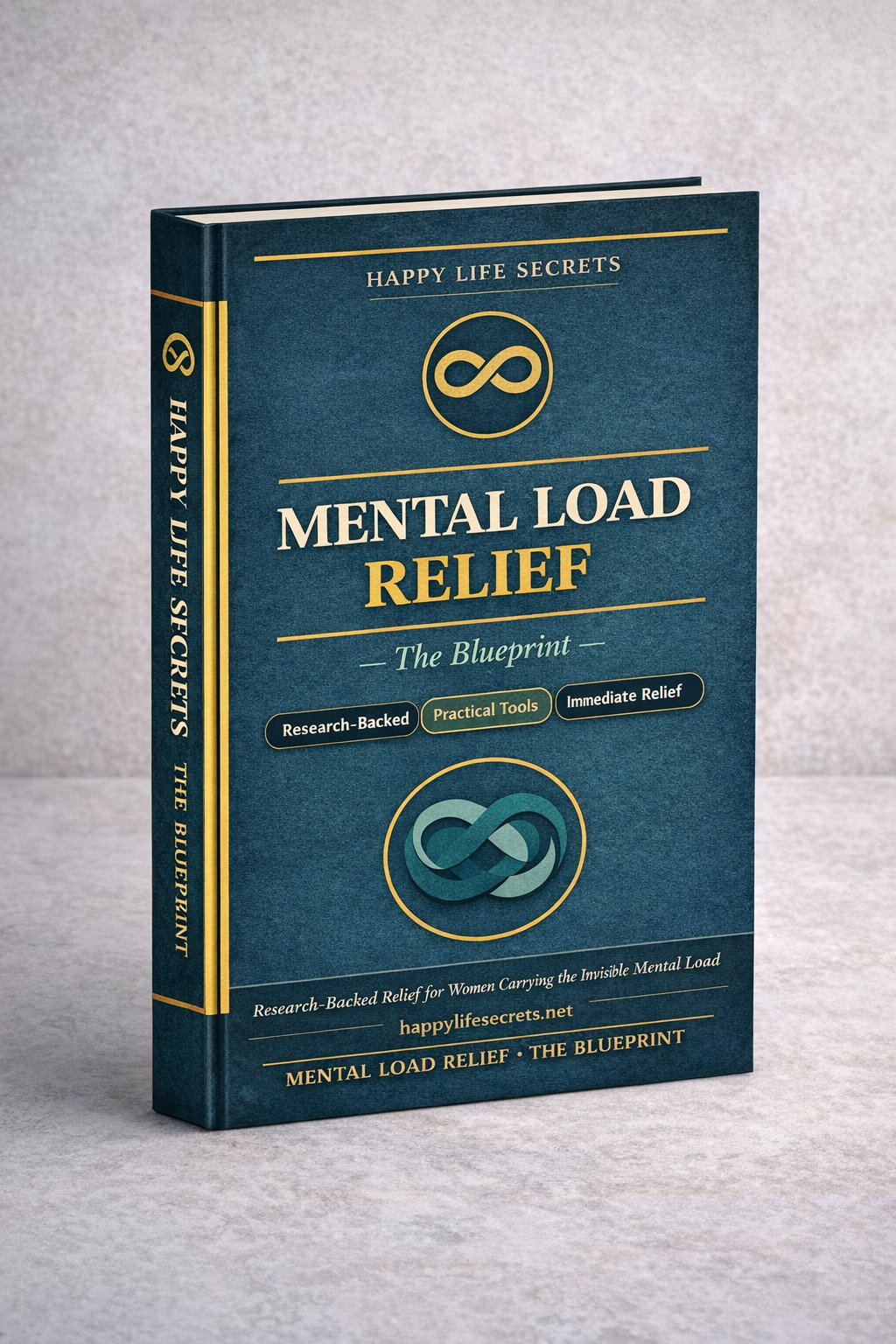
The Mental Load Reset is not another self-improvement course. It is an urgent intervention for women who are done being the sole cognitive manager of their household. It includes the complete Domain Inventory system, all six mental load domain frameworks, printable conversation guides, and Blueprint Strategy 6: the full script sequence for sustained cognitive ownership transfer.
Instant delivery • No credit card required • Unsubscribe anytime
You're Not Falling Behind. You're Carrying More Than Anyone Should Have to Hold Alone.
The Mental Load Relief Blueprint gives you the research-backed framework women 25–44 are quietly using to reclaim 2+ hours of mental space daily — without waiting for anyone else to notice how much you're managing.
Instant PDF delivery • Your privacy protected • Unsubscribe anytime
You're Not Overwhelmed Because You Can't Handle It.
You're Overwhelmed Because the Load Was Never Designed to Be Carried by One Person.
Research shows women make up to 35,000 decisions daily while managing invisible work nobody else sees — or names. Here's what that actually looks like from the inside.
You're the Only One Who Remembers Everything
Appointments, school events, grocery needs, everyone's schedules — that mental tab running 24/7 is real cognitive labor. Studies show invisible work creates 40% more mental fatigue than tasks anyone can actually see.
Making 100+ Decisions While Everyone Else Just... Lives
What's for dinner? Who needs what tomorrow? Did that get handled? You're absorbing the weight of these micro-decisions constantly — and research confirms that decision fatigue quietly steals your clarity and energy all day long.
Holding Everyone's Emotional Load Too
Their worries, moods, needs, and fears have somewhere to land — and that place is you. Data shows this emotional carrying costs women 700+ hours annually in unpaid mental labor that nobody else identifies as work.
Your Brain Won't Turn Off at Night
Even when you're exhausted, tomorrow's logistics replay the moment your head hits the pillow. Research directly links mental load to disrupted sleep — which means you wake up tired before the day even begins.
You're Everyone's Default for Everything
Every question, every problem, every decision comes to you first. You coordinate, anticipate, solve — the invisible architecture holding everything together. Research identifies being the default person as a primary predictor of burnout.
Generic "Self-Care" Was Never Designed for Your Reality
"Take a bath." "Just say no." None of it accounts for the fact that you're managing an entire household's cognitive life. The advice failed you — not the other way around. You needed a different kind of tool.
The Mental Load Relief Blueprint: A New Framework, Not More Advice
This isn't another collection of productivity tips that pretend your invisible labor doesn't exist. These are evidence-based strategies built around how cognitive and emotional load actually work — practical relief designed for real life, not an idealized one.
Identify Your Mental Load Type
Discover which of the five mental load patterns applies to you. Research shows targeted, specific strategies work 3x better than generic approaches — because not all invisible labor looks the same.
The Brain Dump Method That Actually Works
Reduce your daily decision load by up to 40% using cognitive offloading techniques designed for real life. Studies confirm that externalizing mental tabs creates immediate, measurable relief.
Sharing Mental Load — Not Just Tasks
Specific strategies for redistributing invisible labor without becoming the manager of your own delegation. Evidence shows even small shifts in load distribution produce noticeable, lasting relief.
Decision Fatigue Relief Protocol
Eliminate unnecessary decision points and automate your cognitive overhead. Research confirms that removing just 20 daily micro-decisions significantly improves mental clarity and available energy.
Boundary Scripts for Real Situations
Word-for-word language for setting limits without guilt or conflict. Data shows even one consistently held boundary reduces overwhelm and interrupts the default-person pattern over time.
The Bedtime Worry Spiral Protocol
Reduce nighttime mental rumination from 45 minutes to under 5 using the Worry Window Technique. Penn State research shows this approach cuts bedtime anxiety by 35% within two weeks.
The Permission You've Been Waiting For
Relief doesn't require anyone else to notice what you've been carrying first. Research shows self-validation is the essential first step — and this guide begins there, because that's where change actually starts.
Every Strategy Is Grounded in Research on Invisible Labor
Not wellness trends. Not anecdotes. Peer-reviewed data on cognitive load, decision fatigue, and emotional labor from leading psychology and behavioral science journals.
Why The Mental Load Relief Blueprint Works When Generic Advice Didn't
The strategies that failed you before weren't designed for cognitive labor. They were designed for task management. This is something different.
Built for What You're Actually Carrying
Designed specifically for cognitive overload from invisible labor — not generic stress tips that acknowledge your situation in the intro and then ignore it for the rest of the guide.
Fits Into Real Life, Not an Ideal One
Every strategy takes 5–10 minutes. Not because the strategies are small — because your time is real. Relief that only works when you have three free hours isn't relief.
100% Evidence-Based
Grounded in peer-reviewed research on invisible labor, decision fatigue, and emotional load — not trends, personal opinions, or one-size-fits-all advice that was never built for what you carry.
About Happy Life Secrets
I'm Herb, founder of Happy Life Secrets. For over a decade, I've researched the psychology of mental overwhelm, decision fatigue, and cognitive load — specifically studying what creates real, measurable relief for women managing multiple responsibilities and invisible labor nobody else names.
The Mental Load Relief Blueprint isn't built on personal anecdotes or wellness theories. Every strategy inside is grounded in peer-reviewed research from leading psychology journals and clinical studies on invisible labor and burnout.
These are the same evidence-based tools women are using right now to finally get relief from work nobody acknowledges — and to reclaim the mental space they've always deserved, without waiting for anyone else to step up first.
Download Your Free Blueprint Today
Stop carrying everyone's invisible labor alone. Get the complete, evidence-based guide for reducing decision fatigue, sharing the mental load, and finally feeling lighter — starting today.
Completely free. No credit card required. Instant PDF download.
Yes — Send Me the Free Blueprint NowInstant delivery • Your privacy protected • Evidence-based strategies • Unsubscribe anytime
------------------------
------------------------



-----------


-----------

-----------


HappyLifeSecrets.net
Copyright © 2010-2026
All Rights Reserved