
Self-Love Practices for Anxious Women: 7 Happy Life Secrets
Self-Love Practices for Anxious Women Transform Lives Daily
Sarah stared at her reflection in the bathroom mirror at 5:47 AM, dark circles under her eyes telling the story of another sleepless night. As a marketing director and mother of twin eight-year-olds, she felt like she was drowning in her own life. "I kept thinking I was failing everyone – my kids, my husband, my team at work, and most of all, myself," she recalls. What Sarah didn't realize was that millions of women share her experience, and science has uncovered specific self-love practices for anxious women that can genuinely transform how we navigate our overwhelmed lives.
The statistics are sobering: according to recent research, 75% of working mothers report feeling overwhelmed daily, while anxiety disorders affect women twice as often as men. Yet emerging neuroscience reveals that targeted happy life secrets for busy women aren't just feel-good concepts – they're evidence-based strategies that rewire our brains for resilience and joy.
The Science Behind Self-Love Practices for Anxious Women
Dr. Kristin Neff's groundbreaking research at the University of Texas has revolutionized our understanding of self-compassion. Her studies demonstrate that women who practice specific self-love practices for anxious women show measurable decreases in cortisol levels and significant improvements in emotional regulation. "Self-compassion isn't self-indulgence," Dr. Neff explains. "It's actually associated with greater motivation, better relationships, and improved mental health."
The neuroplasticity research is equally compelling. Brain imaging studies show that consistent self-compassion practices literally reshape the brain's stress-response system, creating new neural pathways that support emotional resilience. For busy women juggling multiple roles, these happy life secrets for busy women offer hope grounded in hard science.
Secret #1: The Two-Minute Morning Self-Love Practices for Anxious Women
Lisa, a pediatric nurse and single mother, discovered this first secret during her own burnout recovery. "I started setting my alarm just two minutes earlier and used that time for what I call my 'morning self-love check-in,'" she shares. This simple practice involves placing one hand on your heart and speaking to yourself with the same kindness you'd offer your best friend.
The science backing this approach is robust. Research from Harvard Medical School shows that brief self-compassion practices activate the parasympathetic nervous system, reducing cortisol and increasing feel-good hormones like oxytocin. These self-love practices for anxious women work because they interrupt the brain's default stress response before it cascades into full anxiety.
Secret #2: Reframing Perfectionism Through Happy Life Secrets for Busy Women
Maria, a corporate lawyer and mother of three, used to believe that lowering her standards meant accepting mediocrity. "I thought self-compassion was just making excuses," she admits. However, research from Stanford University reveals the opposite: women who practice self-compassion actually achieve more of their goals because they're not paralyzed by fear of failure.
The key is distinguishing between healthy striving and perfectionism. Happy Life Secrets for busy women include recognizing that perfectionism is often anxiety in disguise. When Maria learned to treat herself with the same understanding she'd show a colleague facing similar challenges, her productivity increased by 30% while her stress levels plummeted.
Secret #3: The Power of Micro-Self-Care Self-Love Practices for Anxious Women
Traditional self-care advice often feels impossible for busy women. Who has time for hour-long bubble baths when you're managing carpools, deadlines, and household responsibilities? The breakthrough comes from understanding that self-love practices for anxious women can be incredibly brief yet profoundly effective.
Neuroscientist Dr. Rick Hanson's research on "taking in the good" shows that even 20-second moments of positive attention can create lasting changes in brain structure. Jennifer, a working mother of two, applies this by practicing what she calls "micro-moments of self-love" – taking three deep breaths while her coffee brews, or giving herself a mental high-five after completing a challenging task.
Secret #4: Building Emotional Resilience with Happy Life Secrets for Busy Women
The fourth secret involves understanding that emotional resilience isn't about avoiding difficult feelings – it's about relating to them differently. Research from the University of California, Berkeley, demonstrates that women who practice emotional self-compassion recover from setbacks 40% faster than those who rely on self-criticism.
Amanda, a working mother and part-time student, learned this during her graduate program. "Instead of beating myself up when I felt overwhelmed, I started treating my anxiety like a friend who needed comfort," she explains. This shift in perspective – a core component of Happy Life Secrets for busy women – transformed her relationship with stress from adversarial to collaborative.
Secret #5: Creating Boundaries Through Self-Love Practices for Anxious Women
Boundary-setting often feels selfish to women who've been conditioned to prioritize others' needs. However, psychological research consistently shows that healthy boundaries are essential for mental health and relationship satisfaction. The key insight from self-love practices for anxious women is that boundaries are acts of love, not selfishness.
Dr. Brené Brown's research on vulnerability and courage reveals that women who practice self-compassion are better equipped to set and maintain healthy boundaries. Rachel, a teacher and mother, discovered this when she started saying no to additional volunteer commitments. "I realized that by protecting my energy, I could show up more fully for the things that truly mattered," she reflects.
Secret #6: The Gratitude-Self-Compassion Connection in Happy Life Secrets for Busy Women
While gratitude practices are well-established, recent research reveals a powerful synergy between gratitude and self-compassion. Studies from UC Davis show that combining gratitude with self-kindness creates more sustainable positive emotions than either practice alone.
The application for Happy Life Secrets for busy women is profound. Instead of using gratitude to diminish your struggles ("I should be grateful, not stressed"), combine it with self-compassion ("I'm grateful for my family AND it's understandable that juggling everything feels overwhelming"). This integrated approach validates your experience while fostering appreciation.
Secret #7: Building Community Around Self-Love Practices for Anxious Women
The final secret recognizes that self-love isn't a solo journey. Research from UCLA's Social Cognitive Neuroscience Lab shows that women's stress-response systems are particularly responsive to social support. When we practice self-love practices for anxious women in community, the benefits multiply exponentially.
Creating or joining a support network focused on Happy Life Secrets for busy women provides accountability, encouragement, and shared wisdom. Whether it's a online community, a local group, or even a text thread with friends committed to self-compassion, the social element amplifies individual practice.
Implementing These Happy Life Secrets for Busy Women
The beauty of these science-backed strategies lies in their accessibility. You don't need hours of free time or expensive resources – just willingness to treat yourself with kindness. Start with one self-love practice for anxious women and build gradually. Research shows that consistency matters more than intensity.
Remember Sarah from our opening story? Six months after implementing these practices, she reports sleeping better, feeling more present with her children, and approaching work challenges with confidence rather than dread. "I finally realized that taking care of myself wasn't selfish – it was essential," she shares.
These Happy Life Secrets for busy women aren't just temporary fixes; they're sustainable practices that create lasting change. In a world that often demands we sacrifice our well-being for productivity, choosing self-compassion becomes a radical act of courage and wisdom.
Instant delivery • No credit card required • Unsubscribe anytime
You're Not Falling Behind. You're Carrying More Than Anyone Should Have to Hold Alone.
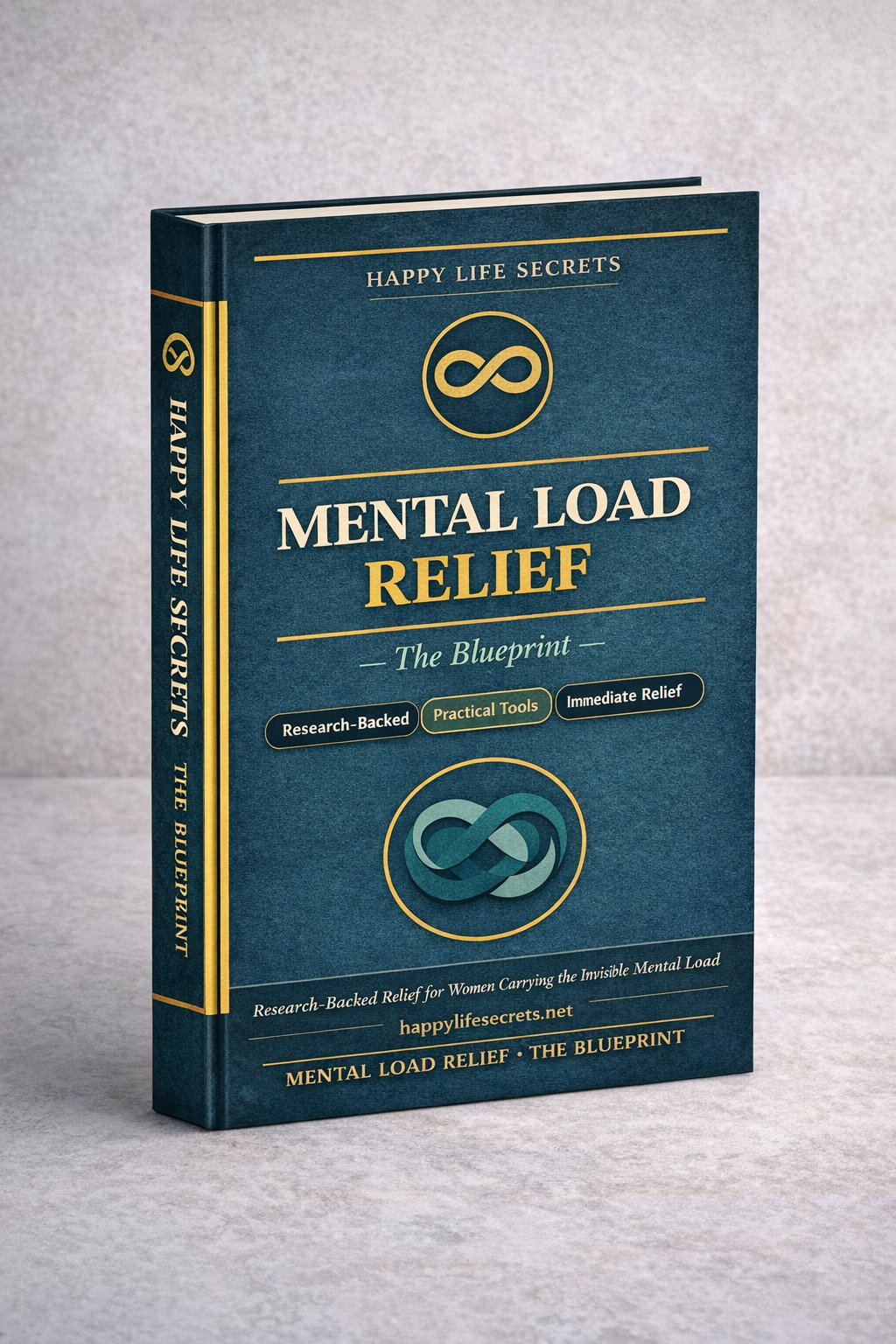
The Mental Load Relief Blueprint gives you the research-backed framework women 25–44 are quietly using to reclaim 2+ hours of mental space daily — without waiting for anyone else to notice how much you're managing.
Instant PDF delivery • Your privacy protected • Unsubscribe anytime
You're Not Overwhelmed Because You Can't Handle It.
You're Overwhelmed Because the Load Was Never Designed to Be Carried by One Person.
Research shows women make up to 35,000 decisions daily while managing invisible work nobody else sees — or names. Here's what that actually looks like from the inside.
You're the Only One Who Remembers Everything
Appointments, school events, grocery needs, everyone's schedules — that mental tab running 24/7 is real cognitive labor. Studies show invisible work creates 40% more mental fatigue than tasks anyone can actually see.
Making 100+ Decisions While Everyone Else Just... Lives
What's for dinner? Who needs what tomorrow? Did that get handled? You're absorbing the weight of these micro-decisions constantly — and research confirms that decision fatigue quietly steals your clarity and energy all day long.
Holding Everyone's Emotional Load Too
Their worries, moods, needs, and fears have somewhere to land — and that place is you. Data shows this emotional carrying costs women 700+ hours annually in unpaid mental labor that nobody else identifies as work.
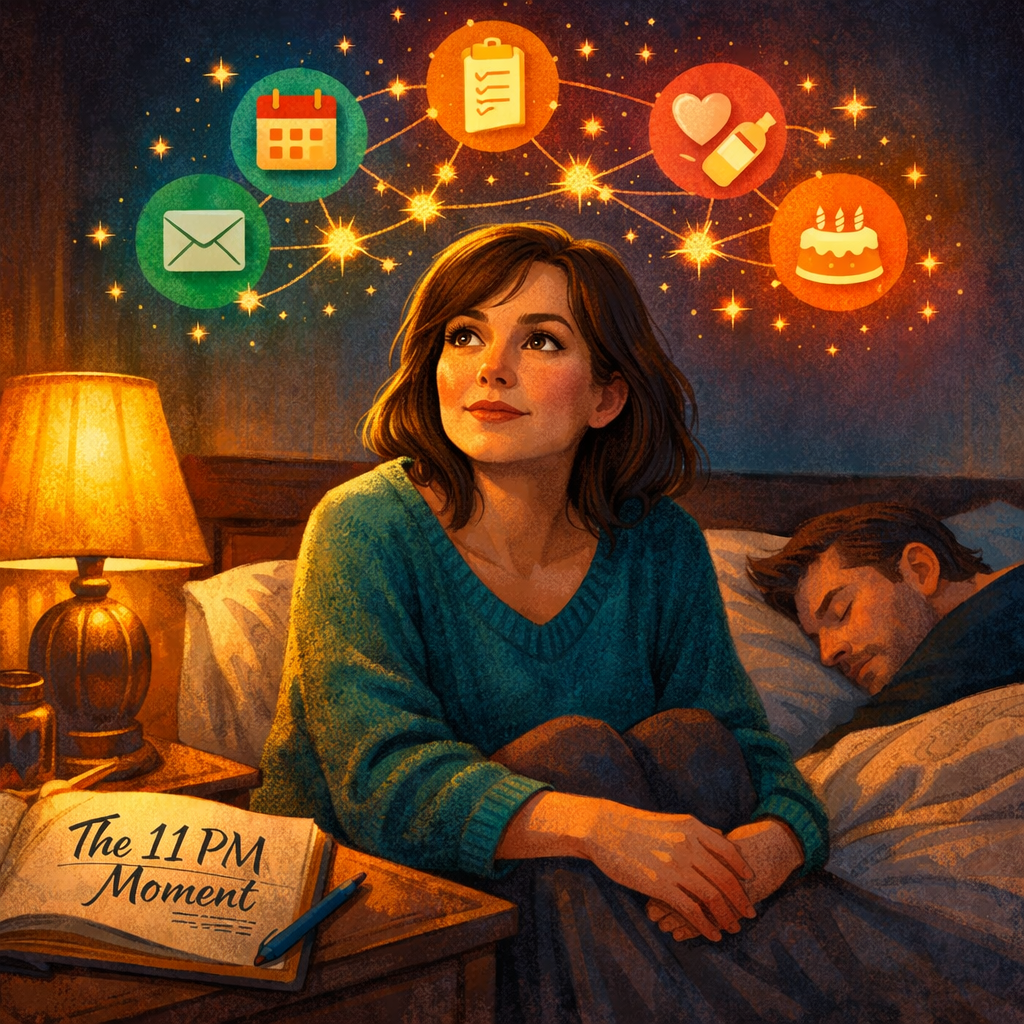
Your Brain Won't Turn Off at Night
Even when you're exhausted, tomorrow's logistics replay the moment your head hits the pillow. Research directly links mental load to disrupted sleep — which means you wake up tired before the day even begins.
You're Everyone's Default for Everything
Every question, every problem, every decision comes to you first. You coordinate, anticipate, solve — the invisible architecture holding everything together. Research identifies being the default person as a primary predictor of burnout.
Generic "Self-Care" Was Never Designed for Your Reality
"Take a bath." "Just say no." None of it accounts for the fact that you're managing an entire household's cognitive life. The advice failed you — not the other way around. You needed a different kind of tool.
The Mental Load Relief Blueprint: A New Framework, Not More Advice
This isn't another collection of productivity tips that pretend your invisible labor doesn't exist. These are evidence-based strategies built around how cognitive and emotional load actually work — practical relief designed for real life, not an idealized one.
Identify Your Mental Load Type
Discover which of the five mental load patterns applies to you. Research shows targeted, specific strategies work 3x better than generic approaches — because not all invisible labor looks the same.
The Brain Dump Method That Actually Works
Reduce your daily decision load by up to 40% using cognitive offloading techniques designed for real life. Studies confirm that externalizing mental tabs creates immediate, measurable relief.
Sharing Mental Load — Not Just Tasks
Specific strategies for redistributing invisible labor without becoming the manager of your own delegation. Evidence shows even small shifts in load distribution produce noticeable, lasting relief.
Decision Fatigue Relief Protocol
Eliminate unnecessary decision points and automate your cognitive overhead. Research confirms that removing just 20 daily micro-decisions significantly improves mental clarity and available energy.
Boundary Scripts for Real Situations
Word-for-word language for setting limits without guilt or conflict. Data shows even one consistently held boundary reduces overwhelm and interrupts the default-person pattern over time.
The Bedtime Worry Spiral Protocol
Reduce nighttime mental rumination from 45 minutes to under 5 using the Worry Window Technique. Penn State research shows this approach cuts bedtime anxiety by 35% within two weeks.
The Permission You've Been Waiting For
Relief doesn't require anyone else to notice what you've been carrying first. Research shows self-validation is the essential first step — and this guide begins there, because that's where change actually starts.
Every Strategy Is Grounded in Research on Invisible Labor
Not wellness trends. Not anecdotes. Peer-reviewed data on cognitive load, decision fatigue, and emotional labor from leading psychology and behavioral science journals.
Why The Mental Load Relief Blueprint Works When Generic Advice Didn't
The strategies that failed you before weren't designed for cognitive labor. They were designed for task management. This is something different.
Built for What You're Actually Carrying
Designed specifically for cognitive overload from invisible labor — not generic stress tips that acknowledge your situation in the intro and then ignore it for the rest of the guide.
Fits Into Real Life, Not an Ideal One
Every strategy takes 5–10 minutes. Not because the strategies are small — because your time is real. Relief that only works when you have three free hours isn't relief.
100% Evidence-Based
Grounded in peer-reviewed research on invisible labor, decision fatigue, and emotional load — not trends, personal opinions, or one-size-fits-all advice that was never built for what you carry.
About Happy Life Secrets
I'm Herb, founder of Happy Life Secrets. For over a decade, I've researched the psychology of mental overwhelm, decision fatigue, and cognitive load — specifically studying what creates real, measurable relief for women managing multiple responsibilities and invisible labor nobody else names.
The Mental Load Relief Blueprint isn't built on personal anecdotes or wellness theories. Every strategy inside is grounded in peer-reviewed research from leading psychology journals and clinical studies on invisible labor and burnout.
These are the same evidence-based tools women are using right now to finally get relief from work nobody acknowledges — and to reclaim the mental space they've always deserved, without waiting for anyone else to step up first.
Download Your Free Blueprint Today
Stop carrying everyone's invisible labor alone. Get the complete, evidence-based guide for reducing decision fatigue, sharing the mental load, and finally feeling lighter — starting today.
Completely free. No credit card required. Instant PDF download.
Yes — Send Me the Free Blueprint NowInstant delivery • Your privacy protected • Evidence-based strategies • Unsubscribe anytime
------------------------
------------------------

-----------


-----------
-----------


HappyLifeSecrets.net
Copyright © 2010-2026
All Rights Reserved