
Office Go-To Person: The Real Reason Everyone Remembers to Ask You
You woke up. Got through the day. Nothing went catastrophically wrong. And yet, by 3pm, you feel like you've run a marathon no one else can see.
If you're the office go-to person, that feeling probably has a familiar rhythm. Someone leans into your doorway to ask where the shared login lives. Someone else pings you about when the vendor contract renews. A third person wants to know who was supposed to follow up after Tuesday's meeting, and somehow you're the one who knows. You always know. It's a quiet kind of trust, and it says a lot about how capable people believe you are. It's also the reason you can feel exhausted even on easy days, when the calendar looks light and the to-do list is short, yet your mind has been switched on since the moment you walked in.
Here's the part that rarely gets said out loud: being the office go-to person is not a personality flaw, and it isn't a sign that you're bad at boundaries or "just wired to overdo it." It's a role no one ever wrote into your job description, built on skills you're genuinely good at: paying attention, following through, and caring whether things go well for the people around you. What's been missing isn't effort or capacity. It's information, a clear picture of what this work actually is and why it weighs so much more than it looks.
That's also why the fixes you've tried didn't hold. The planners, the shared calendars, the "just say no" advice were all designed for visible tasks. Nobody handed you anything designed for the invisible work you're carrying, so of course nothing stuck. That was never a failure on your part. There was simply a piece of the picture no one had shared with you yet. Let's change that.
Why the Office Go-To Person Carries More Than Anyone Can See
The trouble with this kind of work is that it leaves no fingerprints. There's no ticket to close, no deliverable to point to, no line on a performance review that says "remembered everyone's preferences, again." When the office go-to person answers a question in ten seconds, the ten seconds is all anyone sees. The years of quietly held context behind it stay out of view.
Researchers are starting to put numbers on that. Analysis of non-promotable work, the tasks that keep an organization running but rarely appear in promotion conversations, has found that women spend roughly 200 more hours a year on it than men do. That works out to about five extra weeks of work, as this overview of office housework and non-promotable tasks explains. Five weeks of work that isn't on anyone's job description.
So what is that hidden work actually made of? It comes down to six types of mental load, and if you're the office go-to person, you'll likely recognize every one.
Remembering. You hold every detail, deadline, preference, and promise in your head, with no backup and no acknowledgment that remembering is work at all.
Anticipating. Your background vigilance never fully switches off. You scan for problems before they become crises and prepare for scenarios no one else has noticed yet.
Planning. You carry the full coordination map: who goes where, in what order, and what depends on what else. The logistics of everything, held quietly in one person's head.
Deciding. Hundreds of micro-decisions default to you every day, from trivial to significant. It's a decision queue that resets every single morning.
Monitoring. You handed off the task, but you kept the responsibility. So you follow up, check quality, and course-correct to make sure the thing actually happened.
Recovering. Space to restore rarely arrives before the next demand does. Busy stretches stack on top of each other, and rest feels unearned because the list never empties.
If you've ever lain awake at 3am running through tomorrow's list, the email you meant to send, the deadline that might slip, the question someone will surely ask, you've met what many people call the 3am spiral. It's simply what unprocessed cognitive load looks like when it finally gets a quiet moment. It doesn't mean something is wrong with you. It means your mind is still holding work that nobody has ever named.
That load has a measurable price, too. According to a July 2026 analysis of the burnout gap among senior women leaders, McKinsey and LeanIn.org's 2025 Women in the Workplace report found that about 60% of senior-level women frequently feel burned out, compared with around 50% of senior men in equivalent roles. That gap isn't about anyone's resilience. It's about who ends up holding the work that never shows up on a list.
Read those six types one more time and notice what isn't on them: laziness, disorganization, poor time management. The problem was never your effort or your capacity. It's missing information. No one ever gave this work a name, so no one could see it, credit it, or help you set it down. If you're the office go-to person where you work, that is the sentence worth holding onto, because it changes the question from "what's wrong with me?" to "what was I never told?"
The Missing Piece: A Framework for the Invisible Work
Every productivity system you tried failed because no one told you about the 6 types of invisible work. You didn't fail the systems. The systems failed you.
The Happy Life Secrets framework starts from a different place, one that treats the office go-to person as someone doing skilled, real work rather than someone who can't keep up. It isn't a better planner or a smarter app. For the first time ever, it gives you language and structure for all six types (Remembering, Anticipating, Planning, Deciding, Monitoring, and Recovering) so the work stops being invisible, first to you and then to the people around you.
That matters especially at work. A 2026 perspective in Frontiers on cognitive overload as a workplace ergonomic risk makes the case that overload can arise from how work systems are designed, and that it deserves to be treated as an occupational-health concern rather than a personal shortcoming. When the load is a design problem, naming it is the first design decision. It's the moment "I'm just bad at this" becomes "I've been carrying six kinds of work with no map." For an office go-to person, that shift in understanding is often the first real exhale in years.
From there, the shifts are small and very doable. Try noticing which of the six types your last three interruptions belonged to. Most people find that one or two dominate. That single observation tells you where the load is heaviest, where you might invite someone else to share it, and where you've been doing more than anyone realized. From there, you can start having different conversations, ones that begin with "here's what this actually involves" instead of "I'm fine, I've got it." None of it requires you to work harder or become someone else. It simply gives you information you've never had, and information changes what feels possible.
Now you have access to a framework that does what no planner could: it shows you what you've been carrying, so you can decide what to keep, what to share, and what to set down. If you're the office go-to person on your team, you can start exploring the 6 Types framework at happylifesecrets.net, at your own pace, with no pressure.
Being the office go-to person says something good about you. People trust your memory, your judgment, and your steadiness, and those strengths deserve to be carried with support, not in silence. It never had to cost you your evenings.
Relief is possible. Small shifts create real change.
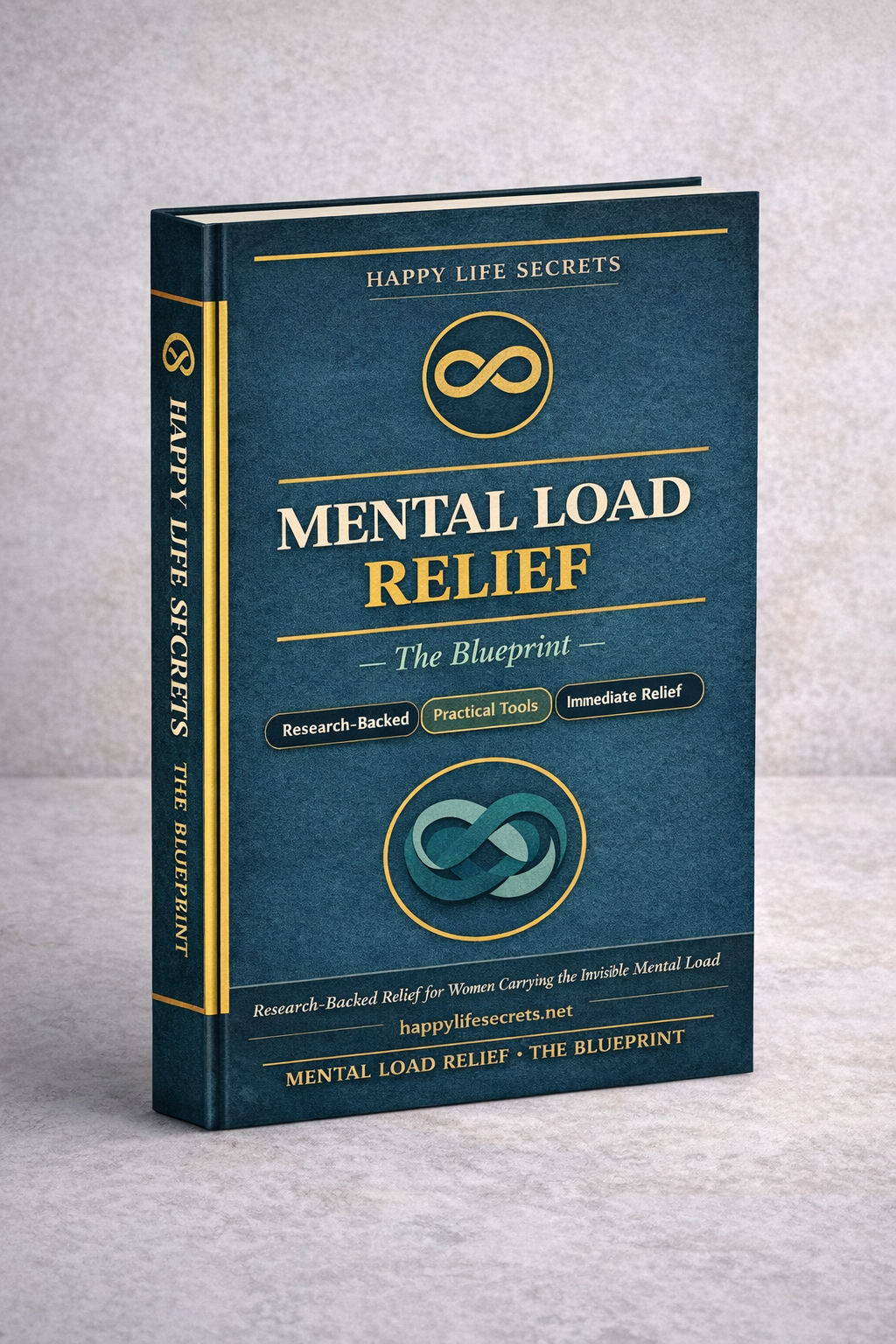
You're Not Falling Behind. You're carrying more than anyone should have to hold alone.
The Mental Load Relief Blueprint gives you a clear map of the invisible work you carry, and simple, practical ways to start setting it down, without waiting for anyone else to notice how much you're managing.
You're Not Overwhelmed Because You Can't Handle It.
You're overwhelmed because the load was never designed to be carried by one person. Here's what that invisible work looks like from the inside.
You're the Only One Who Remembers Everything
Appointments, school events, groceries, everyone's schedules. That mental tab running all day is real work, even though no one else can see it.
Making 100 Decisions While Everyone Else Just Lives
What's for dinner? Who needs what tomorrow? Did that get handled? Every small decision lands on you, and decision fatigue quietly drains your clarity and energy.
Holding Everyone's Emotional Load Too
Their worries, moods, and needs have somewhere to land, and that place is you. It's labor nobody names, and it adds up.
Your Brain Won't Turn Off at Night
Even when you're exhausted, tomorrow's logistics replay the moment your head hits the pillow, so you wake up tired before the day begins.
You're Everyone's Default for Everything
Every question, every problem, every decision comes to you first. You coordinate, anticipate, and solve. You're the invisible structure holding it all together.
Generic "Self-Care" Wasn't Built for Your Reality
"Take a bath." "Just say no." None of it accounts for managing a whole household's mental life. The advice failed you, not the other way around.
The problem was never your capacity. The problem was that nobody gave you a map of what you were actually carrying, or a way to set it down.
A New Framework, Not More Advice
Not another list of productivity tips that pretend your invisible work doesn't exist. Seven practical strategies built around how mental and emotional load actually work, designed for real life.
Identify Your Mental Load Types
Find out which of the 6 types of mental load you carry most heavily, so you can focus your energy where it will make the biggest difference.
The Brain Dump Method That Actually Works
Get the running list out of your head and onto paper, so your mind stops holding everything at once.
Sharing the Mental Load, Not Just Tasks
How to hand off the thinking, not just the doing, so you don't become the manager of your own delegation.
Decision Fatigue Relief
Cut out unnecessary daily decisions and put repeat choices on autopilot, so you have more clarity left for what matters.
Boundary Scripts for Real Situations
Word-for-word language for setting limits without guilt or conflict, starting with one boundary you can hold.
The Bedtime Worry Spiral Fix
The Worry Window technique gives tomorrow's to-do list a set time and place, so it stops following you to bed.
The Permission You've Been Waiting For
Relief doesn't require anyone else to notice what you've been carrying first. This guide starts there, because that's where change begins.
Simple Enough to Start Today
Why This Works When Generic Advice Didn't
The strategies that failed you before were designed for task management. This is designed for the thinking work behind the tasks.
Built for What You Actually Carry
Made for the overload that comes from invisible work, not generic stress tips that mention your situation once and then ignore it.
Fits Real Life, Not an Ideal One
Every strategy takes 5–10 minutes. Relief that only works when you have three free hours isn't relief.
Grounded in Research
Built on what researchers have learned about invisible labor, decision fatigue, and emotional load, not trends or one-size-fits-all advice.
About Happy Life Secrets
I'm Herb, founder of Happy Life Secrets. For over a decade, I've studied the psychology of mental overwhelm, decision fatigue, and cognitive load, and what creates real relief for women managing invisible work nobody else names.
The Mental Load Relief Blueprint pulls that work into one short, practical guide: a clear map of what you're carrying, and simple ways to start setting it down, without waiting for anyone else to step up first.
Download Your Free Blueprint Today
Stop carrying everyone's invisible work alone. Get the guide for easing decision fatigue, sharing the mental load, and finally feeling lighter, starting today.
Yes, Send Me the Free Blueprint → No credit card · Instant PDF · Unsubscribe anytime 3 minutes that change how you see every relationship


-----------
