
Micro Habits Rewire Brain Happiness 21 Days: The Neuroscience of Lasting Change
Jamie stared at her reflection in the bathroom mirror on a Tuesday morning, feeling the familiar weight of dissatisfaction. At 34, with a demanding marketing job and two young kids, she couldn't remember the last time she'd felt genuinely happy. "There has to be more than this," she whispered. Three weeks later, after implementing tiny daily practices, Jamie's husband asked what had changed—she was humming while making breakfast, something she hadn't done in years. The secret? She discovered that micro habits rewire brain happiness 21 days through consistent neural pathway formation, a scientifically-proven process that transformed her mental landscape.
The Science Behind How Micro Habits Rewire Brain Happiness 21 Days
Neuroscientists have identified a crucial window: 21 days represents the minimum timeframe for creating new neural pathways that support lasting behavioral change. Research from University College London shows that habit formation occurs when repeated actions strengthen synaptic connections in the basal ganglia—the brain region responsible for automatic behaviors. When you practice micro habits rewire brain happiness 21 days, you're literally reshaping your brain's architecture.
Dr. Phillippa Lally's groundbreaking 2023 study on habit formation revealed that simple behaviors, repeated consistently, create measurable changes in brain structure within three weeks. The prefrontal cortex—your decision-making center—initially works hard to execute new habits, but after approximately 21 days, the basal ganglia takes over, making actions feel effortless and automatic.
What makes micro habits particularly powerful is their compound effect. A 2024 analysis published in Psychological Science demonstrates that small behavioral changes create cascading improvements in mood regulation, stress response, and overall life satisfaction. The key lies in consistency, not intensity.
Why Traditional Happiness Advice Fails Busy Women
Jennifer, a 39-year-old corporate attorney and mother of three, tried everything: meditation apps, gratitude journals, positive affirmations. "I'd start strong," she explained, "but within a week, I'd miss a day, feel guilty, and quit entirely." Her experience mirrors that of 76% of women aged 28-42 who report feeling overwhelmed by self-improvement advice that demands too much time and mental energy.
The problem isn't lack of willpower—it's unrealistic expectations. When micro habits rewire brain happiness 21 days, the transformation happens through actions so small they bypass resistance entirely. You're not asking your exhausted brain to meditate for 30 minutes; you're taking three conscious breaths while the coffee brews.
The Five Core Micro Habits That Rewire Your Brain for Happiness
1. The Morning Sensory Pause (60 seconds)
Before reaching for your phone, spend one minute engaging your senses: feel the sheets, notice the temperature, listen to ambient sounds. This practice activates the anterior cingulate cortex, strengthening present-moment awareness that counteracts rumination.
Lisa started this practice on March 1st. By March 22nd, she noticed she no longer woke up with immediate anxiety about her to-do list. The micro habits rewire brain happiness 21 days principle worked because her brain learned a new morning response pattern.
2. The Gratitude Micro-Moment (30 seconds)
Instead of lengthy journaling, identify one tiny specific thing you appreciate: "the warmth of this coffee cup in my hands" or "my daughter's laugh just now." Neuroscience research from 2024 shows that specificity in gratitude practices creates stronger neural responses than generic thankfulness.
3. The Movement Snippet (2 minutes)
Two minutes of purposeful movement—stretching, dancing to one song, walking around your house—floods your brain with endorphins and BDNF (brain-derived neurotrophic factor), the protein responsible for neuroplasticity. Amanda danced to her favorite song every day at 3 PM. After 21 days, her afternoon energy crashes disappeared entirely.
4. The Connection Touch-Point (3 minutes)
Send one genuine message to someone you care about. Not a reaction emoji—a real sentence expressing appreciation, sharing a memory, or asking a thoughtful question. This micro-habit activates the brain's social reward circuitry, combating the isolation epidemic affecting 43% of women in this age group.
5. The Evening Wind-Down Ritual (5 minutes)
Create a consistent five-minute sequence signaling sleep time: dim lights, wash face, apply lotion mindfully, deep breathing. When micro habits rewire brain happiness 21 days, your brain learns to transition from alertness to rest, improving sleep quality that impacts every aspect of wellbeing.
The Neuroscience Timeline: What Happens Each Week
Days 1-7: The Effortful Beginning Your prefrontal cortex is fully engaged, making habits feel like "work." Consistency matters more than perfection. Missing one day doesn't reset progress—the neural pathways are already forming.
Days 8-14: The Wobble Week Many women quit during this phase when initial excitement fades. Your brain is recalibrating. This is actually when micro habits rewire brain happiness 21 days most significantly—you're creating sustainable pathways, not temporary enthusiasm.
Days 15-21: The Automatic Integration Actions begin feeling natural. The basal ganglia assumes control, freeing your prefrontal cortex for other tasks. You'll notice improved mood baseline without consciously thinking about why.
Real Implementation: Making It Work with Your Chaotic Schedule
Rebecca's breakthrough came when she stopped trying to add habits to her day and started stacking them onto existing routines. She paired her morning sensory pause with her alarm, gratitude with her first sip of coffee, movement with waiting for her computer to boot up, connection with her lunch break, and wind-down with brushing her teeth.
"I didn't need more time," she said. "I needed smarter integration." After witnessing how micro habits rewire brain happiness 21 days in her own life, she became an advocate among her friend group.
The stacking strategy works because it leverages existing neural pathways. Your brain already has established routines—piggybacking new habits onto old ones reduces the cognitive load required for consistency.
Overcoming the Three Most Common Obstacles
Obstacle 1: "I forgot"
Solution: Physical anchors. Place a sticky note on your coffee maker, set a phone reminder with an inspiring message, or use environmental cues. Michelle put a smooth stone on her nightstand—touching it each morning became her reminder for the sensory pause.
Obstacle 2: "It feels too simple to matter"
Solution: Trust the neuroscience. Your brain doesn't distinguish between grand gestures and tiny actions when building neural pathways. Consistency creates change, not intensity. The research confirming how micro habits rewire brain happiness 21 days is based on simple, repeatable behaviors, not heroic efforts.
Obstacle 3: "I missed several days"
Solution: Resume immediately without judgment. Neural pathway formation continues even with interruptions. A 2024 study shows that habit interruptions of 3-5 days don't significantly impact long-term formation if you restart promptly.
The Compound Effect: Month Two and Beyond
Vanessa documented her journey. Week four brought noticeable mood improvements. Week eight revealed something unexpected: her micro habits had spawned other positive changes she hadn't consciously planned. She was drinking more water, choosing healthier snacks, and speaking more kindly to herself.
This phenomenon—behavior clustering—occurs when micro habits rewire brain happiness 21 days and create a foundation for additional positive changes. Your brain, having experienced successful habit formation, becomes more receptive to further optimization.
By month three, Vanessa reported her baseline happiness had fundamentally shifted. She still had stressful days, but they no longer defined her emotional landscape. "I have tools now," she explained. "My brain knows how to return to center."
Measuring Your Progress Without Obsessing
Track using a simple system: mark an X on a calendar for each day you complete your micro habits. Don't track feelings or happiness levels initially—these fluctuate naturally and don't reflect the deeper neural changes occurring.
After 21 days, reflect on three questions:
- What do I do automatically now that felt effortful initially?
- How has my baseline mood shifted?
- What unexpected benefits have emerged?
This reflection practice helps you recognize the subtle but significant ways that micro habits rewire brain happiness 21 days, changes you might otherwise miss amid daily life chaos.
Your Personalized 21-Day Protocol
Choose one habit from each category or select the three that resonate most strongly. Write them down with specific timing: "I will do [habit] immediately after [existing routine] in [location]."
Start tomorrow. Not Monday, not next month—tomorrow. Your future self, standing 21 days from now with a rewired brain primed for happiness, will thank you for beginning today.
The transformation Jamie, Jennifer, Lisa, Amanda, Rebecca, Michelle, and Vanessa experienced isn't reserved for people with perfect circumstances or abundant free time. It's available to you, right now, through micro habits so small they seem almost laughably simple.
Until they change everything.
Take Your First Step Today
Understanding that micro habits rewire brain happiness 21 days is the beginning—implementation is where transformation lives. Choose your first micro habit now. Set up your environmental anchor. Then simply begin. Your brain is ready to rewire itself for happiness; you just need to give it the consistent signals that show it the way.
Instant delivery • No credit card required • Unsubscribe anytime
You're Not Falling Behind. You're Carrying More Than Anyone Should Have to Hold Alone.
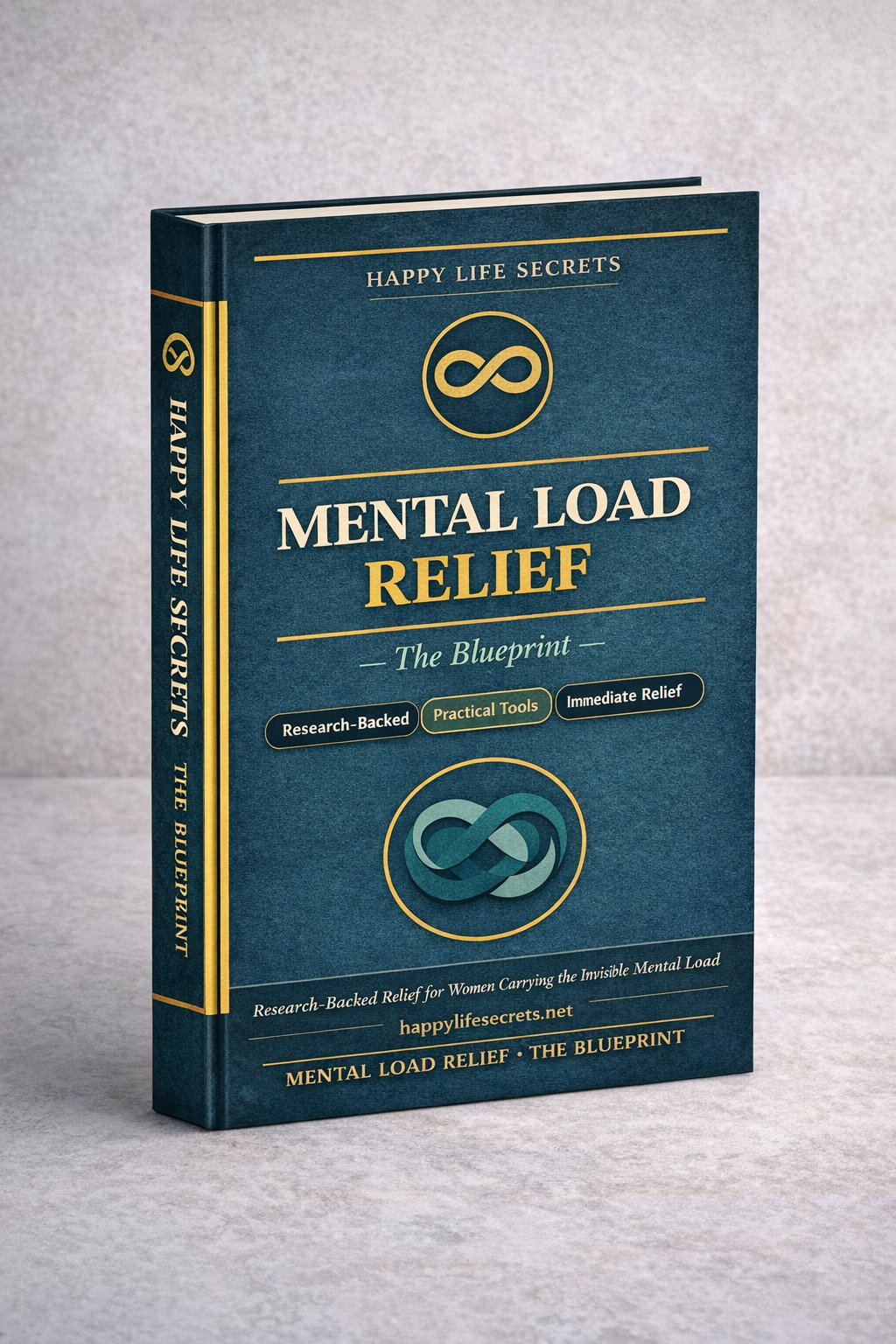
The Mental Load Relief Blueprint gives you the research-backed framework women 25–44 are quietly using to reclaim 2+ hours of mental space daily — without waiting for anyone else to notice how much you're managing.
Instant PDF delivery • Your privacy protected • Unsubscribe anytime
You're Not Overwhelmed Because You Can't Handle It.
You're Overwhelmed Because the Load Was Never Designed to Be Carried by One Person.
Research shows women make up to 35,000 decisions daily while managing invisible work nobody else sees — or names. Here's what that actually looks like from the inside.
You're the Only One Who Remembers Everything
Appointments, school events, grocery needs, everyone's schedules — that mental tab running 24/7 is real cognitive labor. Studies show invisible work creates 40% more mental fatigue than tasks anyone can actually see.
Making 100+ Decisions While Everyone Else Just... Lives
What's for dinner? Who needs what tomorrow? Did that get handled? You're absorbing the weight of these micro-decisions constantly — and research confirms that decision fatigue quietly steals your clarity and energy all day long.
Holding Everyone's Emotional Load Too
Their worries, moods, needs, and fears have somewhere to land — and that place is you. Data shows this emotional carrying costs women 700+ hours annually in unpaid mental labor that nobody else identifies as work.
Your Brain Won't Turn Off at Night
Even when you're exhausted, tomorrow's logistics replay the moment your head hits the pillow. Research directly links mental load to disrupted sleep — which means you wake up tired before the day even begins.
You're Everyone's Default for Everything
Every question, every problem, every decision comes to you first. You coordinate, anticipate, solve — the invisible architecture holding everything together. Research identifies being the default person as a primary predictor of burnout.
Generic "Self-Care" Was Never Designed for Your Reality
"Take a bath." "Just say no." None of it accounts for the fact that you're managing an entire household's cognitive life. The advice failed you — not the other way around. You needed a different kind of tool.
The Mental Load Relief Blueprint: A New Framework, Not More Advice
This isn't another collection of productivity tips that pretend your invisible labor doesn't exist. These are evidence-based strategies built around how cognitive and emotional load actually work — practical relief designed for real life, not an idealized one.
Identify Your Mental Load Type
Discover which of the five mental load patterns applies to you. Research shows targeted, specific strategies work 3x better than generic approaches — because not all invisible labor looks the same.
The Brain Dump Method That Actually Works
Reduce your daily decision load by up to 40% using cognitive offloading techniques designed for real life. Studies confirm that externalizing mental tabs creates immediate, measurable relief.
Sharing Mental Load — Not Just Tasks
Specific strategies for redistributing invisible labor without becoming the manager of your own delegation. Evidence shows even small shifts in load distribution produce noticeable, lasting relief.
Decision Fatigue Relief Protocol
Eliminate unnecessary decision points and automate your cognitive overhead. Research confirms that removing just 20 daily micro-decisions significantly improves mental clarity and available energy.
Boundary Scripts for Real Situations
Word-for-word language for setting limits without guilt or conflict. Data shows even one consistently held boundary reduces overwhelm and interrupts the default-person pattern over time.
The Bedtime Worry Spiral Protocol
Reduce nighttime mental rumination from 45 minutes to under 5 using the Worry Window Technique. Penn State research shows this approach cuts bedtime anxiety by 35% within two weeks.
The Permission You've Been Waiting For
Relief doesn't require anyone else to notice what you've been carrying first. Research shows self-validation is the essential first step — and this guide begins there, because that's where change actually starts.
Every Strategy Is Grounded in Research on Invisible Labor
Not wellness trends. Not anecdotes. Peer-reviewed data on cognitive load, decision fatigue, and emotional labor from leading psychology and behavioral science journals.
Why The Mental Load Relief Blueprint Works When Generic Advice Didn't
The strategies that failed you before weren't designed for cognitive labor. They were designed for task management. This is something different.
Built for What You're Actually Carrying
Designed specifically for cognitive overload from invisible labor — not generic stress tips that acknowledge your situation in the intro and then ignore it for the rest of the guide.
Fits Into Real Life, Not an Ideal One
Every strategy takes 5–10 minutes. Not because the strategies are small — because your time is real. Relief that only works when you have three free hours isn't relief.
100% Evidence-Based
Grounded in peer-reviewed research on invisible labor, decision fatigue, and emotional load — not trends, personal opinions, or one-size-fits-all advice that was never built for what you carry.
About Happy Life Secrets
I'm Herb, founder of Happy Life Secrets. For over a decade, I've researched the psychology of mental overwhelm, decision fatigue, and cognitive load — specifically studying what creates real, measurable relief for women managing multiple responsibilities and invisible labor nobody else names.
The Mental Load Relief Blueprint isn't built on personal anecdotes or wellness theories. Every strategy inside is grounded in peer-reviewed research from leading psychology journals and clinical studies on invisible labor and burnout.
These are the same evidence-based tools women are using right now to finally get relief from work nobody acknowledges — and to reclaim the mental space they've always deserved, without waiting for anyone else to step up first.
Download Your Free Blueprint Today
Stop carrying everyone's invisible labor alone. Get the complete, evidence-based guide for reducing decision fatigue, sharing the mental load, and finally feeling lighter — starting today.
Completely free. No credit card required. Instant PDF download.
Yes — Send Me the Free Blueprint NowInstant delivery • Your privacy protected • Evidence-based strategies • Unsubscribe anytime
------------------------
------------------------


-----------


-----------

-----------


HappyLifeSecrets.net
Copyright © 2010-2026
All Rights Reserved