Mental Load Inventory: How to Map What You Carry in 15 Minutes
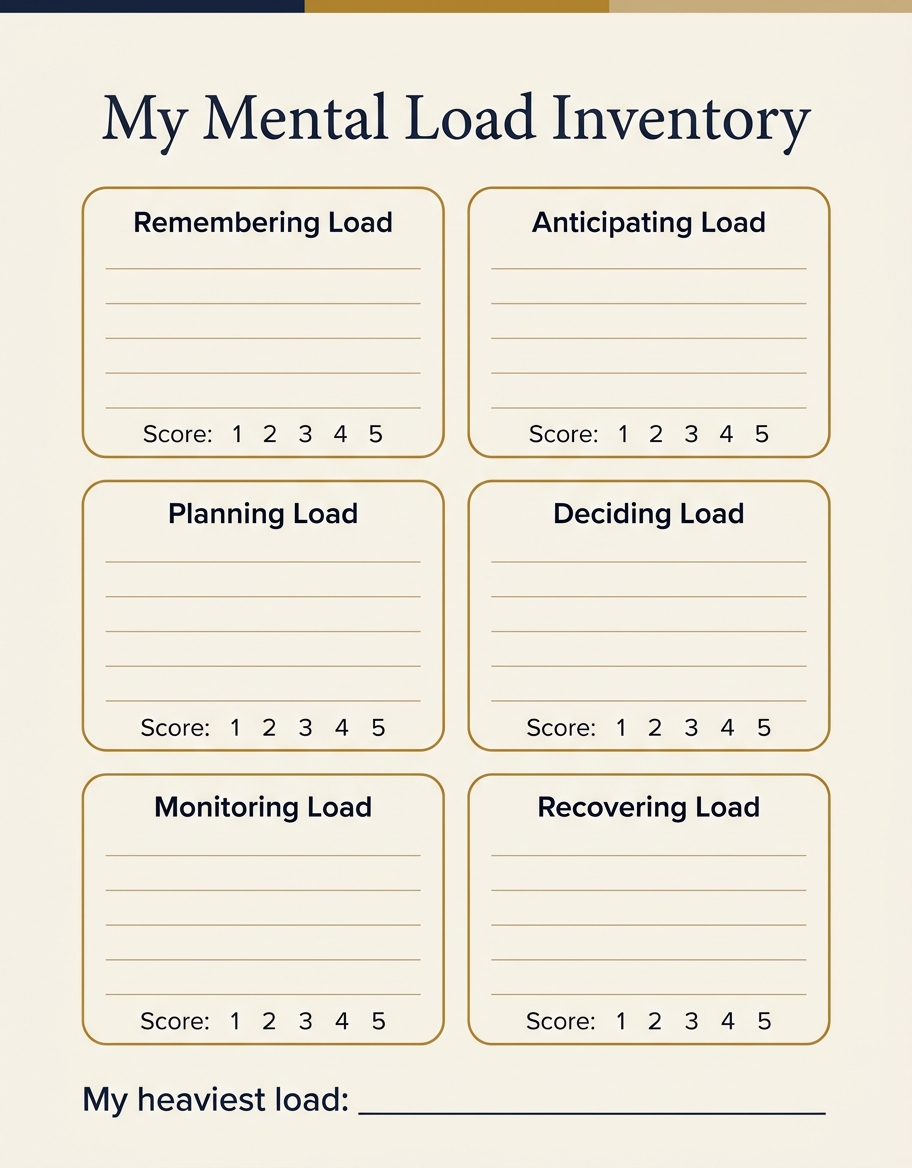
By the end of this mental load inventory, you'll have something most women have never been handed: a one-page map of the invisible work you're carrying, sorted into six types, with the heaviest one circled. It takes about 15 minutes. You can do it at the kitchen table with your coffee going cold beside you, and you'll walk away knowing exactly where a small change will help most.
Why map it at all? Because the thinking part of running a home is real work. In her study of cognitive household labor, sociologist Allison Daminger found that it breaks into distinct pieces: anticipating needs, identifying options, deciding and monitoring how things turn out. She also found it is often shared less evenly than the visible chores are.
That work has been studied for decades. It just never reached you in a form you could use on a Tuesday afternoon. Today, for the first time, you'll see your own version of it, named and on paper.
Why a Mental Load Inventory Works When Lists Don't
If you've tried to-do lists, shared calendars or chore charts and still felt exhausted even on easy days, that wasn't a failure of discipline. Those tools capture tasks. They don't capture the thinking that surrounds every task.
A chore chart says "laundry: Tuesday." It doesn't record that you noticed the soccer uniform has to be clean by Saturday, remembered that the blue one shrinks, and checked twice that it actually got washed. That noticing, remembering and checking is where the weight lives, and no list was built to hold it.
A mental load inventory works differently. Instead of listing chores, you look at the six kinds of thinking work behind them. Researchers are paying more attention to this every year: in a 2026 NPR Life Kit conversation about lightening the mental load, sociologist Leah Ruppanner pointed to survey data from more than 3,000 U.S. parents showing women handled over 70 percent of domestic mental load, and argued that measuring it is what makes it possible to reduce.
What You'll Need
- A sheet of paper (or print the worksheet above)
- A pen
- 15 minutes when you won't be interrupted, or as close to that as real life allows
That’s it. No app, no spreadsheet, no partner present. This first pass at your mental load inventory is just for you.
Your 15-Minute Mental Load Checklist: 7 Steps
Work through the steps in order. Each one takes a minute or three, and each one leaves you with something written down. Don't edit as you go; messy is fine.
Step 1: Empty your head (Remembering Load) · 3 minutes
Set a timer for three minutes and write down everything you're holding for the next seven days: appointments, birthdays, the permission slip, the prescription refill, the thing you promised your sister. Keep going until the timer ends.
Now go back and put a star next to every item that exists only in your head, with no calendar entry, note or reminder anywhere else.
Output: your list, plus a count of starred items. That number is your Remembering Load for the week.
Step 2: The "just in case" scan (Anticipating Load) · 2 minutes
Write down 3 to 5 things you're quietly watching for this week: the weather for Saturday's plans, a cough that might turn into a sick day, a bill that might come in high, a mood you're bracing for.
Next to each one, write the name of anyone else who is also watching for it. Leave it blank if the answer is no one.
Output: a short watch list. Count the blanks.
Step 3: Map your busiest day (Planning Load) · 2 minutes
Pick the most crowded day on your week. Sketch it as a simple line from morning to night and add every handoff: who goes where, who drives, what has to happen before what.
Circle each point where the plan falls apart if you forget it.
Output: one rough day map and a number of circled dependencies.
Step 4: Tally today's decisions (Deciding Load) · 2 minutes
List the decisions you've made since you woke up, big and small: what's for dinner, which bill to pay first, whether that rash needs a call to the pediatrician, what to say yes to. Aim for at least ten. Most women find it easy to reach twenty.
Make a check mark next to each decision that landed on you by default, simply because no one else picked it up.
Output: a decision list and a number of check marks.
Step 5: Find the follow-ups (Monitoring Load) · 2 minutes
Write down every task you've handed off to someone else (a partner, a child, a coworker, a contractor) that you still check on. Did the trash go out? Did the form get signed? Did the plumber actually call back?
Next to each one, note how often you check: daily, weekly or "when I remember."
Output: a follow-up list. These are tasks you gave away but kept responsibility for.
Step 6: The rest check (Recovering Load) · 1 minute
Think about your last free evening. On a scale of 1 to 5, how rested did you feel afterward, with 1 meaning "not at all" and 5 meaning "truly restored"? Write the number down.
Then write one sentence about what got in the way, whether it was an interruption, a task you remembered or a feeling that you hadn't earned the break yet.
Output: one score and one sentence.
Step 7: Score your six and circle one · 2 minutes
Look back over Steps 1 through 6. For each type, give yourself a heaviness rating from 1 (light) to 5 (heavy), based on what you wrote, not on what you think you should feel:
- Remembering Load: ___
- Anticipating Load: ___
- Planning Load: ___
- Deciding Load: ___
- Monitoring Load: ___
- Recovering Load: ___ (here, a low rest score from Step 6 means a heavier load)
Circle the highest number. If two are tied, circle the one that surprised you more.
Output: your personal load profile: six numbers and one circled type.

What to Do With What You Found: How to Reduce Mental Load This Week
Take a look at your finished mental load inventory. This isn’t a grade… This isn't a grade. It's the first clear picture of the invisible work you're carrying, and that picture is useful in itself. Most women find their circled type isn't the one they would have guessed.
Your circled type is where one small change will matter most. Here's a first step for each:
- Remembering: move every starred item from Step 1 into one calendar or note today. Your head isn't a filing cabinet.
- Anticipating: choose one blank item from Step 2 and ask someone to watch for it with you this week.
- Planning: take one circled dependency from Step 3 and hand over the whole thing, from start to finish, not just the driving.
- Deciding: pick one recurring decision from Step 4 (Tuesday dinners, say) and make it once for the whole month.
- Monitoring: choose one follow-up from Step 5 and agree that the person who owns the task also owns confirming it's done.
- Recovering: schedule 20 minutes this week that has no purpose except rest, and treat it like an appointment.
If you share your map with a partner or family, offer it as information rather than a scorecard. The point is to make the work visible so it can be shared, not to decide who has been doing it wrong.
If you'd like a guided path from here, the Mental Load Reset picks up where this page leaves off.
For further reading, a 2019 study of mothers by Lucia Ciciolla and Suniya Luthar found that mothers carried most of the invisible household labor, and that feeling overwhelmed by running the household was linked to lower well-being.
Ready for the full version?
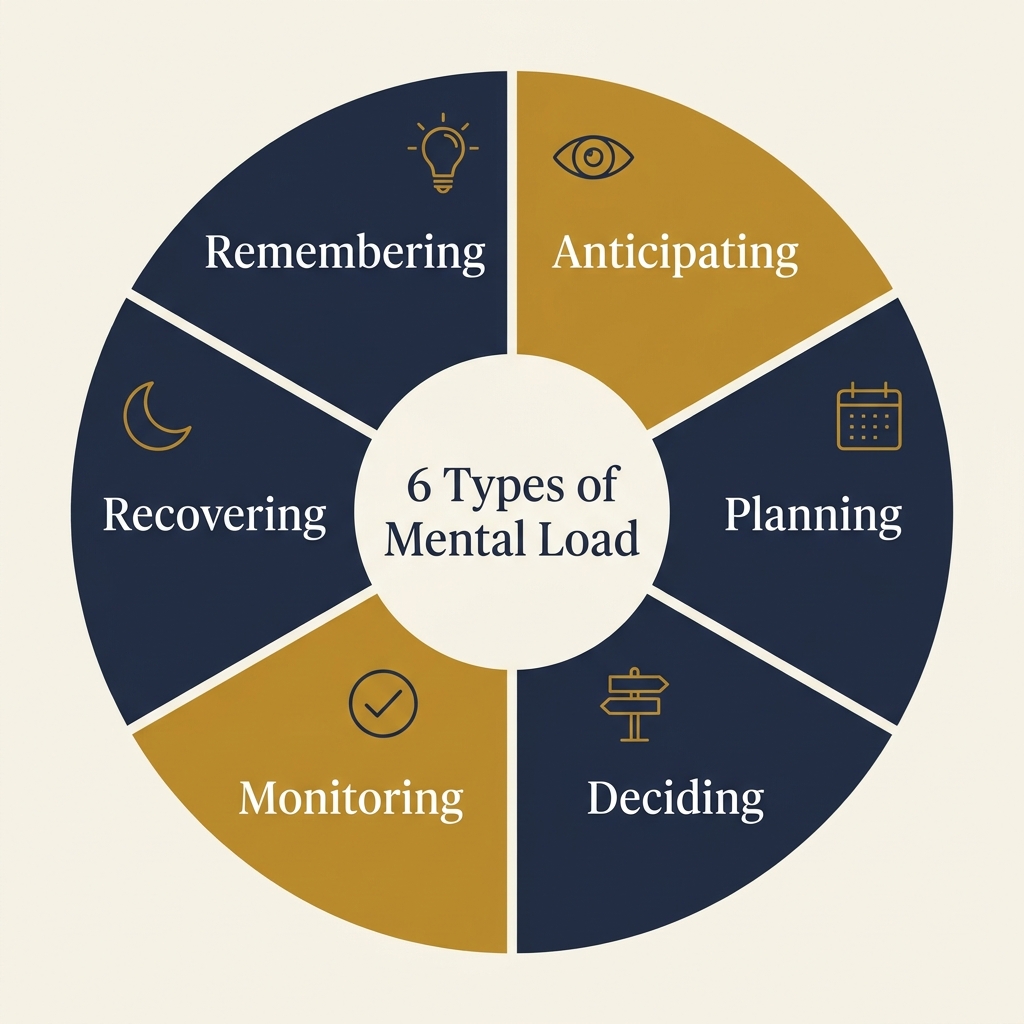
What you just did is a snapshot of one week. The Mental Load Reset ($97) is the complete version of this exercise: it goes through each of the 6 Types of Mental Load in turn, helping you lighten your circled type first and then the rest. If today's map showed you something you want to change, that's the natural next step.
Small shifts create real change, and you just made the first one.
About Happy Life Secrets
Happy Life Secrets helps women see and lighten the mental load: the invisible work of running a home and a life. The 6 Types of Mental Load framework draws on decades of research into household and cognitive labor. Read our story on the About page
 3 minutes that change how you see every relationship


-----------
