
Mental Load Fairness: Why Keeping Score Won't Fix It — And What Actually Shifts the Load
It's 11:47 p.m. and you're lying in bed running a list that no one asked you to keep: the pediatrician callback, the fact that your son's cleats don't fit anymore, whether the anniversary dinner reservation actually went through, who's picking up the dry cleaning before Thursday. Somewhere in there, a small, tired voice starts doing math. I did the school forms. He did the trash. I did the birthday gift, the RSVP, the thank-you notes. He did the trash again. You start keeping score — not because you want to be someone who keeps score, but because it feels like the only way to prove, even just to yourself, that what you're carrying is real.
Here's what's actually going on, and it's not a character flaw or a communication problem: there's a documented, measurable reason mental load fairness feels so elusive, and it has almost nothing to do with how carefully you tally who did what. For the first time ever, research on cognitive labor gives us language for exactly what you've been experiencing — and it explains why the chore chart, the app, the "fair play" card deck, and the running mental ledger all eventually collapse under their own weight.
Why Keeping Score Doesn't Get You Closer to Mental Load Fairness
Scorekeeping feels logical. If the problem is imbalance, then measuring the imbalance should be the fix, right? But scorekeeping only tracks the visible layer — who did the task. It has no way to capture who noticed the task needed doing in the first place, who researched the options, who held the timeline in their head for three weeks, or who kept checking that it actually got done. That invisible layer is precisely what the research below has spent decades documenting, and it's the layer any real path toward mental load fairness has to address.
This isn't a new discovery, either — it's information that simply hasn't reached most households yet. As far back as 1915, home economist Christine Frederick was writing about the cognitive dimension of household management in Household Engineering — the mental coordination of a home, distinct from the physical labor of running it. More than a century later, the exhausted feeling you're carrying isn't new. What's new is that the science has finally caught up enough to name it precisely.
The Research That Explains What You Already Knew Was True
Cognitive labor is unequally distributed — independent of who does the tasks. Sociologist Allison Daminger's research, published in the American Sociological Review, looked specifically at the thinking work that surrounds household tasks: anticipating a need, identifying the options, deciding among them, and monitoring the outcome. Her finding was striking — even in households where physical tasks were split relatively evenly, the cognitive management of those tasks concentrated almost entirely in one partner. Mental load fairness, in other words, can look like it exists on a chore chart and still be completely absent underneath it. What this means for you: the reason you feel like you're carrying everything, even when your partner is "helping," is that the thinking layer was never actually divided — it was just never counted.
Your working memory has a hard limit, and it's already spoken for. Cognitive psychologist John Sweller's Cognitive Load Theory, first published in 1988, established something that sounds almost obvious once you hear it: working memory is finite and measurable. It's not a metaphor. When that limited capacity is filled with tracking everyone else's schedules, needs, and deadlines, there's measurably less of it left for anything else — including rest, creativity, or your own priorities. This is why mental load fairness isn't just about emotional wellbeing; it's about literal cognitive bandwidth, and why "just relax" has never once worked as advice.
Decision-making depletes you as the day goes on — and household decisions never stop coming. Psychologist Roy Baumeister's research on decision fatigue documents that every choice you make draws down a limited pool of mental resources, and that pool gets thinner as the day progresses. In a household where one person is fielding hundreds of small decisions — what's for dinner, which permission slip needs a signature, whether the pediatrician appointment can wait — that depletion compounds hour after hour, long before anyone touches a physical task. This is the "deciding load" piece of mental load fairness, and it's measurable, not imagined.
Even your rest is doing work. Neuroscience on the brain's Default Mode Network — the network that activates when you're not actively focused on a task — has found that this "resting" state doesn't actually produce rest for people carrying a high cognitive load. Instead, it produces mental replay and anticipatory planning: reviewing the day, running tomorrow's list, rehearsing conversations that haven't happened yet. That's the neurological explanation for why you can sleep eight hours and still wake up exhausted. It's not anxiety. It's an overloaded resting state that never fully clocks out.
This imbalance predates your relationship, and it's persistent. Sociologist Arlie Hochschild's landmark 1989 study, The Second Shift, documented that even in dual-income households where both partners work full-time, domestic labor remained unevenly distributed — a pattern more recent, large-scale survey research has continued to confirm well into the 2020s, showing that gaps in the cognitive layer specifically are often even wider than gaps in physical task-sharing. Mental load fairness has been a documented, structural pattern for decades. It was never a reflection of your effort, your organization, or your ability to "just ask better."
Connecting the Research to the 6 Types of Mental Load
This is where the science stops being abstract and starts being useful. The reason a single research finding — even one as validating as Daminger's — can't fully explain what you're feeling is that mental load isn't one thing. It's at least six distinct types, each with its own weight:
Anticipating Load (noticing a need before it becomes urgent),
Identifying Load (researching the options),
Deciding Load (choosing among them),
Planning Load (sequencing everything into a workable timeline),
Monitoring Load (making sure it actually got done), and
Emotional Load (carrying the felt responsibility for how it all turns out).

The 6 Types of Mental Load
Sweller's work on working memory explains why all six types draw from the same finite pool — which is why carrying even three or four of them at once can feel disproportionately heavy. Baumeister's decision fatigue research maps almost exactly onto Deciding Load, showing why that particular type wears you down fastest. Daminger's four-part model — anticipate, identify, decide, monitor — lines up directly with four of the six types, giving academic precision to what the framework names in plain language. And the Default Mode Network research explains why Anticipating Load and Monitoring Load don't switch off even when you're technically off duty.
This is exactly why scorekeeping fails as a strategy for achieving mental load fairness: a chore chart can only ever capture the visible sliver of one or two of these six types. It has no column for Anticipating Load, no way to log Monitoring Load, and no metric at all for Emotional Load. Real fixing imbalance in partnerships doesn't start with a more detailed tally. It starts with naming all six types out loud, together, so the invisible ones stop being invisible.
What This Means for You
Relief is possible here, and it doesn't require an argument, a confrontation, or a better spreadsheet. If keeping score hasn't worked, that's not evidence that your relationship is broken or that you've been doing it wrong — it's evidence that scorekeeping was never built to measure the thing you're actually carrying. Real mental load fairness starts with a different first step: naming which of the six types you're holding, out loud, before trying to redistribute anything.
That might sound small. It isn't. Cognitive labor research consistently shows that the turning point in unequal households isn't a bigger conversation about chores — it's the moment cognitive labor becomes visible and nameable for the first time. Once Anticipating Load and Monitoring Load have names, they can actually be handed off, not just performed more visibly. That's what shifts mental load in a way a chore chart never could: not more tracking, but a shared vocabulary for the layer that was never being tracked at all.
Small shifts create real change here. Naming one type of mental load you're carrying, this week, in a low-stakes moment — not mid-argument — is a realistic starting point. So is picking one recurring task and handing off not just the doing of it, but the anticipating and deciding of it, all the way through. Real solutions to invisible work don't look like a perfectly balanced spreadsheet. They look like both people finally being able to see the same six things — and starting, one type at a time, to actually share the weight of them.
Instant delivery • No credit card required • Unsubscribe anytime
You're Not Falling Behind. You're Carrying More Than Anyone Should Have to Hold Alone.
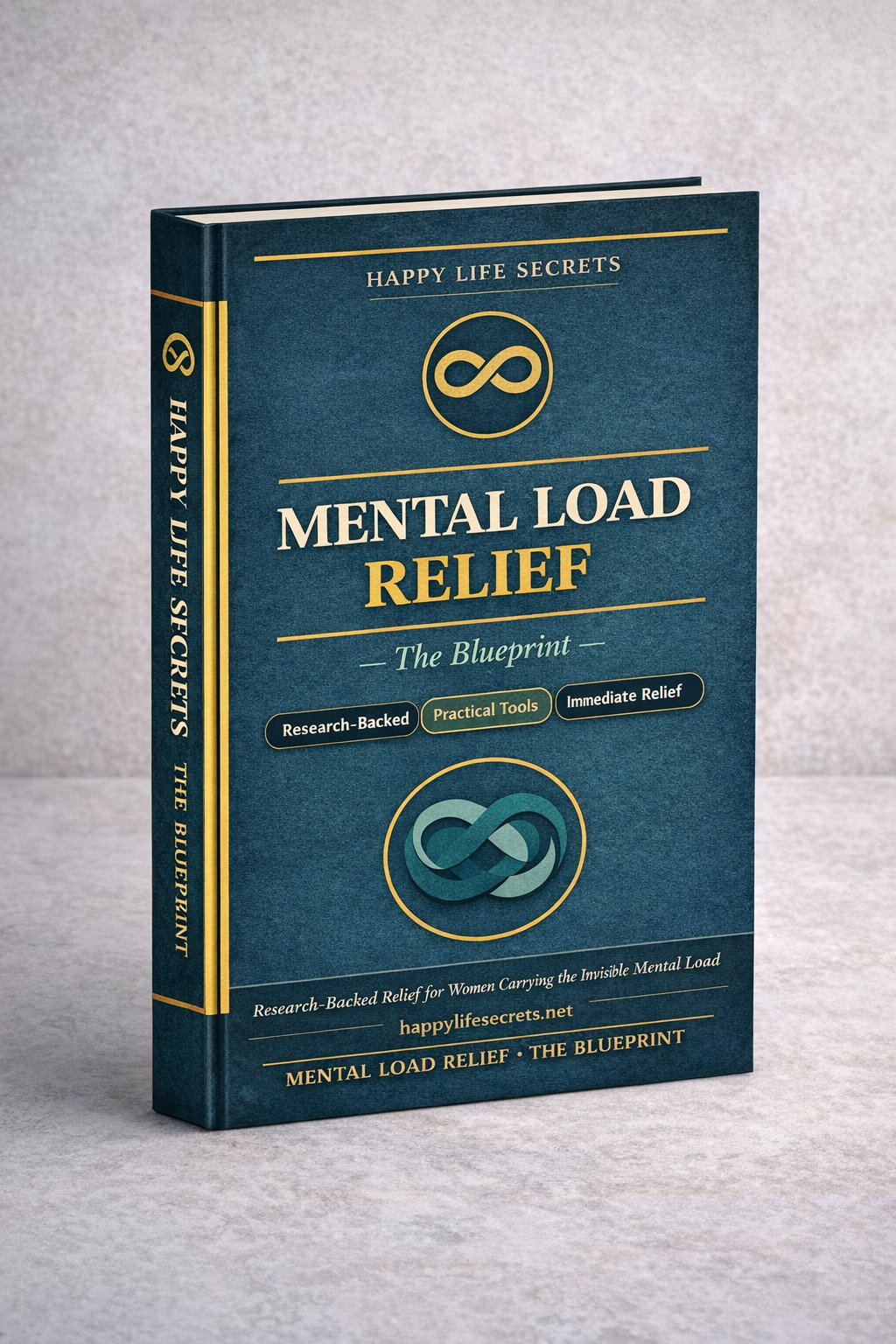
The Mental Load Relief Blueprint gives you the research-backed framework women 25–44 are quietly using to reclaim 2+ hours of mental space daily — without waiting for anyone else to notice how much you're managing.
Instant PDF delivery • Your privacy protected • Unsubscribe anytime
You're Not Overwhelmed Because You Can't Handle It.
You're Overwhelmed Because the Load Was Never Designed to Be Carried by One Person.
Research shows women make up to 35,000 decisions daily while managing invisible work nobody else sees — or names. Here's what that actually looks like from the inside.
You're the Only One Who Remembers Everything
Appointments, school events, grocery needs, everyone's schedules — that mental tab running 24/7 is real cognitive labor. Studies show invisible work creates 40% more mental fatigue than tasks anyone can actually see.
Making 100+ Decisions While Everyone Else Just... Lives
What's for dinner? Who needs what tomorrow? Did that get handled? You're absorbing the weight of these micro-decisions constantly — and research confirms that decision fatigue quietly steals your clarity and energy all day long.
Holding Everyone's Emotional Load Too
Their worries, moods, needs, and fears have somewhere to land — and that place is you. Data shows this emotional carrying costs women 700+ hours annually in unpaid mental labor that nobody else identifies as work.
Your Brain Won't Turn Off at Night
Even when you're exhausted, tomorrow's logistics replay the moment your head hits the pillow. Research directly links mental load to disrupted sleep — which means you wake up tired before the day even begins.
You're Everyone's Default for Everything
Every question, every problem, every decision comes to you first. You coordinate, anticipate, solve — the invisible architecture holding everything together. Research identifies being the default person as a primary predictor of burnout.
Generic "Self-Care" Was Never Designed for Your Reality
"Take a bath." "Just say no." None of it accounts for the fact that you're managing an entire household's cognitive life. The advice failed you — not the other way around. You needed a different kind of tool.
The Mental Load Relief Blueprint: A New Framework, Not More Advice
This isn't another collection of productivity tips that pretend your invisible labor doesn't exist. These are evidence-based strategies built around how cognitive and emotional load actually work — practical relief designed for real life, not an idealized one.
Identify Your Mental Load Type
Discover which of the five mental load patterns applies to you. Research shows targeted, specific strategies work 3x better than generic approaches — because not all invisible labor looks the same.
The Brain Dump Method That Actually Works
Reduce your daily decision load by up to 40% using cognitive offloading techniques designed for real life. Studies confirm that externalizing mental tabs creates immediate, measurable relief.
Sharing Mental Load — Not Just Tasks
Specific strategies for redistributing invisible labor without becoming the manager of your own delegation. Evidence shows even small shifts in load distribution produce noticeable, lasting relief.
Decision Fatigue Relief Protocol
Eliminate unnecessary decision points and automate your cognitive overhead. Research confirms that removing just 20 daily micro-decisions significantly improves mental clarity and available energy.
Boundary Scripts for Real Situations
Word-for-word language for setting limits without guilt or conflict. Data shows even one consistently held boundary reduces overwhelm and interrupts the default-person pattern over time.
The Bedtime Worry Spiral Protocol
Reduce nighttime mental rumination from 45 minutes to under 5 using the Worry Window Technique. Penn State research shows this approach cuts bedtime anxiety by 35% within two weeks.
The Permission You've Been Waiting For
Relief doesn't require anyone else to notice what you've been carrying first. Research shows self-validation is the essential first step — and this guide begins there, because that's where change actually starts.
Every Strategy Is Grounded in Research on Invisible Labor
Not wellness trends. Not anecdotes. Peer-reviewed data on cognitive load, decision fatigue, and emotional labor from leading psychology and behavioral science journals.
Why The Mental Load Relief Blueprint Works When Generic Advice Didn't
The strategies that failed you before weren't designed for cognitive labor. They were designed for task management. This is something different.
Built for What You're Actually Carrying
Designed specifically for cognitive overload from invisible labor — not generic stress tips that acknowledge your situation in the intro and then ignore it for the rest of the guide.
Fits Into Real Life, Not an Ideal One
Every strategy takes 5–10 minutes. Not because the strategies are small — because your time is real. Relief that only works when you have three free hours isn't relief.
100% Evidence-Based
Grounded in peer-reviewed research on invisible labor, decision fatigue, and emotional load — not trends, personal opinions, or one-size-fits-all advice that was never built for what you carry.
About Happy Life Secrets
I'm Herb, founder of Happy Life Secrets. For over a decade, I've researched the psychology of mental overwhelm, decision fatigue, and cognitive load — specifically studying what creates real, measurable relief for women managing multiple responsibilities and invisible labor nobody else names.
The Mental Load Relief Blueprint isn't built on personal anecdotes or wellness theories. Every strategy inside is grounded in peer-reviewed research from leading psychology journals and clinical studies on invisible labor and burnout.
These are the same evidence-based tools women are using right now to finally get relief from work nobody acknowledges — and to reclaim the mental space they've always deserved, without waiting for anyone else to step up first.
Download Your Free Blueprint Today
Stop carrying everyone's invisible labor alone. Get the complete, evidence-based guide for reducing decision fatigue, sharing the mental load, and finally feeling lighter — starting today.
Completely free. No credit card required. Instant PDF download.
Yes — Send Me the Free Blueprint NowInstant delivery • Your privacy protected • Evidence-based strategies • Unsubscribe anytime
------------------------
------------------------



-----------


-----------

-----------


HappyLifeSecrets.net
Copyright © 2010-2026
All Rights Reserved