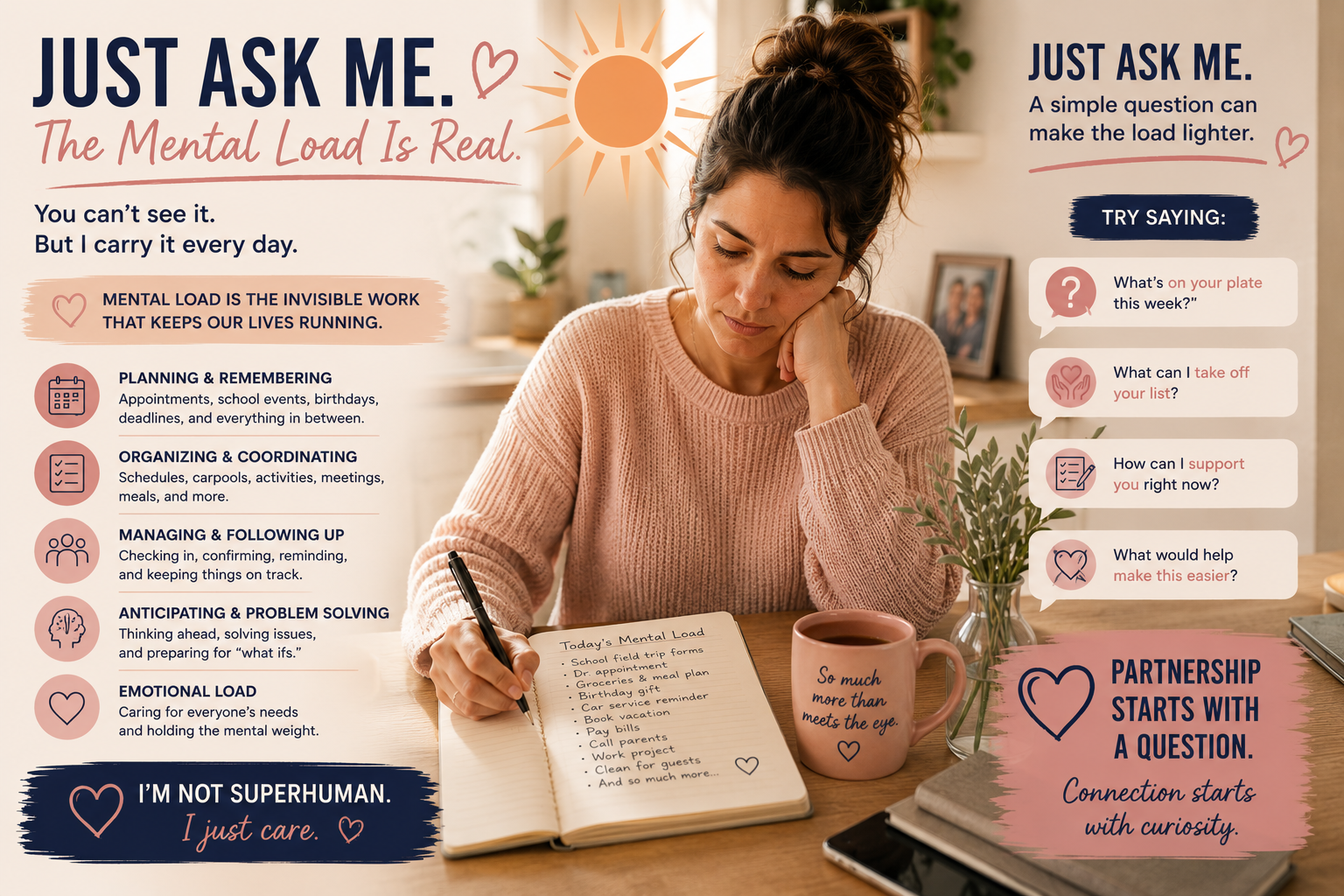
"Just Ask Me For Help Mental Load": Why It Doesn't Work
If you've typed "just ask me for help mental load" into a search bar at midnight, you already know the advice by heart — and you already know it hasn't worked. You're not broken, and you're not ungrateful. You're responding to something real. For the first time, there's language for why that phrase falls flat even when it comes from someone who genuinely means it.
"Just ask me" sounds like a solution. It's offered as one, usually by a partner who loves you and would truly show up if you asked. So why does it land less like relief and more like one more thing on the list?
Because delegation and mental load aren't the same problem. And no one ever told you that.
Why "Just Ask Me" Sounds Right
It's a reasonable thing to say. It's meant as an offer of partnership, not a dismissal — most people who say it are trying to help, and it's worth acknowledging that. On the surface, it solves the visible problem: too many tasks, not enough hands. If the dishes need doing and someone says "just ask," the dishes get done.
That's exactly why the phrase feels so hard to push back on. It sounds generous. It sounds fair. Saying it doesn't work can feel like rejecting a genuine offer.
The Truth: Asking Requires the Work It's Supposed to Replace
Here's what "just ask me" quietly assumes: that the hard part is the doing, and someone else can absorb that if you delegate it. But before you can ask for help with anything, you first have to notice it needs doing, remember it in the middle of everything else, decide it's worth flagging, and then track whether it actually got handled once you handed it off.
That's not delegation. That's the mental load itself — still running, just with an extra step where you now also have to translate it into a request. Small shifts create real change, but only once they target the part of the work that was actually invisible in the first place.
This is where it helps to name what's actually happening, instead of treating "the mental load" as one vague, overwhelming thing.
The 6 Types of Mental Load "Just Ask Me" Doesn't Touch
Remembering Load
Holding every detail, deadline, preference, and promise in your head — with no backup and no acknowledgment that this is work at all. Asking for help with one task doesn't relieve the ongoing job of remembering the other four hundred.
Anticipating Load
The background vigilance that never turns off — scanning for problems before they become crises, preparing for every scenario. You can't hand off vigilance. It's not a task; it's a setting your brain is stuck on.
Planning Load
Holding the full coordination map — who goes where, in what order, what depends on what else. The logistics of everything, carried alone, long before there's a "task" to even ask about.
Deciding Load
Making hundreds of micro-decisions daily that default to you. Every choice from trivial to significant — the decision queue that resets every morning, whether or not anyone asked you to run it.
Monitoring Load
Tracking whether delegated things actually happened — the follow-up, the quality check, the course-correction. You handed off the task but kept the responsibility. This is the part that makes "just ask" feel especially exhausting: even a successful ask still ends with you checking the work.
Recovering Load
Never getting space to restore before the next demand arrives. High-load periods stacking on each other. Rest feels unearned because the list never empties — and it doesn't empty just because one item got delegated.
Once you see the six types laid out like this, "just ask me" starts to look like what it actually is: an offer to help with output, aimed at a problem that's mostly upstream. It's not that the offer is empty. It's that it's answering a different question than the one your nervous system is asking.
Why the Old Advice Never Quite Worked
If you've tried the standard fixes — delegate more, ask for what you need, communicate clearly — and still ended up carrying just as much, that wasn't a failure of effort. It's because most of that advice assumes the load is a to-do list. It isn't. It's a tracking system running underneath the to-do list, and no one hands off a tracking system by asking someone to do the dishes.
That mismatch is worth naming plainly, because it's easy to internalize it as a personal shortcoming — as if you just haven't asked clearly enough, or haven't found the right way to phrase it yet. The exhaustion of asking for help is a completely appropriate response to a system that only ever addresses part of the load.
Think about the last time you actually did ask for help with something small — picking up milk, calling to reschedule an appointment, remembering a friend's birthday gift. Chances are, the task itself took your partner five minutes. But you spent longer than that noticing it needed doing, deciding it was safe to hand off, phrasing the ask so it didn't sound like nagging, and then quietly checking later that it actually happened. Five minutes of doing, wrapped in twenty minutes of invisible coordination. That coordination doesn't show up on anyone's list — including yours — which is exactly why it never gets credited as work.
This is also why "just ask me" can feel oddly lonely, even when it's said with love. It puts the entire burden of initiation back on the one person already holding the tracking system. The offer assumes an equal starting point — two people standing at the same task list, one just waiting to be tapped. But if you're the only one who can see the list in the first place, there's no equal starting point to offer help from.
A Small Shift That Changes the Conversation
None of this means the person offering to help is the problem, or that their offer should be waved away. It means the offer needs a different shape. Instead of "just ask me," a more useful version sounds like: "What's something you're tracking right now that I don't even know exists?" That question reaches past the visible task list and into the six types of load themselves — it invites someone into the noticing, not just the doing.
Small shifts like this create real change, not because they solve everything overnight, but because they finally point at the right layer of the problem. A single conversation won't redistribute years of Remembering Load or Anticipating Load. But naming the load out loud — using words for Planning Load, Deciding Load, Monitoring Load, Recovering Load — gives both people something concrete to work with instead of a vague sense that "things feel unfair."
What Actually Changes This
Relief is possible, but it starts somewhere different than "ask more." It starts with making the six types of load visible — to yourself first, and then to the people who share your household — so the conversation isn't "can you do this task" but "can we actually redistribute the noticing, the remembering, and the tracking, not just the doing."
That's a different conversation. It's also a more honest one, and it's the first one that has a real chance of lasting.
You don't need to carry it all in your head to prove you're capable. You never did.
Instant delivery • No credit card required • Unsubscribe anytime
You're Not Falling Behind. You're Carrying More Than Anyone Should Have to Hold Alone.
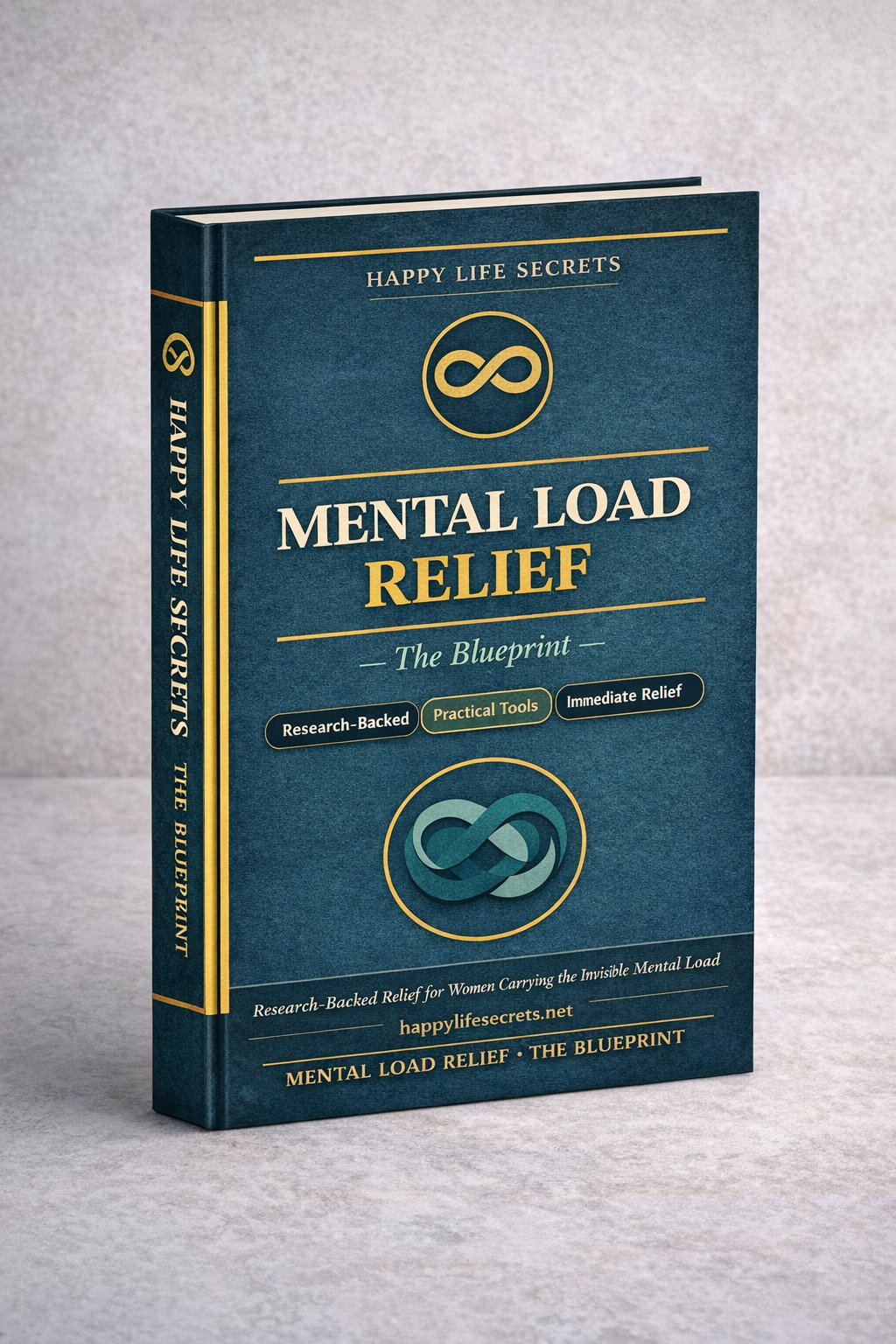
The Mental Load Relief Blueprint gives you the research-backed framework women 25–44 are quietly using to reclaim 2+ hours of mental space daily — without waiting for anyone else to notice how much you're managing.
Instant PDF delivery • Your privacy protected • Unsubscribe anytime
You're Not Overwhelmed Because You Can't Handle It.
You're Overwhelmed Because the Load Was Never Designed to Be Carried by One Person.
Research shows women make up to 35,000 decisions daily while managing invisible work nobody else sees — or names. Here's what that actually looks like from the inside.
You're the Only One Who Remembers Everything
Appointments, school events, grocery needs, everyone's schedules — that mental tab running 24/7 is real cognitive labor. Studies show invisible work creates 40% more mental fatigue than tasks anyone can actually see.
Making 100+ Decisions While Everyone Else Just... Lives
What's for dinner? Who needs what tomorrow? Did that get handled? You're absorbing the weight of these micro-decisions constantly — and research confirms that decision fatigue quietly steals your clarity and energy all day long.
Holding Everyone's Emotional Load Too
Their worries, moods, needs, and fears have somewhere to land — and that place is you. Data shows this emotional carrying costs women 700+ hours annually in unpaid mental labor that nobody else identifies as work.
Your Brain Won't Turn Off at Night
Even when you're exhausted, tomorrow's logistics replay the moment your head hits the pillow. Research directly links mental load to disrupted sleep — which means you wake up tired before the day even begins.
You're Everyone's Default for Everything
Every question, every problem, every decision comes to you first. You coordinate, anticipate, solve — the invisible architecture holding everything together. Research identifies being the default person as a primary predictor of burnout.
Generic "Self-Care" Was Never Designed for Your Reality
"Take a bath." "Just say no." None of it accounts for the fact that you're managing an entire household's cognitive life. The advice failed you — not the other way around. You needed a different kind of tool.
The Mental Load Relief Blueprint: A New Framework, Not More Advice
This isn't another collection of productivity tips that pretend your invisible labor doesn't exist. These are evidence-based strategies built around how cognitive and emotional load actually work — practical relief designed for real life, not an idealized one.
Identify Your Mental Load Type
Discover which of the five mental load patterns applies to you. Research shows targeted, specific strategies work 3x better than generic approaches — because not all invisible labor looks the same.
The Brain Dump Method That Actually Works
Reduce your daily decision load by up to 40% using cognitive offloading techniques designed for real life. Studies confirm that externalizing mental tabs creates immediate, measurable relief.
Sharing Mental Load — Not Just Tasks
Specific strategies for redistributing invisible labor without becoming the manager of your own delegation. Evidence shows even small shifts in load distribution produce noticeable, lasting relief.
Decision Fatigue Relief Protocol
Eliminate unnecessary decision points and automate your cognitive overhead. Research confirms that removing just 20 daily micro-decisions significantly improves mental clarity and available energy.
Boundary Scripts for Real Situations
Word-for-word language for setting limits without guilt or conflict. Data shows even one consistently held boundary reduces overwhelm and interrupts the default-person pattern over time.
The Bedtime Worry Spiral Protocol
Reduce nighttime mental rumination from 45 minutes to under 5 using the Worry Window Technique. Penn State research shows this approach cuts bedtime anxiety by 35% within two weeks.
The Permission You've Been Waiting For
Relief doesn't require anyone else to notice what you've been carrying first. Research shows self-validation is the essential first step — and this guide begins there, because that's where change actually starts.
Every Strategy Is Grounded in Research on Invisible Labor
Not wellness trends. Not anecdotes. Peer-reviewed data on cognitive load, decision fatigue, and emotional labor from leading psychology and behavioral science journals.
Why The Mental Load Relief Blueprint Works When Generic Advice Didn't
The strategies that failed you before weren't designed for cognitive labor. They were designed for task management. This is something different.
Built for What You're Actually Carrying
Designed specifically for cognitive overload from invisible labor — not generic stress tips that acknowledge your situation in the intro and then ignore it for the rest of the guide.
Fits Into Real Life, Not an Ideal One
Every strategy takes 5–10 minutes. Not because the strategies are small — because your time is real. Relief that only works when you have three free hours isn't relief.
100% Evidence-Based
Grounded in peer-reviewed research on invisible labor, decision fatigue, and emotional load — not trends, personal opinions, or one-size-fits-all advice that was never built for what you carry.
About Happy Life Secrets
I'm Herb, founder of Happy Life Secrets. For over a decade, I've researched the psychology of mental overwhelm, decision fatigue, and cognitive load — specifically studying what creates real, measurable relief for women managing multiple responsibilities and invisible labor nobody else names.
The Mental Load Relief Blueprint isn't built on personal anecdotes or wellness theories. Every strategy inside is grounded in peer-reviewed research from leading psychology journals and clinical studies on invisible labor and burnout.
These are the same evidence-based tools women are using right now to finally get relief from work nobody acknowledges — and to reclaim the mental space they've always deserved, without waiting for anyone else to step up first.
Download Your Free Blueprint Today
Stop carrying everyone's invisible labor alone. Get the complete, evidence-based guide for reducing decision fatigue, sharing the mental load, and finally feeling lighter — starting today.
Completely free. No credit card required. Instant PDF download.
Yes — Send Me the Free Blueprint NowInstant delivery • Your privacy protected • Evidence-based strategies • Unsubscribe anytime
------------------------
------------------------



-----------


-----------

-----------


HappyLifeSecrets.net
Copyright © 2010-2026
All Rights Reserved