Email and Slack Overload: Why You Feel Behind All Day (It’s Not a Time Problem)

It’s 4:40 in the afternoon. You’ve been at your desk since before nine. You answered every email that needed an answer, replied in the Slack thread about the deadline, reacted to the one about the client, and caught the message that came in while you were in a meeting. By any fair measure, you worked hard today.
And yet you feel behind. Not a little behind. Behind in a way that follows you to the car.
If that sounds familiar, you’re living with email and Slack overload, and it’s one of the most common reasons women feel exhausted even on easy days. Nothing went wrong. There was no crisis. Just a steady stream of constant work messages that never quite stopped.
Here’s what almost no one tells you: the problem isn’t how fast you type or how tidy your inbox is. Most of what wears you down isn’t the message itself. It’s the invisible work that comes attached to it, and no one has ever shown you how to see that work clearly.
Why you can’t keep up with messages at work (and why it isn’t your fault)
Chances are, you’ve already tried to fix this. Folders and filters. Inbox zero for a week. Notifications off, then back on because you missed something that mattered. A new app that promised to tame it all.
Those tools weren’t useless. They just aimed at the wrong target. Every system you tried was built for tasks: answer this, file that, delete the rest. None of them were built for the thinking work that rides along with each message. You didn’t fail the systems. The systems missed what you were carrying.
So the question isn’t “How do I get through my inbox faster?” It’s “What is each message actually asking me to carry?”
Too many emails at work? Here’s what one message really asks of you
Take one ordinary message: “Hey, can you send the updated numbers before Thursday’s call?” It takes ten seconds to read. Here’s what it quietly hands you.
Something new to hold in your head
Now you have to keep track of Thursday, the call, which numbers, and which version counts as “updated.” It joins all the other small promises you’re holding, most of them written down nowhere but in you.
A quiet scan for what could go wrong
Will finance have the final figures in time? Is the call still on? Did anyone else already send them? Part of your mind starts watching for problems before they happen, and that watching doesn’t switch off when you close the tab.
A plan to fit around everything else
When will you do it? Before or after the report that’s due tomorrow? Who do you need to ask first? One message, and you’re redrawing the map of your week.
A string of small decisions
Reply now or later? A quick answer or a full one? Copy your manager or not? Each choice is tiny. Together they form a decision queue that refills every time you glance at the screen.
Follow-ups you can’t quite let go of
You asked a colleague for one piece of the data. Did she see it? Will it come in time? You handed off the task, but you kept the responsibility for whether it actually happens.
When Slack notifications overwhelm you, even after hours
And before you’ve put any of that down, the next notification arrives with its own bundle. There’s never a gap long enough to come back to yourself. Then it’s 3 a.m., and you’re lying awake wondering whether you ever confirmed the Thursday numbers.
Research on how we switch between tasks helps explain why this feels so heavy. The American Psychological Association’s summary of task-switching research describes lab studies in which people lost time on every switch between tasks. Each cost was small, but they added up, and switching back and forth also brought more errors. The cost grew as the tasks got more complex. That's a big part of email and Slack overload: a workday of constant work messages is, in large part, a workday of switching.
Here’s a composite of what many women describe. Dana is a project coordinator. On paper, her days look manageable: a few meetings, a report, the usual messages. But by mid-afternoon she can’t remember what she meant to start that morning. “I’m busy every second,” she says, “and I still can’t point to one thing I finished.” She isn’t disorganized. She’s carrying dozens of half-open loops that no task list ever showed her.
If you’re curious which of these quiet jobs weighs on you most, the free 2-minute quiz can show you. Then come back. The good part is next.
Seeing email and Slack overload for what it really is
Here’s the shift. You’re not lazy. You’re overloaded. The trouble was never your effort or your discipline. It was missing information about what kind of work you were doing all day.
Researchers have been documenting this kind of work for years, mostly at home. In a 2026 study of 2,309 Italian mothers in Frontiers in Sociology, researchers measured the cognitive, managerial and emotional sides of “mental labor” and found the cognitive side especially heavy. That research looked at family life, but the same thinking work doesn’t stay home. It follows you into your inbox.
At Happy Life Secrets, we’ve put that research together in a way it has never been put together for you: the 6 Types of Mental Load. Every message you get adds to one or more of them.
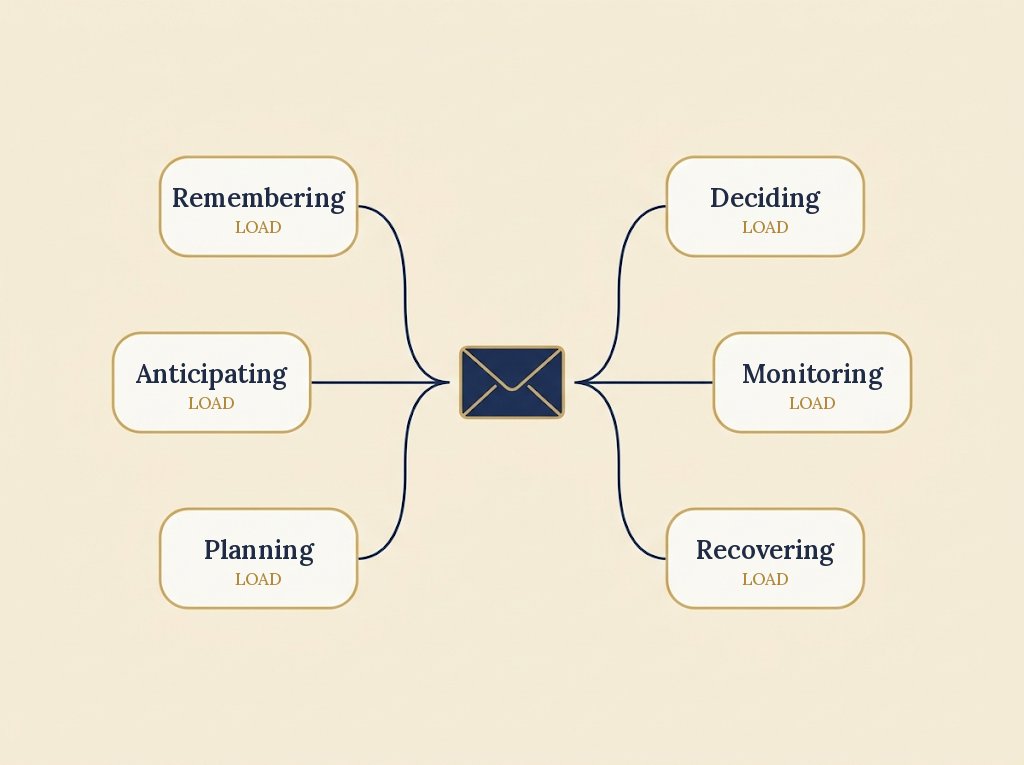
- Remembering Load: holding every detail, deadline, preference and promise in your head, with no backup and no acknowledgment that this is work at all. (The Thursday numbers.)
- Anticipating Load: the background vigilance that never turns off, scanning for problems before they become crises. (Will finance be ready?)
- Planning Load: holding the full coordination map: who goes where, in what order, what depends on what. (Fitting it around tomorrow’s report.)
- Deciding Load: hundreds of micro-decisions a day that default to you, in a decision queue that resets every morning. (Reply now? Copy your manager?)
- Monitoring Load: tracking whether delegated things actually happened. You handed off the task but kept the responsibility. (Did she send her piece?)
- Recovering Load: never getting space to restore before the next demand arrives, so rest feels unearned because the list never empties. (The 3 a.m. check.)
Once you can name the load, a message stops being a vague weight. It becomes something you can sort, set down or share.
Small shifts for constant work messages
You don't need a new system to ease email and Slack overload. Try one or two of these this week.
- Name it before you answer. When a message lands, ask, “Which load is this adding?” Ten seconds of naming turns background pressure into something you can see.
- Give Remembering Load a home. Keep one running list outside your head for every small promise a message creates. If it’s written down, your mind can stop holding it.
- Check in windows, not all day. Pick a few set times to work through email and Slack instead of answering as each one arrives. In Gloria Mark’s study of interrupted work, 48 participants (mostly university students) answered work emails while being interrupted. They worked just as fast, or faster, but reported more stress, frustration, time pressure and effort. Fewer interruptions protect more than your time.
- Close Monitoring loops on purpose. Keep a short “waiting on” list and check it once a day, rather than carrying every follow-up in the back of your mind.
- Give Recovering Load a real ending. Before you log off, jot down tomorrow’s first three tasks and close the apps. A clear stopping point tells your mind the shift is over.
If the overload has started to feel like more than a busy season, talking with a doctor or therapist is a strong step. You deserve support.

Find out which loads your inbox is handing you
Email and Slack overload looks different for every woman. For one, it’s mostly Deciding Load. For another, it’s the Monitoring Load of chasing everyone else’s replies.
Most women carry two or three of these types heavily without knowing which. The free 2-minute quiz shows you yours, so you know exactly where to start.
Relief is possible. Small shifts create real change.
Herb Ammons is the founder of Happy Life Secrets and the creator of the 6 Types of Mental Load, a framework that names the invisible thinking work women carry at home, at work and in their relationships. Read Herb’s story →