Default Parent Mental Load: 7 Questions Women Are Really Asking
If the school nurse always calls you first, you already know what the default parent mental load feels like, even if you've never had a name for it. It's the forms, the appointments, the shoe sizes, the moods, and the quiet sense that if you don't track it, nobody will.
Here's the first thing to know: you're not doing parenting wrong, and you're not imagining the imbalance. Researchers have been documenting this invisible work for decades. It just never reached you in a way you could use.
It also explains why the shared calendars, apps and chore charts didn't fix it. Every system you tried was built for tasks. None of them were built for the thinking behind the tasks: the remembering, the anticipating, the deciding. You didn't fail the systems. The systems missed what you were carrying.
Below are seven questions women ask most about being the default parent, answered honestly, one at a time.

What Is the Default Parent Mental Load?
What is the default parent?
The default parent is the one everyone turns to first: the school, the doctor, the kids and often the other parent too. It isn't about who loves the children more. It's about who holds the information, who notices what's needed and who is assumed to be on call when something comes up.
That question makes complete sense, because the term gets used loosely. Being the default parent isn't only about doing more childcare. It's about carrying the thinking that makes childcare run.
In the 6 Types of Mental Load, much of that is Remembering Load: holding every detail, deadline, preference and promise in your head, with no backup. The pediatrician's number. Which child hates which socks. The class party sign-up that closes Friday. Being the default parent at school alone can mean a dozen of these a week.
Why am I the default parent when we both work full time?
Usually because it started small and nobody decided it. One parent was home more in the early months, or answered the first school email, and the role stuck. Once one person holds the information, everyone keeps routing questions to her. Working the same hours doesn't undo that pattern on its own.
This is one of the most common things working mothers say, and there's a specific reason for it most people have never been told. The thinking work tends to stay put even when paid work evens out.
Sociologist Allison Daminger interviewed both partners in 35 couples and found that the thinking side of housework is real, separate work: anticipating needs, weighing options, deciding and checking how things turned out. In Daminger's study of cognitive household labor, the women did more of that work overall, especially the anticipating and the checking.
Here's a composite of what many women describe. Maria, 41, works full time, as does her husband. He's listed first on the school contact form, but the nurse still calls her. She's the one who knows the allergy plan, the dentist's name and that her daughter has seemed quiet this week. She isn't doing more because she cares more. She's doing more because the information lives with her.
"Isn't This Just Part of Being a Mom?"
Isn't being the default parent just part of being a mother?
Caring deeply about your children is part of being a mother. Being the only one who tracks everything isn't required. Many families share the thinking work, and research on couples has found some who do. The default parent role is a pattern that formed over time, which means it can be reshaped.
It's a fair question, especially if you grew up watching your own mother carry everything. When something is that familiar, it can feel like the natural order of things rather than a workload.
Part of what keeps it going is Deciding Load: hundreds of small decisions a day that default to you. Is she too sick for school? Does he need a jacket? Which weekend works for the birthday party? None of them is big, and that's exactly why they're easy to overlook. It's also why so many default parents feel exhausted even on easy days. Nothing major happened, but the decision queue never stopped.
Is the default parent mental load why I feel so exhausted?
It can be a big part of it. Carrying the default parent mental load means your mind rarely gets a true break, even when the kids are asleep. Exhaustion has many possible causes, though, and only a doctor or therapist can tell you what's going on for you. The load itself is real and well documented.

It makes sense to connect the two. Much of that tiredness comes from Anticipating Load: the background vigilance that scans for problems before they become crises. The fever that might turn into a missed workday. The friendship drama that might turn into a hard week.
Research has looked at this directly. A 2019 study of 393 mothers found that feeling mainly responsible for managing the household, especially the children's well-being, was linked with lower satisfaction with life and with their partners, and with feeling overwhelmed. You can read Ciciolla and Luthar's study of invisible household labor in full.
The 6 Types don't replace professional help. They name something extra, the workload underneath, so you can describe it clearly to a doctor, a counselor or your family. If you're struggling, talking with a doctor or therapist is a strong step. You're not lazy. You're overloaded. And you deserve support.
Curious which of the six you carry most? The free 2-minute quiz shows you in about the time it takes to pack a lunch box.
"Why Do I Still Feel Like the Default Parent?"
My partner is a hands-on dad. Why am I still the default parent?
Because doing parenting tasks and holding the parenting information are different jobs. Your partner may do bath time, school runs and soccer practice, while the noticing, scheduling and following up stay with you. Help with tasks and help with thinking are two different things, so you can have an involved partner and still be the default.
This is one of the most important questions, and the answer is at the heart of the 6 Types. Think about the last time he took a child to the doctor. Someone noticed the cough, decided it was worth a visit, booked it, packed the insurance card and asked afterward what the doctor said. That last step is Monitoring Load: you handed off the task but kept the responsibility.
None of this makes your partner the problem. Most involved fathers genuinely don't see this layer, because it happens inside your head before anything shows up as a job. Daminger's research found that partners often shared the final decisions fairly evenly, while the earlier noticing and the later follow-up stayed largely with women.
How do I stop being the default parent without it turning into a fight?
Talk about the thinking, not the chores. Instead of listing what your partner hasn't done, describe what happens in your head before anything gets done: the noticing, the remembering, the deciding. Most partners have simply never seen that layer. Naming it turns a scorecard argument into a shared problem to solve together.
If past conversations about who does what went badly, it makes sense to brace for this one. But this isn't the same conversation with better wording. Talking about the thinking layer is a different conversation from talking about tasks, and it often goes differently because nobody is being graded.
One approach many couples find workable: pick one area and hand over the whole thing, not just the doing. Dental and doctor visits, for example. Your partner owns noticing when they're due, booking them, remembering them and following up with the school if a note is needed. Update the school contact form too, so the calls start going to him. That's ownership, not help. Handing over one whole area like this is one of the simplest ways to lighten the default parent mental load.

This pattern isn't unique to your home. A 2026 study of mental labor among 2,309 Italian mothers found they carried a substantial mental load, with the cognitive side, the noticing and thinking ahead, especially pronounced. If you'd like to rehearse what to say first, Christine, our free AI mental load coach, can help you find words that feel like you.
"Can This Actually Change?"
What's the first step to sharing the default parent mental load?
Start by finding out which kind of mental load is wearing you down most. Being the default parent is really several loads at once, and most women carry two or three of them heavily. Once you know yours, you can hand off the right piece instead of trying to change everything at once.
That's a hopeful question to ask, and the answer is more manageable than it feels right now. Here are the 6 Types of Mental Load at a glance:
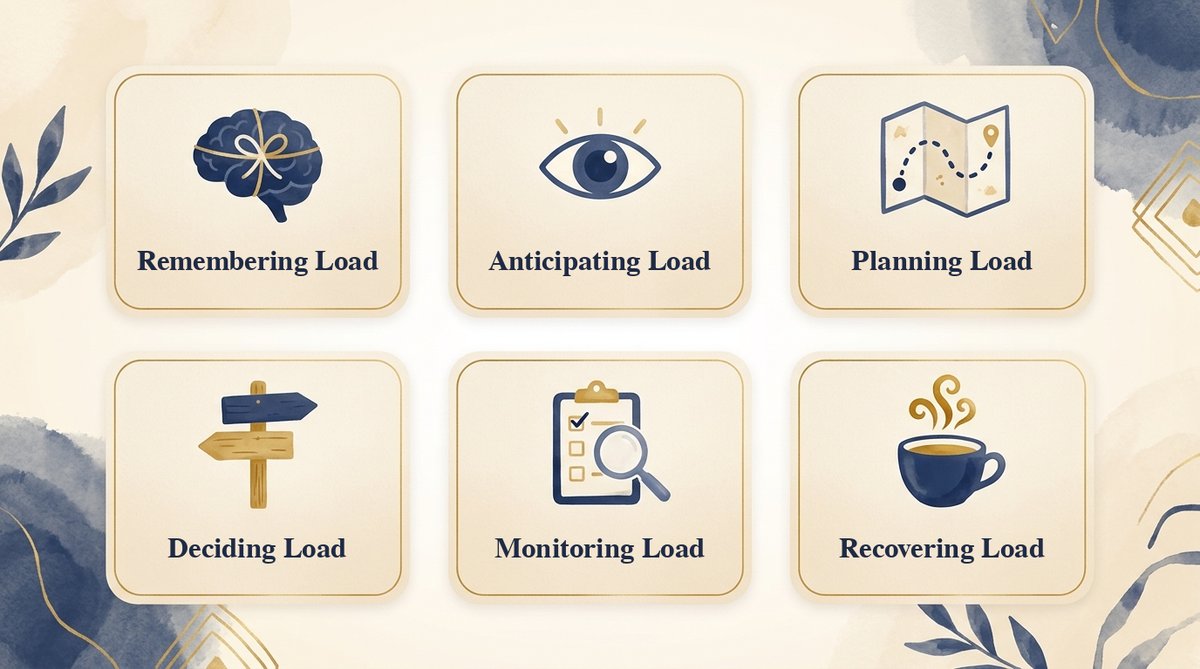
- Remembering Load: holding every detail, deadline, preference and promise in your head, with no backup.
- Anticipating Load: the background vigilance that scans for problems before they become crises.
- Planning Load: holding the full coordination map of who goes where and what depends on what.
- Deciding Load: the hundreds of micro-decisions a day that default to you.
- Monitoring Load: tracking whether delegated things actually happened.
- Recovering Load: never getting space to restore before the next demand arrives.
Most mothers recognize themselves in several of these but can't tell which ones are heaviest. That matters, because the fix for Monitoring Load looks different from the fix for Recovering Load.
The free 2-minute quiz shows which types you carry most. From there, small shifts create real change, one load at a time.
You Were Never Just "the One Who Knows"
The default parent mental load isn't proof that you're controlling, or that you care more, or that your partner doesn't care. It's a role that formed quietly, and the thinking work behind it was invisible, even to you.
Now it has a name. And once you can name it, you can start sharing it. For more on how this plays out between partners, explore our mental load in partnerships articles.
Your next step takes two minutes. Take the free 2-minute quiz, "What's Your Mental Load Type?" and see which of the six you've been carrying.
You were never failing. You were carrying work no one had named. Now it has a name.
About the author
Herb Ammons is the founder of Happy Life Secrets and the creator of the 6 Types of Mental Load, a framework that names the invisible thinking work women carry at home, at work and in their relationships. Read Herb's story →