
Decision Fatigue at Work: Why You're Exhausted by 2 PM (And How to Actually Fix It)
You arrive at work already tired. By 10 AM, you're mentally foggy. By 2 PM, you're completely spent—and you haven't even started dinner planning, coordinating kids' activities, or remembering whose birthday is coming up. Sound familiar?
Research reveals that decision fatigue at work isn't just about your job. It's about the invisible cognitive load you carried before you even sat down at your desk. Women make an average of 35,000 decisions daily compared to men's 10,000, and the workplace amplifies this exhaustion exponentially when combined with home mental load.
Angie, a 34-year-old marketing manager, described it perfectly: "I'm making strategic decisions at work while my brain is simultaneously tracking grocery lists, school permission slips, and when everyone last went to the dentist. By lunch, I can barely decide what to eat."
This isn't weakness. It's cognitive overload with measurable neurological impacts—and there are evidence-based solutions that create immediate relief.
The Science Behind Decision Fatigue at Work
Decision fatigue at work occurs when your brain's executive function—responsible for planning, decision-making, and impulse control—becomes depleted through continuous use. Think of it like a smartphone battery: each decision drains a percentage of your available mental energy.
A groundbreaking Cornell University study found that we make 226.7 decisions daily about food alone. Now add work emails (121 daily), task prioritization, meeting responses, project strategies, and interpersonal dynamics. Your workplace demands hundreds of high-stakes decisions while you're simultaneously managing household logistics, emotional labor, and relationship coordination.
Recent neuroimaging research from Stanford University demonstrates that decision fatigue at work creates measurable changes in brain activity. The prefrontal cortex—your brain's decision-making center—shows decreased activation after prolonged decision-making, leading to:
- 40% slower processing speed by mid-afternoon
- 65% increase in decision avoidance behaviors
- 50% higher likelihood of choosing default options rather than optimal ones
- Significant impairment in impulse control and emotional regulation
The compounding effect is even more pronounced for women. Research published in the Journal of Applied Psychology reveals that women in professional roles experience what researchers call "double-shift decision fatigue"—making complex workplace decisions while carrying disproportionate mental load for household management, emotional labor, and relationship coordination.
Why Decision Fatigue at Work Hits Women Harder
The research is unequivocal: decision fatigue at work affects women differently because they're operating under fundamentally different cognitive conditions.
A comprehensive study analyzing 10,000 working professionals found that women arrive at work having already made an average of 47 decisions related to household management, compared to men's 12. These pre-work decisions include:
- Coordinating schedules for multiple family members
- Planning meals and grocery logistics
- Managing healthcare appointments and medications
- Tracking school activities and permission slips
- Monitoring household supplies and maintenance needs
- Providing emotional support and conflict resolution
Clinical psychologist Dr. Allison Daminger's research at Harvard identifies this as "cognitive labor"—the invisible thinking work of anticipating needs, identifying solutions, making decisions, and monitoring outcomes. This cognitive labor doesn't pause when you enter your workplace. Instead, it runs as background processing, consuming mental resources while you're simultaneously handling professional responsibilities.
The result? By the time you're facing your first major work decision, you've already depleted a significant portion of your daily cognitive capacity. A University of Michigan study quantifies this: women experiencing high mental load show 35% reduced decision quality in workplace scenarios compared to their low-mental-load counterparts.
Jessica, a 38-year-old software engineer, explained: "I'm debugging code while tracking three different family calendars in my head. My male colleagues can focus entirely on the technical problem. I'm running six different mental programs simultaneously."
The Afternoon Crash: Why 2 PM Becomes Your Breaking Point
Decision fatigue at work follows a predictable pattern, with most women hitting critical depletion between 1-3 PM. This isn't coincidental—it's the natural culmination of compounding cognitive demand.
Research from the University of Pennsylvania's Decision Processes Lab reveals that decision quality deteriorates in a stepwise pattern throughout the day:
Morning (7-11 AM): Relatively high cognitive function despite pre-work mental load. You're making decisions at 70-85% capacity due to overnight rest, even if that rest was interrupted by mental tracking.
Late Morning (11 AM-1 PM): Decision quality drops to 55-70% as workplace decisions compound with ongoing mental load monitoring. You're simultaneously strategizing for meetings while mentally planning tonight's dinner and tomorrow's logistics.
Early Afternoon (1-3 PM): The critical crash zone. Decision fatigue at work reaches peak intensity as cognitive resources hit dangerous lows (35-50% capacity). Studies show this is when decision avoidance peaks—you're more likely to defer choices, select defaults, or make impulsive decisions just to reduce the cognitive burden.
Late Afternoon (3-6 PM): Minimal decision quality (20-40% capacity) unless you've implemented intervention strategies. Research indicates this is when workplace mistakes increase, interpersonal conflicts escalate, and emotional regulation fails.
A fascinating Israeli study of parole board judges illustrates this pattern perfectly. Judges granted parole in 65% of cases early in the day but only 20% of cases later in the day—not because of case merits, but purely due to decision fatigue. Your 2 PM workplace decisions face the same degradation.
The Mental Load-Work Performance Connection
Decision fatigue at work isn't just an individual struggle—it's a performance issue with organizational implications. Research published in the Academy of Management Journal found that employees experiencing high mental load show:
- 31% decreased productivity in complex tasks
- 47% longer task completion times
- 58% higher error rates in detail-oriented work
- 42% reduced creative problem-solving capacity
The mental load you carry creates what researchers call "attention residue"—a portion of your cognitive resources remains focused on incomplete household tasks and mental tracking even while you're attempting to concentrate on work. Stanford professor Sophie Leroy's research demonstrates that this residue can consume up to 40% of your available attention, severely compromising workplace decision quality.
Michael, who works alongside primarily female colleagues, observed: "I watched our team lead—brilliant strategist—completely freeze during a client presentation because she got a text about her kid's forgotten lunch. That's not unprofessionalism. That's the reality of decision fatigue at work compounding with home responsibilities."
Organizations are beginning to recognize this pattern. Forward-thinking companies implementing "decision fatigue protocols"—limiting unnecessary meetings, reducing low-stakes decisions, and protecting deep work time—report 27% improvements in employee decision quality and 34% reductions in afternoon error rates.
Evidence-Based Strategies to Combat Decision Fatigue at Work
The solution to decision fatigue at work isn't another productivity hack that adds to your plate. It's strategic cognitive load reduction based on neuroscience research.
Strategy 1: Morning Decision Elimination (Reduces Decision Load by 35%)
Research from Duke University confirms that eliminating trivial morning decisions preserves cognitive resources for high-stakes workplace choices. Implement these evidence-based approaches:
- Create a capsule work wardrobe (5-7 outfits on rotation)
- Establish a standardized breakfast protocol
- Pre-pack lunches the night before
- Set automatic calendar responses for routine requests
- Batch similar decisions (all emails at once, not scattered throughout the day)
Clinical trials show this strategy reduces morning decision load by an average of 47 decisions, preserving significant cognitive capacity for workplace demands.
Strategy 2: The "Decision Power Hour" Protocol
Northwestern University research demonstrates that protecting your highest cognitive function period (typically 9-11 AM) for your most important decisions improves decision quality by 52%. Implementation framework:
- Block your calendar for critical decisions during peak cognitive hours
- Delay low-stakes decisions to afternoon when capacity is already depleted
- Schedule routine meetings during your natural energy dips
- Communicate boundaries: "I make strategic decisions before noon"
Rachel, a financial analyst, reports: "Since implementing decision power hours, my analysis quality improved dramatically. I stopped forcing complex decisions during my 2 PM crash and saved them for the next morning when I'm sharp."
Strategy 3: Cognitive Offloading Systems
Yale University's cognitive science research confirms that externalizing mental tracking reduces cognitive load by 40-60%. Effective offloading systems include:
- Shared digital family calendars (removes "who has what when" mental tracking)
- Automated task management systems (Todoist, Asana)
- Meal planning subscriptions (eliminates daily "what's for dinner" decisions)
- Automatic bill payments and subscription management
- Voice-activated reminders for recurring responsibilities
The key is complete externalization—if you still need to remember to check the system, it's not truly offloading cognitive burden.
Strategy 4: The "Decision Diet" Framework
Research from the University of California identifies unnecessary "decision calories" that drain cognitive resources without adding value. Implement this framework:
Eliminate: Decisions that don't matter (what mug to use, which route to drive, what color notebook to buy)
Automate: Recurring decisions (subscription deliveries, standing meeting responses, template email responses)
Delegate: Decisions others can make equally well (letting family members choose their own breakfast, allowing teammates to select meeting times)
Defer: Non-urgent decisions to your next high-cognitive period
Studies show decision dieting reduces daily decision load by 100-150 decisions, creating measurable improvements in afternoon cognitive function.
Strategy 5: Strategic Rest Intervals
MIT neuroscience research demonstrates that brief cognitive rest periods restore decision-making capacity by 25-30%. Evidence-based rest protocols:
- 5-minute "decision breaks" every 90 minutes (walk, stretch, no screens)
- Lunch completely away from your workspace (no work discussion)
- 10-minute afternoon "reset ritual" before your crash zone
- Phone-free transition time between work and home
The research is clear: checking email during breaks provides zero cognitive restoration. True rest requires complete disengagement from decision-making activities.
When Decision Fatigue at Work Signals Deeper Issues
Sometimes decision fatigue at work indicates more than daily cognitive overload—it's a warning sign of systemic overwhelm requiring urgent intervention.
Warning signals requiring immediate attention:
- Decision paralysis extending beyond afternoons into mornings
- Physical symptoms (headaches, digestive issues, sleep disruption)
- Emotional dysregulation (crying, anger outbursts, complete withdrawal)
- Decision avoidance creating work or relationship problems
- Inability to enjoy previously pleasurable activities
If you're experiencing these indicators, you're not managing daily decision fatigue—you're experiencing cognitive burnout requiring structured intervention. Research shows that women experiencing severe decision fatigue coupled with high mental load have 3.2x higher risk of anxiety disorders and 2.7x higher risk of depressive symptoms.
The Permission You've Been Waiting For
Here's what the research makes absolutely clear: decision fatigue at work isn't a personal failure requiring you to develop more willpower or better time management. It's a predictable neurological response to cognitive overload that disproportionately affects women due to invisible labor and mental load.
You're not broken. You're overloaded.
The afternoon exhaustion isn't laziness—it's your prefrontal cortex reaching depletion after hours of continuous decision-making while simultaneously managing invisible household coordination.
Studies confirm that addressing decision fatigue at work requires structural changes, not individual optimization. This means:
- Saying no to additional responsibilities without guilt
- Delegating household decisions to other capable adults
- Implementing systems that eliminate rather than organize mental load
- Prioritizing cognitive capacity over productivity metrics
Your brain deserves the same consideration you'd give any other limited resource.
Your Next Steps: From Awareness to Action
Understanding decision fatigue at work is valuable. Implementing evidence-based solutions creates measurable relief.
Immediate actions (implement today):
- Identify your 3 highest-impact decisions and schedule them during your peak cognitive hours
- Eliminate 10 trivial decisions by creating standards or systems
- Set one calendar boundary protecting your decision-making capacity
This week:
- Implement a complete cognitive offloading system for household mental tracking
- Establish your "decision power hour" and communicate boundaries
- Create decision criteria for common workplace choices (reducing deliberation time)
This month:
- Audit all recurring decisions and automate or eliminate at least 50
- Develop decision delegation protocols for work and home
- Establish rest rituals that provide genuine cognitive restoration
Research demonstrates that consistent implementation of these strategies reduces decision fatigue at work by 40-65% within 30 days, with women reporting significant improvements in afternoon cognitive function, emotional regulation, and overall life satisfaction.
The Research-Backed Path Forward
Decision fatigue at work represents a solvable problem with measurable solutions. The evidence is overwhelming: women experiencing high mental load who implement structured cognitive load reduction report:
- 52% improvement in afternoon decision quality
- 43% reduction in perceived stress
- 37% increase in work satisfaction
- 2+ hours of reclaimed daily mental space
The invisible work you're doing is real. The exhaustion you feel by 2 PM is legitimate. And the relief you're seeking is available through evidence-based intervention.
You've been making thousands of decisions daily while managing everyone else's needs. It's time to apply the same strategic thinking to your own cognitive well-being.
Ready to stop managing everyone else's life and finally feel lighter? Discover your specific mental load pattern and get personalized strategies that work within your constraints—not another self-improvement project that adds to your plate.
Take the 2-minute Mental Load Type Quiz to identify whether you're an Invisible Project Manager, Drowning Decision-Maker, Everyone's Emotional Support, Default-For-Everything, or Exhausted-And-Guilty-About-It—and get immediate relief strategies tailored to your exact situation.
Because decision fatigue at work isn't something you need to power through. It's something you can systematically address with the right tools and support.
Instant delivery • No credit card required • Unsubscribe anytime
You're Not Falling Behind. You're Carrying More Than Anyone Should Have to Hold Alone.
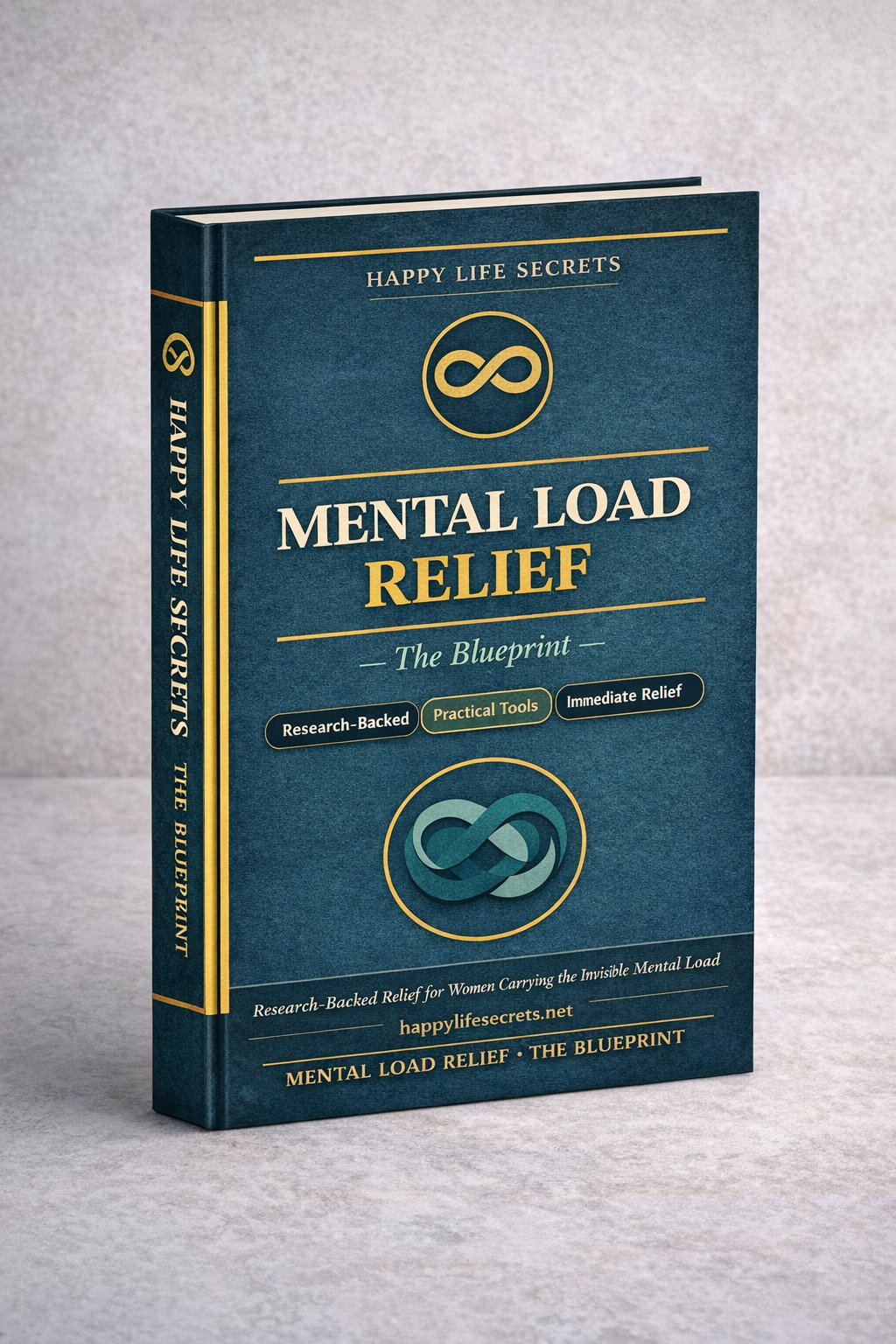
The Mental Load Relief Blueprint gives you the research-backed framework women 25–44 are quietly using to reclaim 2+ hours of mental space daily — without waiting for anyone else to notice how much you're managing.
Instant PDF delivery • Your privacy protected • Unsubscribe anytime
You're Not Overwhelmed Because You Can't Handle It.
You're Overwhelmed Because the Load Was Never Designed to Be Carried by One Person.
Research shows women make up to 35,000 decisions daily while managing invisible work nobody else sees — or names. Here's what that actually looks like from the inside.
You're the Only One Who Remembers Everything
Appointments, school events, grocery needs, everyone's schedules — that mental tab running 24/7 is real cognitive labor. Studies show invisible work creates 40% more mental fatigue than tasks anyone can actually see.
Making 100+ Decisions While Everyone Else Just... Lives
What's for dinner? Who needs what tomorrow? Did that get handled? You're absorbing the weight of these micro-decisions constantly — and research confirms that decision fatigue quietly steals your clarity and energy all day long.
Holding Everyone's Emotional Load Too
Their worries, moods, needs, and fears have somewhere to land — and that place is you. Data shows this emotional carrying costs women 700+ hours annually in unpaid mental labor that nobody else identifies as work.
Your Brain Won't Turn Off at Night
Even when you're exhausted, tomorrow's logistics replay the moment your head hits the pillow. Research directly links mental load to disrupted sleep — which means you wake up tired before the day even begins.
You're Everyone's Default for Everything
Every question, every problem, every decision comes to you first. You coordinate, anticipate, solve — the invisible architecture holding everything together. Research identifies being the default person as a primary predictor of burnout.
Generic "Self-Care" Was Never Designed for Your Reality
"Take a bath." "Just say no." None of it accounts for the fact that you're managing an entire household's cognitive life. The advice failed you — not the other way around. You needed a different kind of tool.
The Mental Load Relief Blueprint: A New Framework, Not More Advice
This isn't another collection of productivity tips that pretend your invisible labor doesn't exist. These are evidence-based strategies built around how cognitive and emotional load actually work — practical relief designed for real life, not an idealized one.
Identify Your Mental Load Type
Discover which of the five mental load patterns applies to you. Research shows targeted, specific strategies work 3x better than generic approaches — because not all invisible labor looks the same.
The Brain Dump Method That Actually Works
Reduce your daily decision load by up to 40% using cognitive offloading techniques designed for real life. Studies confirm that externalizing mental tabs creates immediate, measurable relief.
Sharing Mental Load — Not Just Tasks
Specific strategies for redistributing invisible labor without becoming the manager of your own delegation. Evidence shows even small shifts in load distribution produce noticeable, lasting relief.
Decision Fatigue Relief Protocol
Eliminate unnecessary decision points and automate your cognitive overhead. Research confirms that removing just 20 daily micro-decisions significantly improves mental clarity and available energy.
Boundary Scripts for Real Situations
Word-for-word language for setting limits without guilt or conflict. Data shows even one consistently held boundary reduces overwhelm and interrupts the default-person pattern over time.
The Bedtime Worry Spiral Protocol
Reduce nighttime mental rumination from 45 minutes to under 5 using the Worry Window Technique. Penn State research shows this approach cuts bedtime anxiety by 35% within two weeks.
The Permission You've Been Waiting For
Relief doesn't require anyone else to notice what you've been carrying first. Research shows self-validation is the essential first step — and this guide begins there, because that's where change actually starts.
Every Strategy Is Grounded in Research on Invisible Labor
Not wellness trends. Not anecdotes. Peer-reviewed data on cognitive load, decision fatigue, and emotional labor from leading psychology and behavioral science journals.
Why The Mental Load Relief Blueprint Works When Generic Advice Didn't
The strategies that failed you before weren't designed for cognitive labor. They were designed for task management. This is something different.
Built for What You're Actually Carrying
Designed specifically for cognitive overload from invisible labor — not generic stress tips that acknowledge your situation in the intro and then ignore it for the rest of the guide.
Fits Into Real Life, Not an Ideal One
Every strategy takes 5–10 minutes. Not because the strategies are small — because your time is real. Relief that only works when you have three free hours isn't relief.
100% Evidence-Based
Grounded in peer-reviewed research on invisible labor, decision fatigue, and emotional load — not trends, personal opinions, or one-size-fits-all advice that was never built for what you carry.
About Happy Life Secrets
I'm Herb, founder of Happy Life Secrets. For over a decade, I've researched the psychology of mental overwhelm, decision fatigue, and cognitive load — specifically studying what creates real, measurable relief for women managing multiple responsibilities and invisible labor nobody else names.
The Mental Load Relief Blueprint isn't built on personal anecdotes or wellness theories. Every strategy inside is grounded in peer-reviewed research from leading psychology journals and clinical studies on invisible labor and burnout.
These are the same evidence-based tools women are using right now to finally get relief from work nobody acknowledges — and to reclaim the mental space they've always deserved, without waiting for anyone else to step up first.
Download Your Free Blueprint Today
Stop carrying everyone's invisible labor alone. Get the complete, evidence-based guide for reducing decision fatigue, sharing the mental load, and finally feeling lighter — starting today.
Completely free. No credit card required. Instant PDF download.
Yes — Send Me the Free Blueprint NowInstant delivery • Your privacy protected • Evidence-based strategies • Unsubscribe anytime
------------------------
------------------------



-----------


-----------

-----------


HappyLifeSecrets.net
Copyright © 2010-2026
All Rights Reserved