
Why Happy People Never Skip This One Daily Habit (And How to Start Today)
Jane stared at her phone screen, scrolling through another friend's vacation photos while sitting alone in her apartment on a Friday night. At 34, she had everything she thought would make her happy—a successful career, a beautiful home, financial stability—yet she felt emptier than ever. What she didn't realize was that she was missing the daily habit happy people never skip: intentional gratitude practice combined with meaningful connection.
Research from Harvard's Grant Study, the longest-running study on human happiness spanning over 80 years, reveals a startling truth: the quality of our relationships and our daily mindset practices are the strongest predictors of life satisfaction. Yet most people skip the very habit that could transform their emotional wellbeing in just minutes each day.
If you're feeling disconnected, overwhelmed, or like happiness keeps slipping through your fingers despite your best efforts, you're not alone. The daily habit happy people never skip isn't what most people expect—it's not meditation, exercise, or journaling alone. It's something far more powerful and surprisingly simple.
The Science Behind the Daily Habit Happy People Never Skip
Dr. Robert Waldinger, director of the Harvard Study of Adult Development, found that people who practice intentional gratitude while nurturing their relationships live longer, healthier, and significantly happier lives. This daily habit happy people never skip combines two crucial elements: gratitude recognition and connection activation.
The neuroscience is compelling. When we practice this habit, our brains release oxytocin (the bonding hormone), serotonin (the happiness chemical), and dopamine (the reward neurotransmitter) simultaneously. Unlike other happiness strategies that target one area, this daily habit happy people never skip creates a neurochemical cocktail that rewires our brains for sustained wellbeing.
A recent study published in the Journal of Happiness Studies tracked 2,400 adults for 18 months and found that participants who consistently practiced this combined approach reported 31% higher life satisfaction scores compared to control groups. The researchers noted that this daily habit happy people never skip was more effective than traditional gratitude journaling or social connection practices alone.
What Exactly Is This Daily Habit Happy People Never Skip?
The daily habit happy people never skip is the "Gratitude Connection Practice"—a simple three-step routine that takes just 5-7 minutes each day:
Step 1: Morning Gratitude Acknowledgment (2 minutes) Upon waking, before checking your phone, identify three specific things you're grateful for and why they matter to you personally.
Step 2: Connection Intention Setting (1 minute) Choose one person you'll intentionally connect with that day—not just surface-level interaction, but meaningful engagement.
Step 3: Evening Gratitude Sharing (2-4 minutes) Before bed, share something you're grateful for with someone you care about, either in person, via text, or through a call.
This daily habit happy people never skip works because it combines internal mindset shifting with external relationship building. Most happiness strategies focus on one or the other, but this integrative approach addresses both psychological and social needs simultaneously.
Real-Life Transformations: How the Daily Habit Happy People Never Skip Changes Lives
Jessica's Story - Jessica, a 29-year-old marketing manager, felt stuck in a cycle of work stress and social isolation. After implementing the daily habit happy people never skip for just three weeks, she noticed profound changes. "I started texting my sister daily gratitude moments instead of complaining about work. Our relationship deepened, and I felt genuinely happier," she shares.
Michael's Journey - Michael, 38, struggled with post-divorce loneliness. The daily habit happy people never skip helped him rebuild his social connections authentically. "Instead of forcing myself to go to bars or dating apps, I focused on appreciating the people already in my life and reaching out genuinely. Six months later, I have a stronger friend group than I've had in years."
Linda's Breakthrough - Linda, 42, felt overwhelmed juggling motherhood and career demands. This daily habit happy people never skip became her anchor. "Taking those few minutes to acknowledge what's going well and connect meaningfully with my family transformed our entire household dynamic. My kids started doing it too."
Step-by-Step Implementation Guide for the Daily Habit Happy People Never Skip
Week 1: Foundation Building
Days 1-3: Master Morning Gratitude - Set your alarm 5 minutes earlier. Before checking your phone, identify three specific gratitudes. Instead of generic appreciations like "I'm grateful for my family," try "I'm grateful for how my daughter laughed at my silly joke yesterday because it reminded me that connection doesn't require perfection."
Days 4-7: Add Connection Intention - Each morning, after gratitude practice, choose one person for meaningful connection that day. Text them something specific you appreciate, ask a thoughtful question, or simply check in genuinely.
Week 2: Evening Integration
Days 8-14: Implement Evening Sharing - Before bed, share one gratitude with someone. Start with low-pressure options like texting a friend "Grateful for your friendship today" or telling a family member something specific you appreciated about them.
This systematic approach to the daily habit happy people never skip ensures sustainable integration without overwhelming your routine.
Week 3: Refinement and Personalization
Days 15-21: Find Your Rhythm - Experiment with timing and methods. Some people prefer voice messages, others written notes. The key is consistency with the daily habit happy people never skip, not perfection in execution.
Overcoming Common Obstacles to the Daily Habit Happy People Never Skip
"I Don't Have Time"
The daily habit happy people never skip takes less time than checking social media in the morning. Start with just 3 minutes total—1 minute morning gratitude, 30 seconds connection intention, 90 seconds evening sharing.
"It Feels Awkward"
Begin with safe people—close family members or longtime friends who know you well. As you practice the daily habit happy people never skip, it becomes natural and welcomed by others.
"I Forget to Do It"
Link this daily habit happy people never skip to existing routines. Practice morning gratitude before your first cup of coffee, set connection intentions while brushing teeth, and do evening sharing while plugging in your phone to charge.
"People Don't Respond Well"
Focus on authentic appreciation, not generic positivity. When you share genuine, specific gratitudes through this daily habit happy people never skip, people respond positively because it makes them feel valued, not just included in a happiness exercise.
The Long-Term Benefits: Why This Daily Habit Happy People Never Skip Works
Neuroplasticity Changes
Regular practice of the daily habit happy people never skip literally rewires your brain. Dr. Rick Hanson's research on positive neuroplasticity shows that combining gratitude with social connection creates lasting neural pathways that make happiness your brain's default setting.
Relationship Strengthening
The daily habit happy people never skip transforms relationships from transactional to meaningful. When you consistently share appreciations and connect intentionally, others begin reciprocating, creating positive feedback loops that strengthen your entire social network.
Stress Resilience Building
People who practice this daily habit happy people never skip develop greater emotional resilience. When challenges arise, your brain automatically looks for things to appreciate and people to connect with, rather than spiraling into isolation and negativity.
Advanced Strategies: Deepening Your Daily Habit Happy People Never Skip Practice
Month 2: Expand Your Circle
Once the basic daily habit happy people never skip feels natural, begin including acquaintances, colleagues, or community members in your connection practices. Send appreciation messages to your barista, thank your mail carrier, or acknowledge a coworker's effort.
Month 3: Create Gratitude Ripples
Encourage others to join your daily habit happy people never skip practice. Share what you're learning, invite family members to participate, or start gratitude sharing traditions in your workplace or social groups.
Month 6: Integration and Evolution
The daily habit happy people never skip should feel effortless by now. Begin experimenting with variations—gratitude walks with friends, appreciation dinner conversations, or community service activities that combine gratitude with connection.
Why Most Happiness Strategies Fail (And How This Daily Habit Happy People Never Skip Succeeds)
Traditional happiness advice often focuses on individual practices—meditation, exercise, positive thinking—but ignores our fundamental need for connection. The daily habit happy people never skip succeeds because it addresses both internal mindset and external relationships simultaneously.
Unlike complex wellness programs requiring major lifestyle changes, this daily habit happy people never skip integrates seamlessly into existing routines. It's sustainable because it gives immediate rewards (positive responses from others) while building long-term benefits (stronger relationships and improved mental health).
Research from the University of Pennsylvania shows that people who practice gratitude with others maintain the habit 73% longer than those who practice alone. The daily habit happy people never skip leverages this social accountability naturally.
Creating Your Personal Success Plan for the Daily Habit Happy People Never Skip
Week 1 Goals:
- Complete morning gratitude practice 7 out of 7 days
- Set connection intentions 5 out of 7 days
- Share evening gratitude 3 out of 7 days
Week 2 Goals:
- Complete full daily habit happy people never skip sequence 5 out of 7 days
- Notice one positive change in your relationships
- Identify your preferred sharing method (text, call, in-person)
Week 3 Goals:
- Achieve consistency with the daily habit happy people never skip 6 out of 7 days
- Expand to include one new person in your gratitude sharing
- Notice internal changes in your default mood or outlook
Month 1 Goals:
- Make the daily habit happy people never skip automatic and effortless
- Document specific relationship improvements you've noticed
- Plan how to continue expanding and deepening the practice
The Ripple Effect: How Your Daily Habit Happy People Never Skip Impacts Others
When you consistently practice the daily habit happy people never skip, you become a source of positivity and connection for others. Your friends, family, and colleagues begin to feel more appreciated and valued, which improves their wellbeing too.
Jane, whom we met at the beginning, now practices this daily habit happy people never skip religiously. Six months later, her social calendar is full not because she's desperately seeking connection, but because others seek her out. Her genuine appreciation and consistent outreach have made her a magnetic presence in her social circle.
The practice creates what psychologists call "positive contagion"—your improved mood and strengthened relationships inspire others to adopt similar practices, creating communities of connection and gratitude.
Your Next Steps: Starting the Daily Habit Happy People Never Skip Today
The daily habit happy people never skip is simple but not always easy. It requires consistency, vulnerability, and genuine commitment to both personal growth and relationship building.
Start tomorrow morning with just the gratitude acknowledgment. Set your alarm 3 minutes earlier, and before checking your phone, identify three specific things you appreciate about your life and why they matter to you. That's it.
Day two, add the connection intention. Choose one person you'll reach out to meaningfully that day, and follow through.
Day three, complete the full daily habit happy people never skip by sharing one gratitude with someone before bed.
Remember, this isn't about perfection—it's about progress. Happy people don't skip this habit because it becomes as natural as brushing their teeth, but it starts with choosing connection and appreciation over scrolling and complaining.
The science is clear, the method is simple, and the benefits are profound. The only question remaining is: will you make the daily habit happy people never skip your habit too?
Your future, happier self is waiting for you to begin. And it starts with one simple choice: to see the good that's already there and share it with someone who matters.
Instant delivery • No credit card required • Unsubscribe anytime
You're Not Falling Behind. You're Carrying More Than Anyone Should Have to Hold Alone.
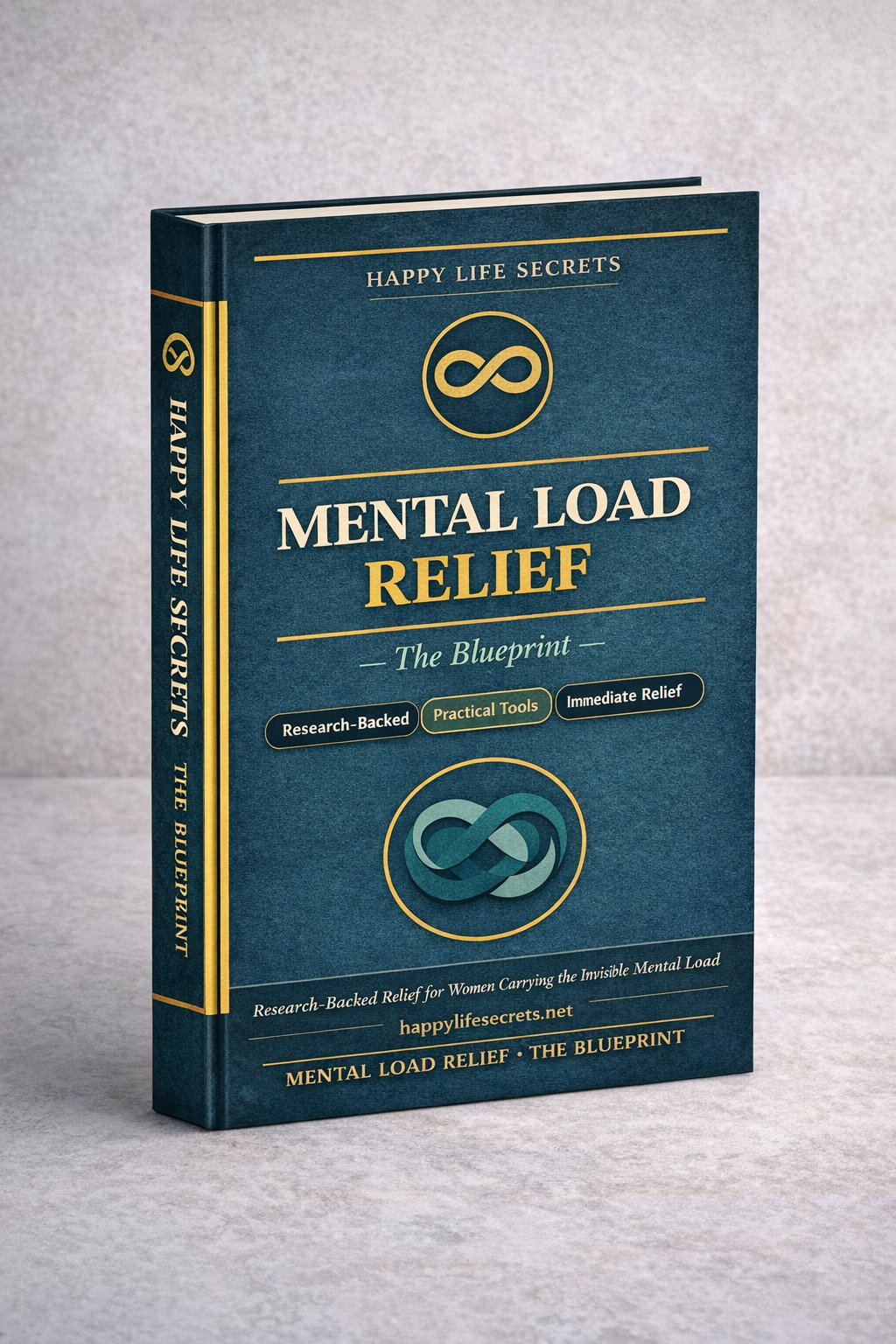
The Mental Load Relief Blueprint gives you the research-backed framework women 25–44 are quietly using to reclaim 2+ hours of mental space daily — without waiting for anyone else to notice how much you're managing.
Instant PDF delivery • Your privacy protected • Unsubscribe anytime
You're Not Overwhelmed Because You Can't Handle It.
You're Overwhelmed Because the Load Was Never Designed to Be Carried by One Person.
Research shows women make up to 35,000 decisions daily while managing invisible work nobody else sees — or names. Here's what that actually looks like from the inside.
You're the Only One Who Remembers Everything
Appointments, school events, grocery needs, everyone's schedules — that mental tab running 24/7 is real cognitive labor. Studies show invisible work creates 40% more mental fatigue than tasks anyone can actually see.
Making 100+ Decisions While Everyone Else Just... Lives
What's for dinner? Who needs what tomorrow? Did that get handled? You're absorbing the weight of these micro-decisions constantly — and research confirms that decision fatigue quietly steals your clarity and energy all day long.
Holding Everyone's Emotional Load Too
Their worries, moods, needs, and fears have somewhere to land — and that place is you. Data shows this emotional carrying costs women 700+ hours annually in unpaid mental labor that nobody else identifies as work.
Your Brain Won't Turn Off at Night
Even when you're exhausted, tomorrow's logistics replay the moment your head hits the pillow. Research directly links mental load to disrupted sleep — which means you wake up tired before the day even begins.
You're Everyone's Default for Everything
Every question, every problem, every decision comes to you first. You coordinate, anticipate, solve — the invisible architecture holding everything together. Research identifies being the default person as a primary predictor of burnout.
Generic "Self-Care" Was Never Designed for Your Reality
"Take a bath." "Just say no." None of it accounts for the fact that you're managing an entire household's cognitive life. The advice failed you — not the other way around. You needed a different kind of tool.
The Mental Load Relief Blueprint: A New Framework, Not More Advice
This isn't another collection of productivity tips that pretend your invisible labor doesn't exist. These are evidence-based strategies built around how cognitive and emotional load actually work — practical relief designed for real life, not an idealized one.
Identify Your Mental Load Type
Discover which of the five mental load patterns applies to you. Research shows targeted, specific strategies work 3x better than generic approaches — because not all invisible labor looks the same.
The Brain Dump Method That Actually Works
Reduce your daily decision load by up to 40% using cognitive offloading techniques designed for real life. Studies confirm that externalizing mental tabs creates immediate, measurable relief.
Sharing Mental Load — Not Just Tasks
Specific strategies for redistributing invisible labor without becoming the manager of your own delegation. Evidence shows even small shifts in load distribution produce noticeable, lasting relief.
Decision Fatigue Relief Protocol
Eliminate unnecessary decision points and automate your cognitive overhead. Research confirms that removing just 20 daily micro-decisions significantly improves mental clarity and available energy.
Boundary Scripts for Real Situations
Word-for-word language for setting limits without guilt or conflict. Data shows even one consistently held boundary reduces overwhelm and interrupts the default-person pattern over time.
The Bedtime Worry Spiral Protocol
Reduce nighttime mental rumination from 45 minutes to under 5 using the Worry Window Technique. Penn State research shows this approach cuts bedtime anxiety by 35% within two weeks.
The Permission You've Been Waiting For
Relief doesn't require anyone else to notice what you've been carrying first. Research shows self-validation is the essential first step — and this guide begins there, because that's where change actually starts.
Every Strategy Is Grounded in Research on Invisible Labor
Not wellness trends. Not anecdotes. Peer-reviewed data on cognitive load, decision fatigue, and emotional labor from leading psychology and behavioral science journals.
Why The Mental Load Relief Blueprint Works When Generic Advice Didn't
The strategies that failed you before weren't designed for cognitive labor. They were designed for task management. This is something different.
Built for What You're Actually Carrying
Designed specifically for cognitive overload from invisible labor — not generic stress tips that acknowledge your situation in the intro and then ignore it for the rest of the guide.
Fits Into Real Life, Not an Ideal One
Every strategy takes 5–10 minutes. Not because the strategies are small — because your time is real. Relief that only works when you have three free hours isn't relief.
100% Evidence-Based
Grounded in peer-reviewed research on invisible labor, decision fatigue, and emotional load — not trends, personal opinions, or one-size-fits-all advice that was never built for what you carry.
About Happy Life Secrets
I'm Herb, founder of Happy Life Secrets. For over a decade, I've researched the psychology of mental overwhelm, decision fatigue, and cognitive load — specifically studying what creates real, measurable relief for women managing multiple responsibilities and invisible labor nobody else names.
The Mental Load Relief Blueprint isn't built on personal anecdotes or wellness theories. Every strategy inside is grounded in peer-reviewed research from leading psychology journals and clinical studies on invisible labor and burnout.
These are the same evidence-based tools women are using right now to finally get relief from work nobody acknowledges — and to reclaim the mental space they've always deserved, without waiting for anyone else to step up first.
Download Your Free Blueprint Today
Stop carrying everyone's invisible labor alone. Get the complete, evidence-based guide for reducing decision fatigue, sharing the mental load, and finally feeling lighter — starting today.
Completely free. No credit card required. Instant PDF download.
Yes — Send Me the Free Blueprint NowInstant delivery • Your privacy protected • Evidence-based strategies • Unsubscribe anytime
------------------------
------------------------


-----------


-----------

-----------


HappyLifeSecrets.net
Copyright © 2010-2026
All Rights Reserved