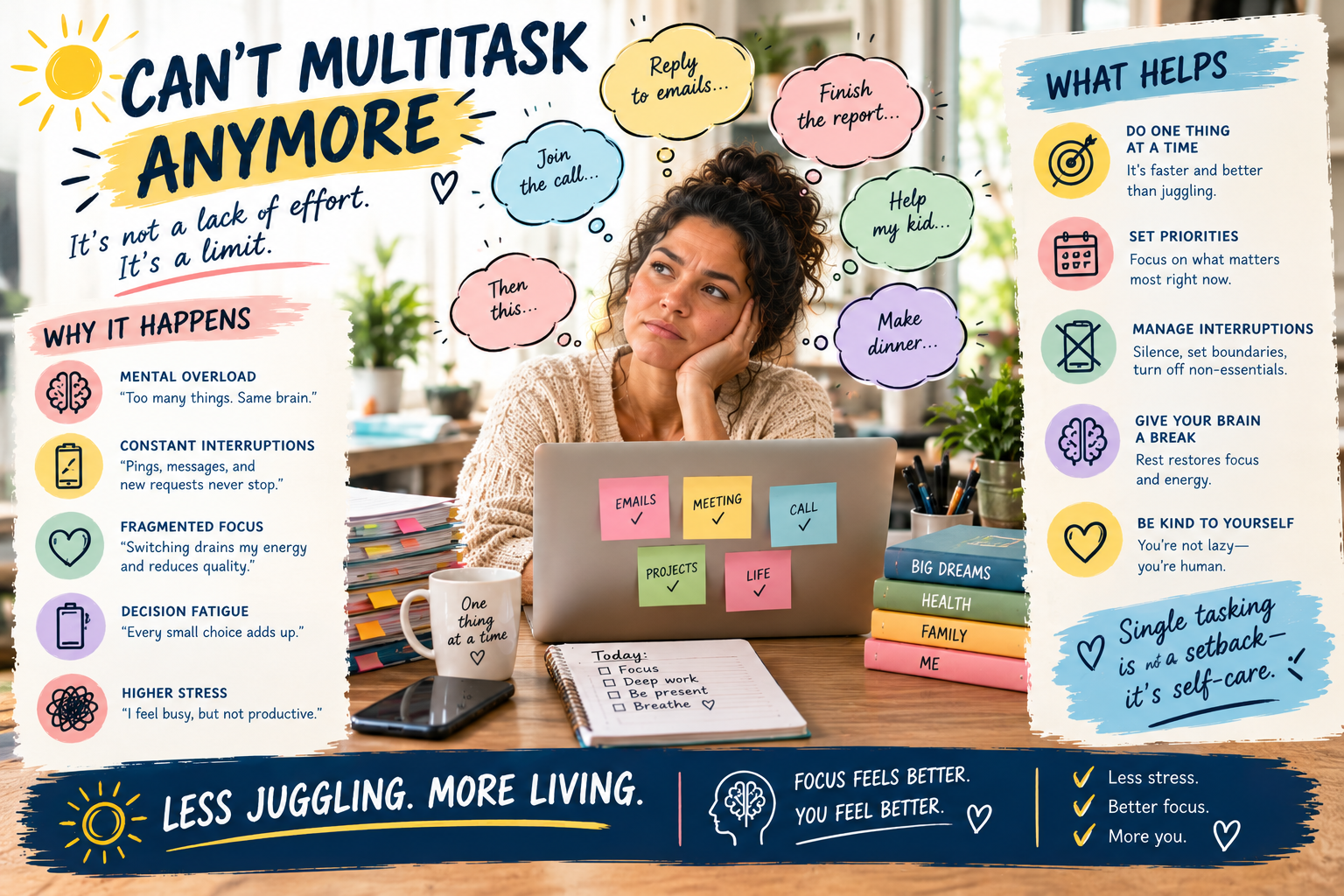
Can't Multitask Anymore? Why It's Not a Focus Problem
If you feel like you can't multitask anymore, you're not imagining it, and you're not broken. The woman who once juggled a work deadline, a dentist appointment and a birthday gift without missing a beat is still you. What's changed is how much invisible work is running in the background, quietly filling your mental bandwidth before the day even begins.
This isn't a focus problem. It's a capacity problem. And capacity can be understood, and it can be restored.
Below are the seven questions women ask most often when they notice this shift, answered honestly. For the first time ever, you'll see why the old fixes didn't hold, and what actually helps.
Why You Can't Multitask Anymore: 7 Questions Answered
Why can't I multitask anymore? I used to be so good at it.
This is often the very first thing women notice, and it can feel unsettling. You remember being the one who kept every plate spinning. So when you suddenly can't multitask anymore, it's natural to wonder what's gone wrong with you.
Here's what most people have never been told: nothing has gone wrong with you. Multitasking was never really about juggling tasks. It was about having enough free mental space to hold them. Every task you take on uses some of that space. So does every unfinished thought sitting quietly in the background: the permission slip, the prescription refill, the email you meant to answer, the gift you still need to order.
Over the years, that background load grows. It doesn't announce itself. It just keeps taking up room until there's nothing left for the juggling you used to do with ease. Your skill didn't disappear. Your space did. And space is something you can get back.
I don't have kids at home. Does this still apply to me?
Absolutely. And it's such a fair question, because so much of the conversation about mental load centers on young moms. But mental load isn't about children. It's about who holds the thinking.
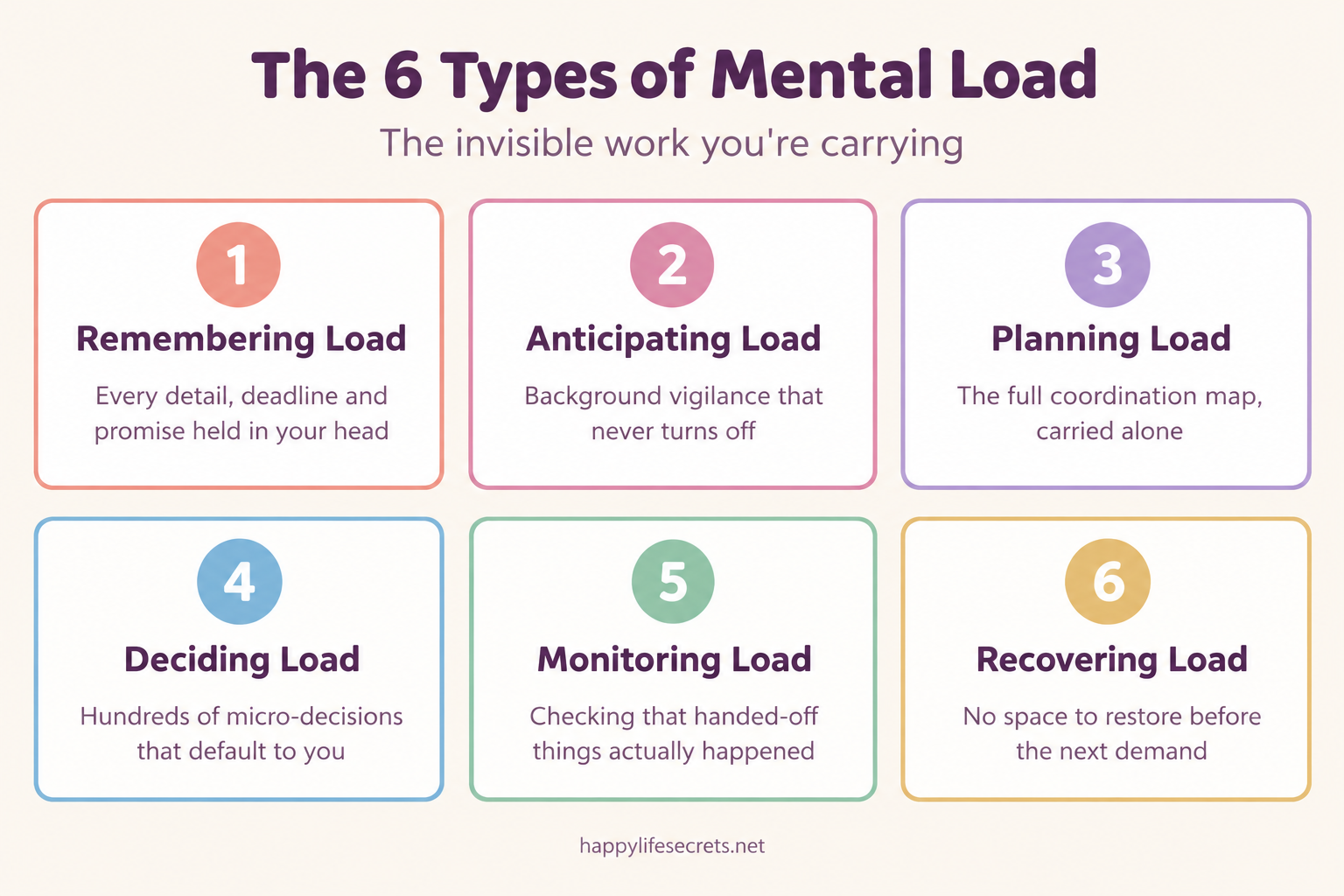
If you're the one who remembers your mother's appointments, anticipates what your team needs before the meeting, plans the holiday travel or decides what's for dinner every single night, you're carrying it. Happy Life Secrets organizes this work into the 6 Types of Mental Load: Remembering, Anticipating, Planning, Deciding, Monitoring and Recovering.
Many women without children carry heavy Remembering and Anticipating Load for aging parents, partners, friends and workplaces. Many women whose children have grown still carry habits of vigilance that never got the memo to rest. So if you can't multitask anymore and there are no kids in the house, you're in exactly the right place. Your load counts, even when no one else can see it.
Isn't this just stress, getting older, or brain fog and overwhelm?
It makes complete sense to reach for those explanations. They're the ones we hear most. And stress is part of the picture. But "just stress" usually comes with one piece of advice: relax. If relaxing were enough, you'd have solved this a long time ago.
What researchers are now describing is more specific. In a September 2026 study of nearly 1,900 mothers, researchers at Johannes Gutenberg University Mainz found that constant mental preoccupation with everyday tasks was the most common source of distress, named by 92.8% of participants, along with the feeling that tasks are never finished. Invisible work like planning and organizing was rated as more burdensome than the visible chores.
That's the difference. Your brain isn't failing. It's running dozens of open loops at once, mostly Remembering Load and Monitoring Load, and every one of them presses against the same cognitive capacity limit you need to concentrate. If you've ever typed "why I can't concentrate" into a search bar late at night, this is often the answer. (If changes in memory or focus feel sudden or come with other symptoms, a check-in with your doctor is always worth it.)
I've tried planners, apps and to-do lists. Why didn't any of them work?
That's such an honest question, and the answer isn't that you didn't try hard enough. You almost certainly tried harder than most.
Most productivity tools were designed to manage tasks. But tasks were never the heaviest part. A planner can hold the appointment, but it can't hold the anticipating, that quiet scanning for what might go wrong. An app can send a reminder, but you still had to decide when to set it, what it should say and whether the thing actually got done. That's Deciding Load and Monitoring Load, and no to-do list was built to carry them.
So when the tool didn't stick, it wasn't a personal failure. It was a mismatch. You were handed solutions for the visible layer of your life when the weight was living in the invisible one. That's why so many women who can't multitask anymore feel like they've tried everything. They have. They just tried everything designed for a different problem.
My partner helps a lot. Why do I still feel like I'm carrying everything?
This is one of the most important questions in this whole conversation, and it often comes with a little guilt, because you know your partner genuinely cares. You're right about that. You're also right about how you feel. Both can be true at once.
Here's why. Helping with tasks and sharing the thinking behind them are two different things. When your partner picks up the groceries, that's real help. But someone still noticed you were low on milk, remembered what else was missing, decided which store and will check whether the right things came home. That cognitive layer often stays with one person, and it's often you.
New research backs this up. An October 2026 report on two studies of UK and US couples found that women felt more satisfied in their relationships when partners shared more of the mental load, and that both partners agreed women carried more of it, regardless of how traditional or egalitarian their views were.
That isn't about anyone being a bad partner. It's about a layer most couples have never had words for. The conversation that helps isn't about splitting more chores. It's a different conversation, one about the cognitive layer that's been invisible until now. When that layer is finally shared, many women find the feeling that they can't multitask anymore begins to ease.
Is there actually a way to get my mental bandwidth back?
Yes. And it's okay if part of you hesitates to believe that. When you've felt stretched thin for a long time, even hope can feel like one more thing to manage.
Here's what's encouraging: your brain is built to adapt. In June 2026, Georgetown University researchers showed how weeks of practice can shift a task out of the brain's frontal "bottleneck", freeing that space for something else. Once a task truly becomes routine, it stops competing for your attention.
The same idea applies at home. When the remembering, planning and deciding live in a clear system instead of in your head, they stop draining the space you need to focus. You don't have to become a different person. You need fewer open loops running at the same time.
Women who feel they can't multitask anymore often find that once even two or three of the 6 Types are lifted, the juggling starts to feel possible again. Relief is possible, and it usually begins sooner than you'd expect.
I'm exhausted even on easy days. Where do I even start?
Start right here, with knowing that being exhausted even on easy days makes complete sense. Easy days still carry Recovering Load, the sense that rest is unearned because the list never empties. So a quiet Saturday doesn't refill the tank. Your mind is still on duty, and that's one of the quiet reasons you can't multitask anymore.
The first step isn't adding anything. It's naming what you're already carrying. Take ten minutes and notice which of the 6 Types feels heaviest right now. Is it Remembering? Deciding? Monitoring the things you've already handed off? You don't have to fix anything today. Simply seeing the invisible work you're carrying, laid out in front of you, takes away some of its power.
From there, small shifts create real change. One open loop closed. One decision made once instead of every morning. One thing written down and out of your head for good.
You're Not Losing Your Edge. You're Carrying More Than Anyone Can See.
If you can't multitask anymore, it isn't a flaw in you. It's a sign that the invisible work you're carrying has outgrown the space you have to hold it. And that's something you can change.
For the first time ever, the Mental Load Reset maps that hidden work across all 6 Types of Mental Load, so you can see exactly where your bandwidth is going and begin taking it back, one small shift at a time. Start the Mental Load Reset at Happy Life Secrets.
Relief is possible. Small shifts create real change.
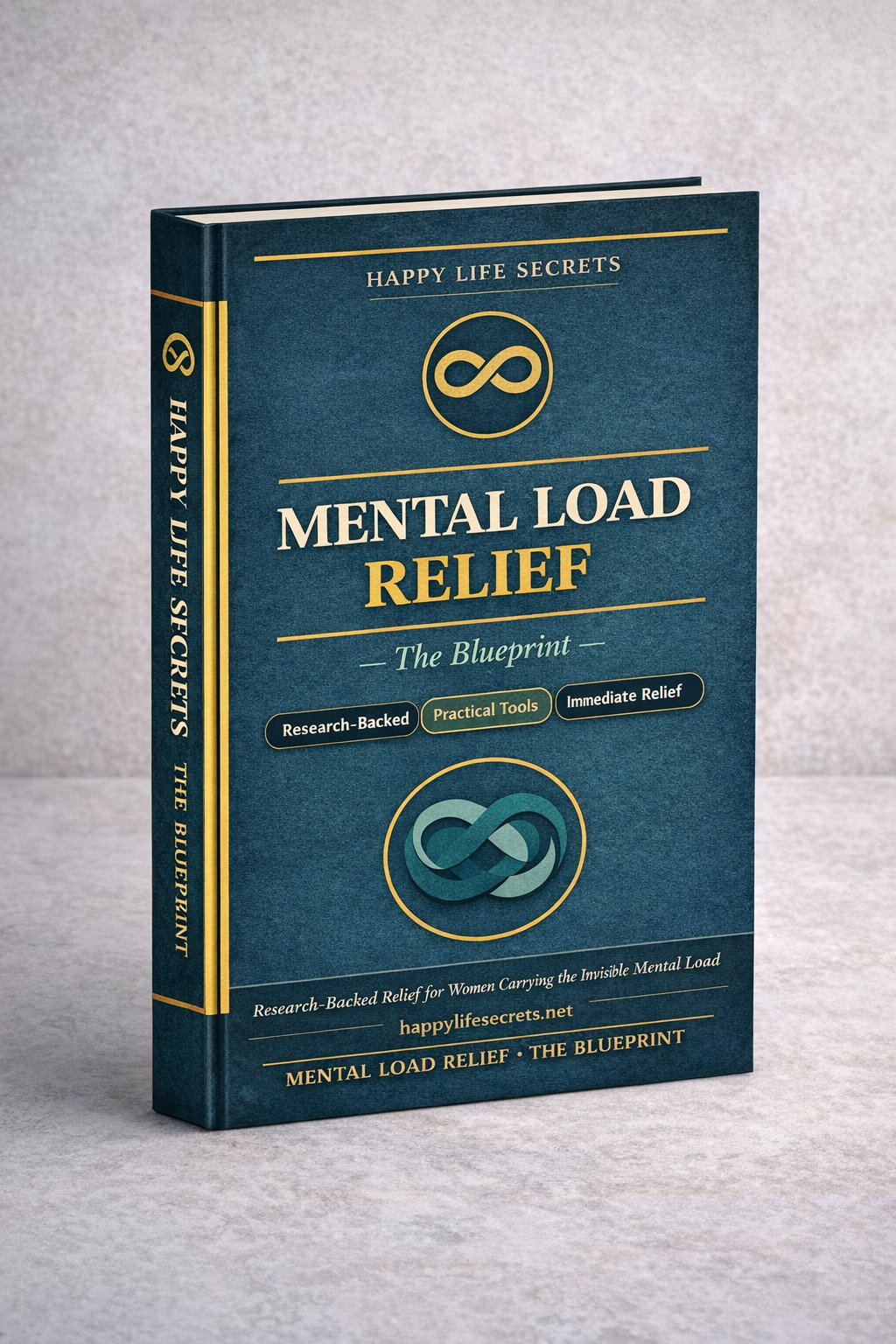
You're Not Falling Behind. You're carrying more than anyone should have to hold alone.
The Mental Load Relief Blueprint gives you a clear map of the invisible work you carry, and simple, practical ways to start setting it down, without waiting for anyone else to notice how much you're managing.
You're Not Overwhelmed Because You Can't Handle It.
You're overwhelmed because the load was never designed to be carried by one person. Here's what that invisible work looks like from the inside.
You're the Only One Who Remembers Everything
Appointments, school events, groceries, everyone's schedules. That mental tab running all day is real work, even though no one else can see it.
Making 100 Decisions While Everyone Else Just Lives
What's for dinner? Who needs what tomorrow? Did that get handled? Every small decision lands on you, and decision fatigue quietly drains your clarity and energy.
Holding Everyone's Emotional Load Too
Their worries, moods, and needs have somewhere to land, and that place is you. It's labor nobody names, and it adds up.
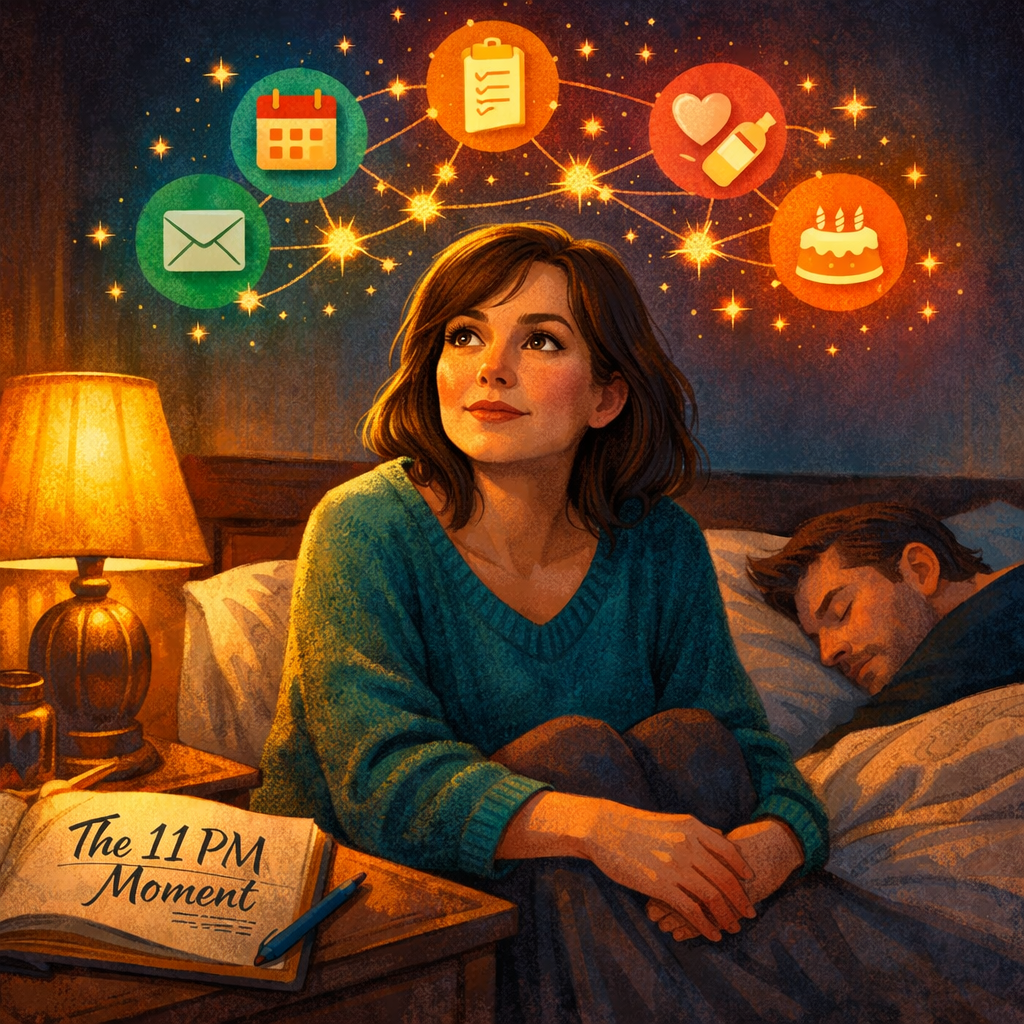
Your Brain Won't Turn Off at Night
Even when you're exhausted, tomorrow's logistics replay the moment your head hits the pillow, so you wake up tired before the day begins.
You're Everyone's Default for Everything
Every question, every problem, every decision comes to you first. You coordinate, anticipate, and solve. You're the invisible structure holding it all together.
Generic "Self-Care" Wasn't Built for Your Reality
"Take a bath." "Just say no." None of it accounts for managing a whole household's mental life. The advice failed you, not the other way around.
The problem was never your capacity. The problem was that nobody gave you a map of what you were actually carrying, or a way to set it down.
A New Framework, Not More Advice
Not another list of productivity tips that pretend your invisible work doesn't exist. Seven practical strategies built around how mental and emotional load actually work, designed for real life.
Identify Your Mental Load Types
Find out which of the 6 types of mental load you carry most heavily, so you can focus your energy where it will make the biggest difference.
The Brain Dump Method That Actually Works
Get the running list out of your head and onto paper, so your mind stops holding everything at once.
Sharing the Mental Load, Not Just Tasks
How to hand off the thinking, not just the doing, so you don't become the manager of your own delegation.
Decision Fatigue Relief
Cut out unnecessary daily decisions and put repeat choices on autopilot, so you have more clarity left for what matters.
Boundary Scripts for Real Situations
Word-for-word language for setting limits without guilt or conflict, starting with one boundary you can hold.
The Bedtime Worry Spiral Fix
The Worry Window technique gives tomorrow's to-do list a set time and place, so it stops following you to bed.
The Permission You've Been Waiting For
Relief doesn't require anyone else to notice what you've been carrying first. This guide starts there, because that's where change begins.
Simple Enough to Start Today
Why This Works When Generic Advice Didn't
The strategies that failed you before were designed for task management. This is designed for the thinking work behind the tasks.
Built for What You Actually Carry
Made for the overload that comes from invisible work, not generic stress tips that mention your situation once and then ignore it.
Fits Real Life, Not an Ideal One
Every strategy takes 5–10 minutes. Relief that only works when you have three free hours isn't relief.
Grounded in Research
Built on what researchers have learned about invisible labor, decision fatigue, and emotional load, not trends or one-size-fits-all advice.
About Happy Life Secrets
I'm Herb, founder of Happy Life Secrets. For over a decade, I've studied the psychology of mental overwhelm, decision fatigue, and cognitive load, and what creates real relief for women managing invisible work nobody else names.
The Mental Load Relief Blueprint pulls that work into one short, practical guide: a clear map of what you're carrying, and simple ways to start setting it down, without waiting for anyone else to step up first.
Download Your Free Blueprint Today
Stop carrying everyone's invisible work alone. Get the guide for easing decision fatigue, sharing the mental load, and finally feeling lighter, starting today.
Yes, Send Me the Free Blueprint → No credit card · Instant PDF · Unsubscribe anytime------------------------

-----------
 3 minutes that change how you see every relationship
-----------

-----------

-----------


HappyLifeSecrets.net
Copyright © 2010-2026
All Rights Reserved