The Hidden Cost of Being "Always Available" at Work
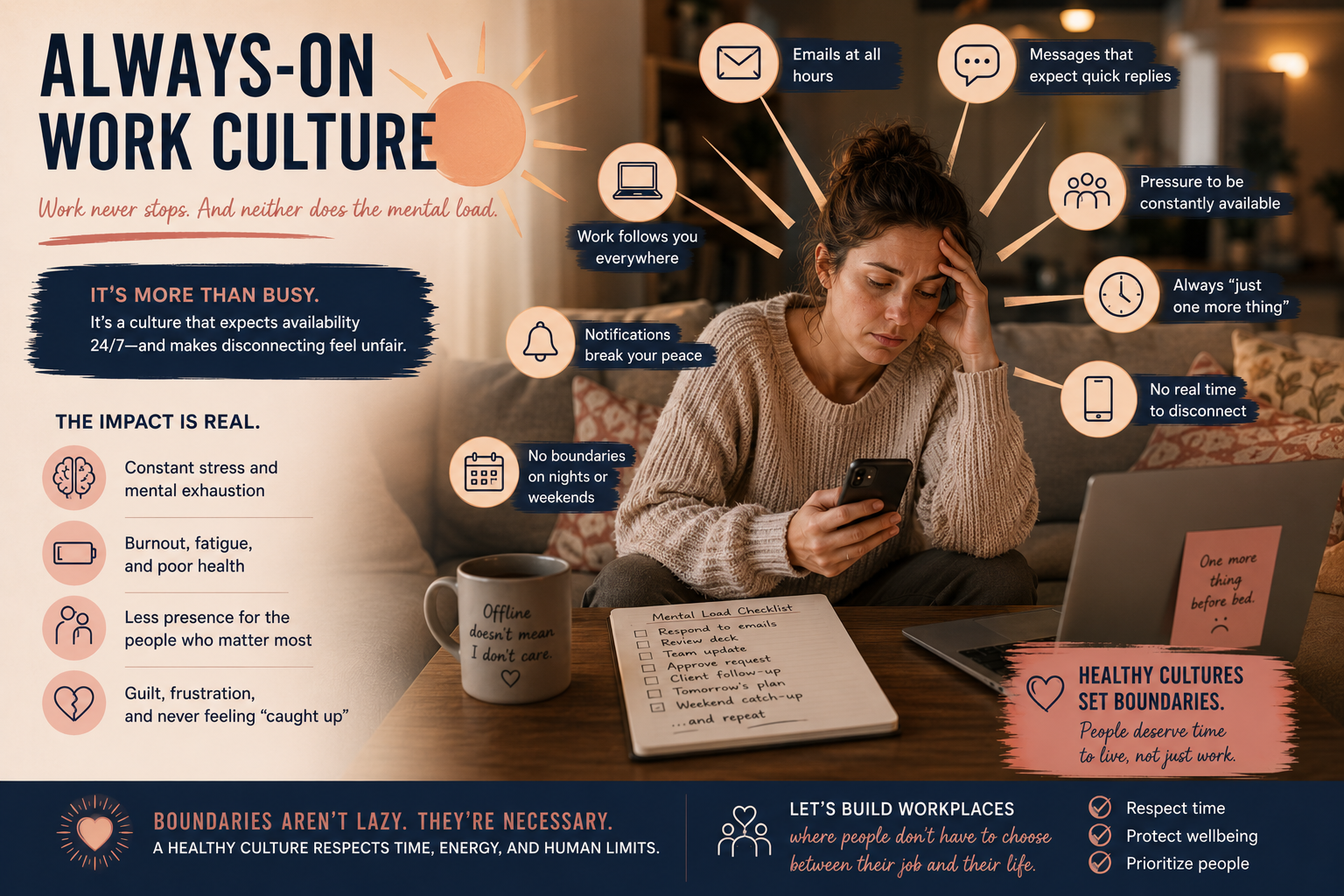
It's 9:47 p.m. Your laptop has been closed for two hours. You are, by every reasonable definition, off the clock. And yet some part of you is still there — half-listening for the notification chime, half-drafting tomorrow's response to a message that hasn't arrived yet. You didn't decide to keep working. You just never fully left. That's what always-on work culture does. It doesn't ask you to work more hours; it asks you to never completely stop, and most of us said yes without ever being asked.
If you've tried to fix this — a "no email after 6 p.m." rule, deleting Slack from your phone on weekends, a stern conversation with yourself about boundaries — and it didn't stick, here's the part that matters: that's not a discipline failure. It's not that you lack willpower or need a better app. For the first time ever, there's a body of research that explains exactly what's happening in your brain when you're expected to be reachable indefinitely, and why the usual advice ("just set boundaries") doesn't address the actual mechanism. The invisible work you're carrying isn't imaginary, and it isn't yours to white-knuckle through alone.
The Research: Why Your Brain Won't Clock Out
Always-on work culture has moved from a vague complaint to a measured, documented phenomenon, and the findings line up in a way that's genuinely validating.
Notification load has a measurable ceiling — and most workplaces are past it. A 2026 study of HR and benefits leaders found that the overwhelming majority now say information overload is actively damaging employee mental health, driven less by longer hours and more by the sheer volume and unpredictability of digital alerts — emails, chat pings, meeting reminders, AI-generated summaries — arriving faster than anyone can triage them (Wellhub's Return on Wellbeing 2026 research). Translated: it's not that you're bad at managing your inbox. The inbox has structurally outpaced what any brain is built to process, and the fatigue you feel by mid-afternoon isn't a personal failing — it's the predictable output of a system running past its design limits.
Cognitive overload behaves like a physical strain — because it is one. Researchers writing in Frontiers in Organizational Psychology this year argued that workplaces have spent decades treating physical ergonomics seriously — proper chairs, screen height, repetitive-strain prevention — while treating mental overload as a personality issue rather than a hazard of work-system design (recent peer-reviewed research on cognitive overload as an occupational hazard). This builds on decades-old foundational work: cognitive scientist John Sweller established back in 1988 that working memory is finite and measurable, not an elastic resource that expands under pressure. What this means for you: the "just push through it" instinct treats your attention like it's unlimited. It isn't, and it was never supposed to be.
Your brain doesn't distinguish "on call" from "on." Psychologist Roy Baumeister's decision fatigue research documented that every choice — trivial or significant — draws from the same limited pool of mental resources, and that pool depletes progressively across the day, not just during active work. Add to this what researchers call the Default Mode Network: the brain's resting state, which is supposed to restore you but instead activates mental replay and anticipatory planning when it's been trained to expect interruption. In plain language, the Default Mode Network — your brain's version of "downtime" — doesn't produce rest for people under high always-on pressure. It produces rehearsal. You lie down, and your mind runs the meeting again, drafts the email again, scans for what's coming tomorrow. That's not overthinking. That's a nervous system that's been taught the shift never really ends.
This is now a named, tracked workplace phenomenon — not an individual quirk. A July 2026 Harvard Business Review piece on invisible workplace labor described mental load as a hidden driver of burnout and disengagement that traditional workload tracking — hours, deadlines, output — simply doesn't measure, and noted that high performers carry the heaviest version of it because they're the ones systems quietly route the most "keeping track" toward (Harvard Business Review's reporting on invisible work and employee burnout). This is not new — the information just hasn't reached most workplaces yet. What's changed is that researchers finally have language and data for something employees have described anecdotally for years.
Where This Connects: The 6 Types of Mental Load
Always-on work culture doesn't distribute its weight evenly — it concentrates in specific kinds of invisible effort, and the HLS framework of the 6 Types of Mental Load maps directly onto what the research above describes.
Anticipating Load is the background vigilance that never fully powers down — the part of you scanning for the next ping before it arrives, bracing for the message that might need an immediate answer. This is the Default Mode Network research in action: your "rest" state has been recruited into work.
Monitoring Load shows up as the low-grade tracking of whether things are actually handled — did that thread get a reply, is that deliverable still on track — even outside working hours. This is the notification-overload research made personal: you're not just receiving alerts, you're maintaining an internal dashboard the alerts feed into.
Remembering Load is what accumulates when every deadline, promise, and half-finished thread lives in your head because always-on access means there's no clean handoff point where work stops and memory gets to rest.
Naming which load you're actually carrying is a small shift — but small shifts create real change, because you stop treating a systemic, measurable phenomenon as a private failing.
What This Means for You
None of this means always-on work culture disappears because you understand the neuroscience behind it. But relief is possible, and it starts somewhere more useful than sheer willpower: with recognizing that the exhaustion is real, measurable, and not a reflection of how well you're managing your job.
A few places to start, informed by what the research actually points to rather than generic advice:
- Externalize monitoring, don't just mentally track it. Since Monitoring Load is about holding an internal status board, moving that board somewhere external — a shared doc, a simple checklist, anything outside your head — reduces the cognitive tax even when the actual work doesn't change.
- Protect one true recovery window. Given that the Default Mode Network needs an actual absence of anticipatory triggers to produce real rest, one consistent stretch of time with notifications fully off (not just silenced) does more than scattered, half-protected boundaries.
- Notice when you're exhausted even on easy days. That's a strong signal that Anticipating Load — not your workload on paper — is the actual driver, and it's worth naming out loud rather than pushing through quietly.
- Stop measuring the problem by hours worked. The research is consistent that the damage comes from unpredictability and volume of demands, not clock time — so the fix isn't working less, it's reducing how much your brain has to stay braced.
You're not carrying this because you haven't figured out the right system yet. You're carrying it because the system itself — the one nearly every modern workplace runs on — was never designed with a stopping point. Now that there's language and research for what that costs, the invisible work you're carrying finally has a name.
That's where change actually starts.
Instant delivery • No credit card required • Unsubscribe anytime
You're Not Falling Behind. You're Carrying More Than Anyone Should Have to Hold Alone.
The Mental Load Relief Blueprint gives you the research-backed framework women 25–44 are quietly using to reclaim 2+ hours of mental space daily — without waiting for anyone else to notice how much you're managing.
Instant PDF delivery • Your privacy protected • Unsubscribe anytime
You're Not Overwhelmed Because You Can't Handle It.
You're Overwhelmed Because the Load Was Never Designed to Be Carried by One Person.
Research shows women make up to 35,000 decisions daily while managing invisible work nobody else sees — or names. Here's what that actually looks like from the inside.
You're the Only One Who Remembers Everything
Appointments, school events, grocery needs, everyone's schedules — that mental tab running 24/7 is real cognitive labor. Studies show invisible work creates 40% more mental fatigue than tasks anyone can actually see.
Making 100+ Decisions While Everyone Else Just... Lives
What's for dinner? Who needs what tomorrow? Did that get handled? You're absorbing the weight of these micro-decisions constantly — and research confirms that decision fatigue quietly steals your clarity and energy all day long.
Holding Everyone's Emotional Load Too
Their worries, moods, needs, and fears have somewhere to land — and that place is you. Data shows this emotional carrying costs women 700+ hours annually in unpaid mental labor that nobody else identifies as work.
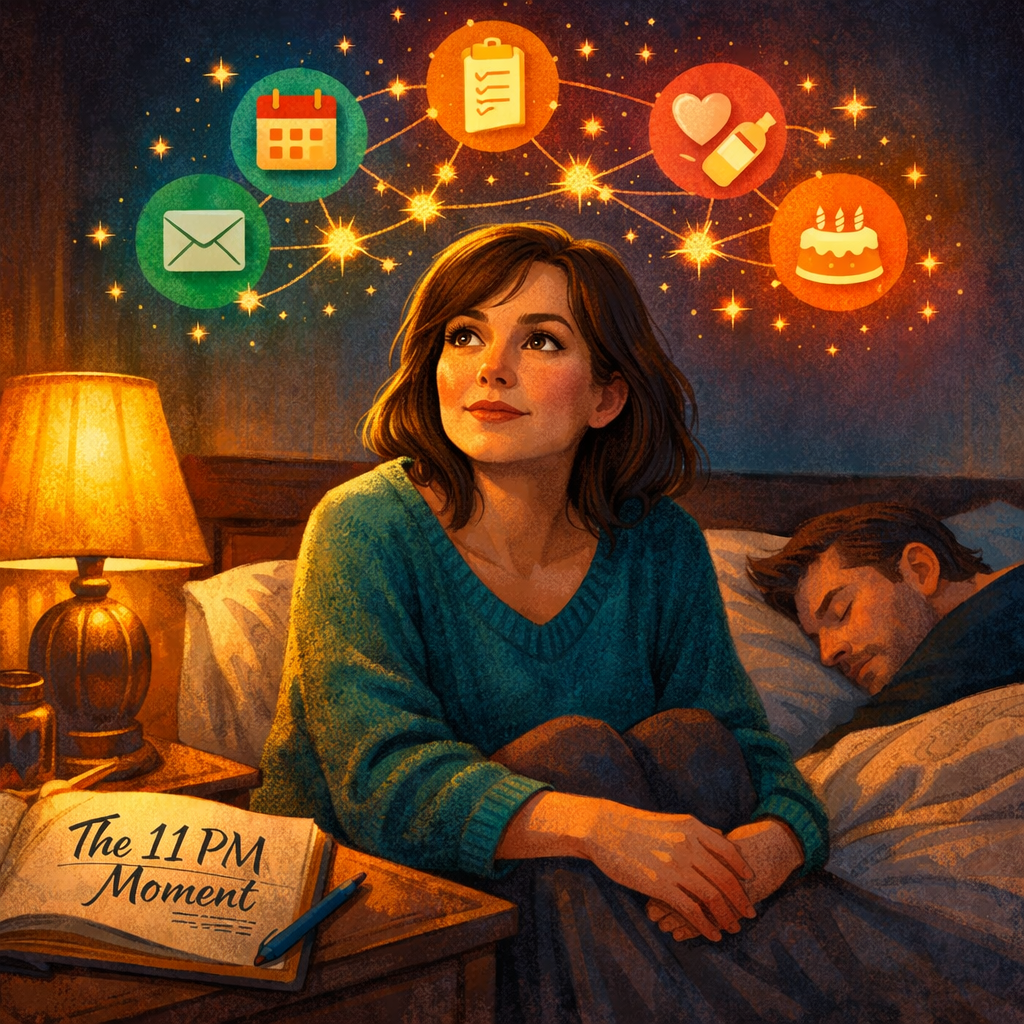
Your Brain Won't Turn Off at Night
Even when you're exhausted, tomorrow's logistics replay the moment your head hits the pillow. Research directly links mental load to disrupted sleep — which means you wake up tired before the day even begins.
You're Everyone's Default for Everything
Every question, every problem, every decision comes to you first. You coordinate, anticipate, solve — the invisible architecture holding everything together. Research identifies being the default person as a primary predictor of burnout.
Generic "Self-Care" Was Never Designed for Your Reality
"Take a bath." "Just say no." None of it accounts for the fact that you're managing an entire household's cognitive life. The advice failed you — not the other way around. You needed a different kind of tool.
The Mental Load Relief Blueprint: A New Framework, Not More Advice
This isn't another collection of productivity tips that pretend your invisible labor doesn't exist. These are evidence-based strategies built around how cognitive and emotional load actually work — practical relief designed for real life, not an idealized one.
Identify Your Mental Load Type
Discover which of the five mental load patterns applies to you. Research shows targeted, specific strategies work 3x better than generic approaches — because not all invisible labor looks the same.
The Brain Dump Method That Actually Works
Reduce your daily decision load by up to 40% using cognitive offloading techniques designed for real life. Studies confirm that externalizing mental tabs creates immediate, measurable relief.
Sharing Mental Load — Not Just Tasks
Specific strategies for redistributing invisible labor without becoming the manager of your own delegation. Evidence shows even small shifts in load distribution produce noticeable, lasting relief.
Decision Fatigue Relief Protocol
Eliminate unnecessary decision points and automate your cognitive overhead. Research confirms that removing just 20 daily micro-decisions significantly improves mental clarity and available energy.
Boundary Scripts for Real Situations
Word-for-word language for setting limits without guilt or conflict. Data shows even one consistently held boundary reduces overwhelm and interrupts the default-person pattern over time.
The Bedtime Worry Spiral Protocol
Reduce nighttime mental rumination from 45 minutes to under 5 using the Worry Window Technique. Penn State research shows this approach cuts bedtime anxiety by 35% within two weeks.
The Permission You've Been Waiting For
Relief doesn't require anyone else to notice what you've been carrying first. Research shows self-validation is the essential first step — and this guide begins there, because that's where change actually starts.
Every Strategy Is Grounded in Research on Invisible Labor
Not wellness trends. Not anecdotes. Peer-reviewed data on cognitive load, decision fatigue, and emotional labor from leading psychology and behavioral science journals.
Why The Mental Load Relief Blueprint Works When Generic Advice Didn't
The strategies that failed you before weren't designed for cognitive labor. They were designed for task management. This is something different.
Built for What You're Actually Carrying
Designed specifically for cognitive overload from invisible labor — not generic stress tips that acknowledge your situation in the intro and then ignore it for the rest of the guide.
Fits Into Real Life, Not an Ideal One
Every strategy takes 5–10 minutes. Not because the strategies are small — because your time is real. Relief that only works when you have three free hours isn't relief.
100% Evidence-Based
Grounded in peer-reviewed research on invisible labor, decision fatigue, and emotional load — not trends, personal opinions, or one-size-fits-all advice that was never built for what you carry.
About Happy Life Secrets
I'm Herb, founder of Happy Life Secrets. For over a decade, I've researched the psychology of mental overwhelm, decision fatigue, and cognitive load — specifically studying what creates real, measurable relief for women managing multiple responsibilities and invisible labor nobody else names.
The Mental Load Relief Blueprint isn't built on personal anecdotes or wellness theories. Every strategy inside is grounded in peer-reviewed research from leading psychology journals and clinical studies on invisible labor and burnout.
These are the same evidence-based tools women are using right now to finally get relief from work nobody acknowledges — and to reclaim the mental space they've always deserved, without waiting for anyone else to step up first.
Download Your Free Blueprint Today
Stop carrying everyone's invisible labor alone. Get the complete, evidence-based guide for reducing decision fatigue, sharing the mental load, and finally feeling lighter — starting today.
Completely free. No credit card required. Instant PDF download.
Yes — Send Me the Free Blueprint NowInstant delivery • Your privacy protected • Evidence-based strategies • Unsubscribe anytime
------------------------
------------------------


-----------


-----------

-----------


HappyLifeSecrets.net
Copyright © 2010-2026
All Rights Reserved