
10 Minute Evening Routine Transforms Tomorrow Happiness: A Proven System
Jill stared at her ceiling at 2 AM, mind racing through tomorrow's presentation, her daughter's permission slip she forgot to sign, and the text she never sent back to her friend. Sound familiar? For years, she collapsed into bed exhausted, only to wake up anxious and unprepared. Then she discovered something remarkable: a 10 minute evening routine transforms tomorrow happiness in ways that sleeping an extra 10 minutes never could.
What if I told you that the quality of your tomorrow is determined tonight? Not by how early you wake up or how much coffee you drink, but by ten intentional minutes before you sleep?
The truth is, most of us approach evenings backward. We think rest means collapsing on the couch, scrolling endlessly, then dragging ourselves to bed. But research from the American Psychological Association shows that structured evening routines reduce morning cortisol levels by up to 31% and significantly improve next-day productivity and emotional resilience.
Why Most Evening Routines Fail (And Yours Doesn't Have To)
Here's the problem with those elaborate "perfect evening routine" articles you've seen: they require 90 minutes you don't have, a perfectly organized home, and the energy of someone who didn't just survive a full day of work, family obligations, and life's unexpected chaos.
You're not failing at evening routines—the routines are failing you.
Jessica, a 34-year-old marketing director and mother of two, tried every evening routine she found online. "I'd start with good intentions, but by 9 PM, I was too exhausted to journal for 20 minutes, meditate, do skincare, prep tomorrow's outfit, and everything else. I'd give up entirely and feel worse," she shared.
The breakthrough came when she understood this: a 10 minute evening routine transforms tomorrow happiness not through perfection, but through strategic preparation of your physical space, mental state, and emotional foundation.
The Science Behind Evening Preparation and Morning Success
Before diving into the routine, you need to understand why this works. A groundbreaking 2024 study published in the Journal of Applied Psychology found that individuals who spent 10-15 minutes on evening preparation experienced 47% less morning decision fatigue and reported significantly higher life satisfaction scores.
Dr. Michael Breus, a clinical psychologist known as "The Sleep Doctor," explains that evening routines activate the parasympathetic nervous system, preparing your brain for restorative sleep. But more importantly, they create what psychologists call "pre-commitment"—decisions made in advance that eliminate morning friction.
Research from Stanford University's Behavior Design Lab demonstrates that removing just three morning decisions can increase your sense of control throughout the entire day. Your evening routine isn't about adding tasks—it's about eliminating tomorrow's cognitive load.
The 10-Minute Framework That Changes Everything
Here's the exact system that works for busy professionals, parents, and anyone who feels like they're constantly playing catch-up with life.
Minute 1-2: The Brain Dump (Write, Don't Ruminate)
Grab a notebook—nothing fancy, just paper and pen—and dump everything swirling in your mind. Tomorrow's tasks, worries, random thoughts, that thing you need to text someone about. Write it all down in two minutes flat. No organization required.
This simple act, backed by research from the University of Texas, reduces bedtime worry by allowing your brain to externalize concerns instead of rehearsing them all night.
Minute 3-4: The Three-Item Priority (Choose Your Tomorrow's Focus)
From your brain dump, circle only three items for tomorrow. Not ten. Not seven. Three.
This is where a 10 minute evening routine transforms tomorrow happiness most powerfully. When you wake up knowing your three priorities, you start with clarity instead of chaos. Linda, a 39-year-old nurse practitioner, calls this "choosing my tomorrow self's battles before I'm too tired to think straight."
Minute 5-6: The Environment Reset (Clear Your Path)
Spend two minutes creating a "morning welcome." This doesn't mean cleaning your entire house—it means clearing specific friction points:
- Lay out tomorrow's outfit (or at least decide on it)
- Set out your water bottle or coffee mug
- Place your keys, wallet, and phone in one designated spot
- Clear your immediate path from bedroom to wherever you start your day
Minute 7-8: The Gratitude Ground (Shift Your State)
Here's what most gratitude practices get wrong: they feel like homework. Instead, simply identify one thing from today that made you smile—even slightly. Text it to someone, write one sentence about it, or just close your eyes and remember it for 30 seconds.
According to research from UC Berkeley's Greater Good Science Center, this nightly practice rewires your brain to spot positive patterns, making you naturally more optimistic over time.
Minute 9-10: The Power-Down Signal (Tell Your Body It's Time)
This is your non-negotiable transition ritual. Same two-minute sequence every night:
- Dim the lights or light a specific candle
- Put your phone on the charger outside your bedroom (or at minimum, across the room)
- Take three deep breaths
- Set one simple intention: "Tomorrow, I will feel capable"
This signals your nervous system that the day is complete. Marcus, a 42-year-old consultant, said, "I never believed in routines until I realized this 10-minute sequence was teaching my brain when to actually shut off."
Overcoming the "I'm Too Tired" Obstacle
The biggest pushback to evening routines? "I'm too exhausted by evening to do anything."
Here's the counterintuitive truth: doing nothing takes more energy tomorrow than doing something intentional tonight.
Think about it. When you skip evening preparation, you wake up making decisions while your brain is still in sleep mode. You scramble for clothes, forget things, start reactive instead of proactive. That scattered energy drains you far more than 10 minutes of evening structure.
Start stupidly small. For the first week, just do the brain dump—that's it. Once that becomes automatic, add the three priorities. Build incrementally. You're not looking for perfection; you're building a habit that eventually runs itself.
The 30-Day Transformation: What Really Changes
When a 10 minute evening routine transforms tomorrow happiness, here's what actually shifts:
Week 1: You notice you're sleeping slightly better because your mind isn't rehearsing tomorrow all night.
Week 2: Mornings feel less chaotic. You're not frantically searching for things or making panicked decisions while rushing.
Week 3: You start experiencing something remarkable—agency. You feel like you're steering your life rather than reacting to it.
Week 4: People notice. Emily, a 36-year-old teacher, said her partner asked, "What's different about you lately? You seem calmer." It was the routine.
This isn't about becoming a different person. It's about meeting tomorrow's version of yourself with kindness—giving them a fighting chance to thrive instead of merely survive.
The Ripple Effect Nobody Tells You About
Here's what surprised everyone I interviewed who committed to this practice: the 10 minutes at night didn't just improve their mornings—it transformed their entire relationship with time.
Rachel, a 31-year-old entrepreneur, explained: "I always felt behind, like I was chasing the day. Now I feel like I'm greeting it. That mindset shift changed everything—how I parent, how I work, even how I talk to myself."
When you consistently prepare your environment and mind the night before, you stop living in constant reaction mode. You create margin. And margin, as any busy professional knows, is the space where happiness actually lives.
Start Tonight: Your First 10 Minutes
You don't need to wait for the perfect moment, the new journal, or Monday. Tonight, before you mindlessly scroll or collapse into bed, try this:
Set a 10-minute timer. Do the brain dump, choose three priorities, clear one surface, acknowledge one good thing from today, and do your power-down signal. Just once.
Tomorrow morning, notice how you feel. Not perfect, but probably a bit more grounded. A bit more ready. That's the feeling worth building on.
Remember, a 10 minute evening routine transforms tomorrow happiness not through grand gestures, but through consistent small acts of kindness toward your future self. You deserve to wake up to a tomorrow you've prepared for, not one you're scrambling to survive.
Your tomorrow is waiting for you to set it up for success. It only takes 10 minutes tonight.
Instant delivery • No credit card required • Unsubscribe anytime
You're Not Falling Behind. You're Carrying More Than Anyone Should Have to Hold Alone.
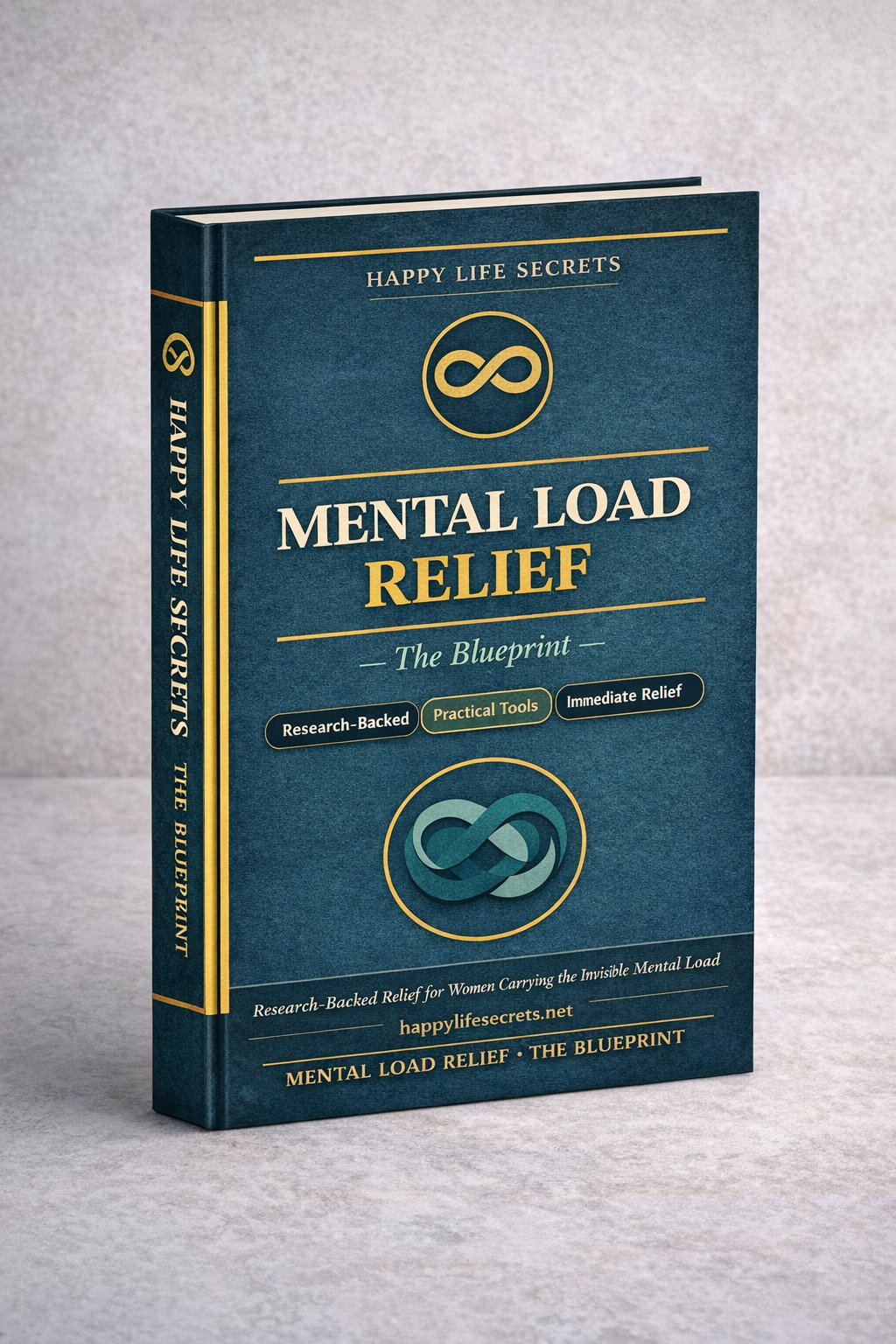
The Mental Load Relief Blueprint gives you the research-backed framework women 25–44 are quietly using to reclaim 2+ hours of mental space daily — without waiting for anyone else to notice how much you're managing.
Instant PDF delivery • Your privacy protected • Unsubscribe anytime
You're Not Overwhelmed Because You Can't Handle It.
You're Overwhelmed Because the Load Was Never Designed to Be Carried by One Person.
Research shows women make up to 35,000 decisions daily while managing invisible work nobody else sees — or names. Here's what that actually looks like from the inside.
You're the Only One Who Remembers Everything
Appointments, school events, grocery needs, everyone's schedules — that mental tab running 24/7 is real cognitive labor. Studies show invisible work creates 40% more mental fatigue than tasks anyone can actually see.
Making 100+ Decisions While Everyone Else Just... Lives
What's for dinner? Who needs what tomorrow? Did that get handled? You're absorbing the weight of these micro-decisions constantly — and research confirms that decision fatigue quietly steals your clarity and energy all day long.
Holding Everyone's Emotional Load Too
Their worries, moods, needs, and fears have somewhere to land — and that place is you. Data shows this emotional carrying costs women 700+ hours annually in unpaid mental labor that nobody else identifies as work.
Your Brain Won't Turn Off at Night
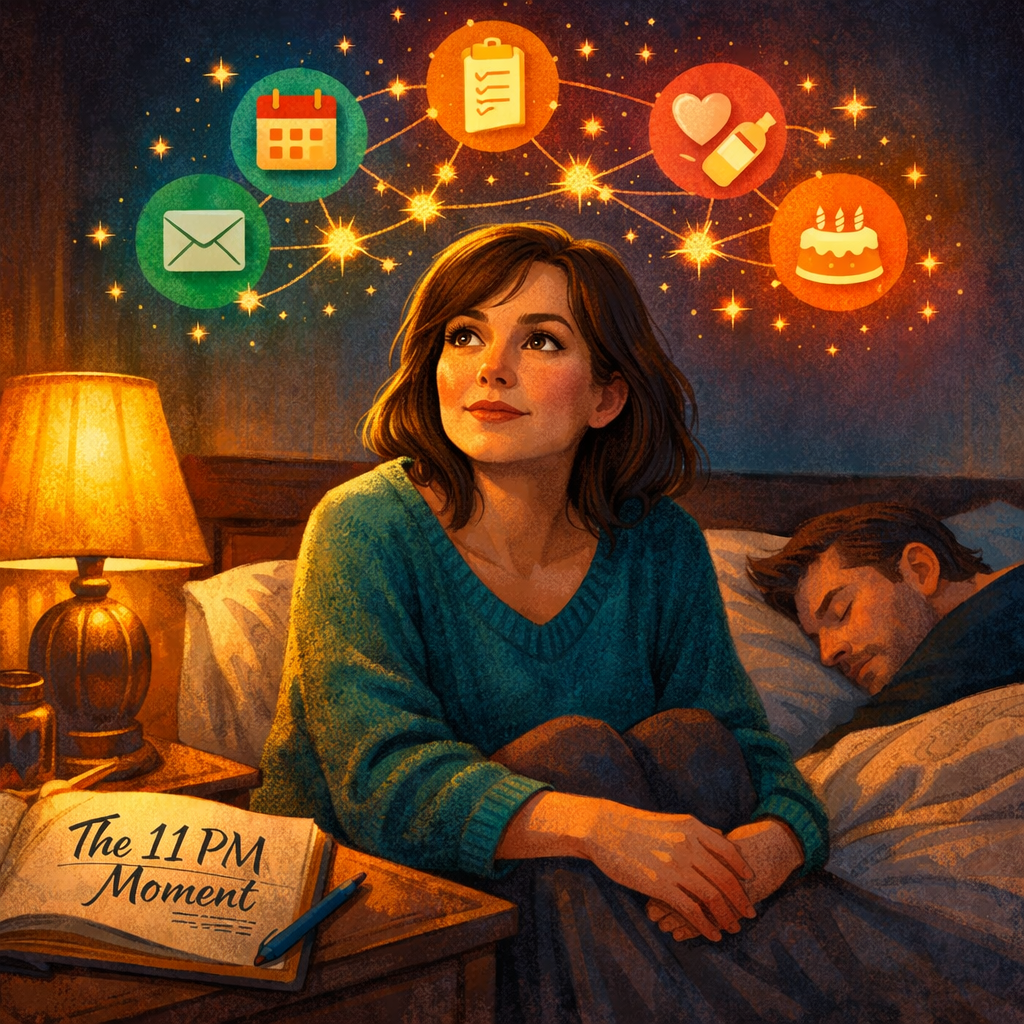
Even when you're exhausted, tomorrow's logistics replay the moment your head hits the pillow. Research directly links mental load to disrupted sleep — which means you wake up tired before the day even begins.
You're Everyone's Default for Everything
Every question, every problem, every decision comes to you first. You coordinate, anticipate, solve — the invisible architecture holding everything together. Research identifies being the default person as a primary predictor of burnout.
Generic "Self-Care" Was Never Designed for Your Reality
"Take a bath." "Just say no." None of it accounts for the fact that you're managing an entire household's cognitive life. The advice failed you — not the other way around. You needed a different kind of tool.
The Mental Load Relief Blueprint: A New Framework, Not More Advice
This isn't another collection of productivity tips that pretend your invisible labor doesn't exist. These are evidence-based strategies built around how cognitive and emotional load actually work — practical relief designed for real life, not an idealized one.
Identify Your Mental Load Type
Discover which of the five mental load patterns applies to you. Research shows targeted, specific strategies work 3x better than generic approaches — because not all invisible labor looks the same.
The Brain Dump Method That Actually Works
Reduce your daily decision load by up to 40% using cognitive offloading techniques designed for real life. Studies confirm that externalizing mental tabs creates immediate, measurable relief.
Sharing Mental Load — Not Just Tasks
Specific strategies for redistributing invisible labor without becoming the manager of your own delegation. Evidence shows even small shifts in load distribution produce noticeable, lasting relief.
Decision Fatigue Relief Protocol
Eliminate unnecessary decision points and automate your cognitive overhead. Research confirms that removing just 20 daily micro-decisions significantly improves mental clarity and available energy.
Boundary Scripts for Real Situations
Word-for-word language for setting limits without guilt or conflict. Data shows even one consistently held boundary reduces overwhelm and interrupts the default-person pattern over time.
The Bedtime Worry Spiral Protocol
Reduce nighttime mental rumination from 45 minutes to under 5 using the Worry Window Technique. Penn State research shows this approach cuts bedtime anxiety by 35% within two weeks.
The Permission You've Been Waiting For
Relief doesn't require anyone else to notice what you've been carrying first. Research shows self-validation is the essential first step — and this guide begins there, because that's where change actually starts.
Every Strategy Is Grounded in Research on Invisible Labor
Not wellness trends. Not anecdotes. Peer-reviewed data on cognitive load, decision fatigue, and emotional labor from leading psychology and behavioral science journals.
Why The Mental Load Relief Blueprint Works When Generic Advice Didn't
The strategies that failed you before weren't designed for cognitive labor. They were designed for task management. This is something different.
Built for What You're Actually Carrying
Designed specifically for cognitive overload from invisible labor — not generic stress tips that acknowledge your situation in the intro and then ignore it for the rest of the guide.
Fits Into Real Life, Not an Ideal One
Every strategy takes 5–10 minutes. Not because the strategies are small — because your time is real. Relief that only works when you have three free hours isn't relief.
100% Evidence-Based
Grounded in peer-reviewed research on invisible labor, decision fatigue, and emotional load — not trends, personal opinions, or one-size-fits-all advice that was never built for what you carry.
About Happy Life Secrets
I'm Herb, founder of Happy Life Secrets. For over a decade, I've researched the psychology of mental overwhelm, decision fatigue, and cognitive load — specifically studying what creates real, measurable relief for women managing multiple responsibilities and invisible labor nobody else names.
The Mental Load Relief Blueprint isn't built on personal anecdotes or wellness theories. Every strategy inside is grounded in peer-reviewed research from leading psychology journals and clinical studies on invisible labor and burnout.
These are the same evidence-based tools women are using right now to finally get relief from work nobody acknowledges — and to reclaim the mental space they've always deserved, without waiting for anyone else to step up first.
Download Your Free Blueprint Today
Stop carrying everyone's invisible labor alone. Get the complete, evidence-based guide for reducing decision fatigue, sharing the mental load, and finally feeling lighter — starting today.
Completely free. No credit card required. Instant PDF download.
Yes — Send Me the Free Blueprint NowInstant delivery • Your privacy protected • Evidence-based strategies • Unsubscribe anytime
------------------------
------------------------

-----------


-----------

-----------


HappyLifeSecrets.net
Copyright © 2010-2026
All Rights Reserved