
Invisible Work in Marriage: 5 Myths Keeping You From Being Truly Seen
He Doesn't See It — A Guide to Making the Invisible Work Visible
If you've ever tried to explain invisible work in marriage to your partner — and walked away feeling more frustrated than before — you are not imagining things. The conversation is genuinely hard. Not because your partner is a bad person, but because most of us are working from a set of beliefs about household labor that were never quite right to begin with.
The invisible work in marriage that women carry — the anticipating, planning, monitoring, remembering, deciding, and recovering that keeps a household functioning — is real, measurable, and exhausting. It is also surrounded by a layer of cultural myths that make it almost impossible to discuss clearly. These myths sound reasonable. They come from well-meaning people. And they are quietly keeping you stuck.
This article dismantles five of the most common ones. Not to blame anyone. Not to add more to your plate. But because when the false beliefs are out of the way, the actual conversation — and actual relief — becomes possible for the first time.
The 5 Myths About Invisible Work in Marriage (And What's Actually True)
Myth #1: "If it bothered you that much, you would have said something."
Why it sounds right: Communication is important in relationships. If a problem goes unspoken, how can a partner be expected to address it? This one feels fair on its surface.
Why it's incomplete: The invisible work in marriage doesn't go unmentioned because the person carrying it chose silence. It goes unmentioned because naming it in real time is exhausting, risks conflict, and often produces a response that feels dismissive — which teaches her, over time, that it's easier to just handle it herself. The expectation that she should speak up in every moment assumes that speaking up is low-cost. It isn't. It is, in fact, additional cognitive labor layered on top of the original labor.
THE TRUTH: She has said something — in the thousand small moments that went unrecognized. The problem isn't silence. It's that the existing system makes speaking up harder than carrying it. The six types of mental load — remembering, anticipating, planning, deciding, monitoring, and recovering — don't disappear when you ask someone to notice them. They require a structural shift, not a better conversation technique.
Myth #2: "Chores are split pretty evenly — so the load must be equal."
Why it sounds right: Fairness in a household seems like it should be measurable. You can count tasks. You can divide them. If both people are doing work, the load is shared. This logic is clean and appealing.
Why it's incomplete: The invisible work in marriage is not the tasks themselves. It is the cognitive management that surrounds the tasks — noticing that the task needs to exist, tracking it over time, deciding when and how it should happen, and monitoring whether it actually got done. When one person in a partnership does the task and the other person manages all of that surrounding cognitive labor, the labor is not equal. Even if the dishes are split fifty-fifty, the mental load is not.
THE TRUTH: Task equality and mental load equality are not the same thing. A household where chores are divided but one person still carries all the planning, monitoring, and anticipating has not solved the imbalance — it has just made it harder to see. This is why so many women in seemingly "fair" households still feel exhausted. The work they're doing isn't on any chore chart.
Myth #3: "He'd help more if you just asked."
Why it sounds right: Men often say this sincerely: "Just tell me what you need." It sounds like openness. Like willingness. Like a genuine offer.
Why it's incomplete: "Just ask" places the entire cognitive burden of delegation on the person who is already overloaded. Noticing the task, assessing its priority, formulating the request, timing the ask, and following up if it doesn't happen — all of that is mental labor. When the solution to invisible work in marriage is "ask him," the underlying system doesn't change. She is now managing herself and managing his participation. That is not relief. That is a new job title.
THE TRUTH: Asking is not the same as sharing the load. Real relief comes from shifting cognitive ownership — not just task completion. When a partner takes genuine ownership of a category, the mental load actually moves. For the first time, she is not responsible for knowing that something needs to happen. He is. That shift — from task-taker to co-owner — is what changes how exhausted she feels.
Myth #4: "You're more organized than me — that's just how you are."
Why it sounds right: People do have different organizational styles. Some people naturally track details better than others. If she seems to have a better memory for the household, maybe that's just a personality difference — not a structural problem.
Why it's incomplete: This myth turns a learned pattern of responsibility into a fixed personality trait. The invisible work in marriage isn't carried by women because they are biologically more organized. It is carried by women because, over time, households organize themselves around who picks things up when they fall. When one person consistently notices what needs doing and the other consistently doesn't, the roles calcify — and then get labeled as "personalities."
THE TRUTH: Organization isn't a trait she was born with. It's a habit she developed because the consequences of things falling through the cracks land on her. The anticipating load and monitoring load that make her seem "more organized" are responses to a system of responsibility — not proof that she's naturally suited to carry it. Small shifts create real change — and so do shifts in who holds responsibility.
Myth #5: "If you resent him, that's a relationship problem — not a mental load problem."
Why it sounds right: Resentment in a relationship is taken seriously. Therapy addresses it. Communication frameworks address it. If she's feeling resentful, the logical place to look is the relationship dynamic — not the to-do list.
Why it's incomplete: Resentment in the context of invisible work in marriage is not a relationship malfunction. It is a completely predictable response to carrying an unrecognized, unacknowledged, and structurally unequal cognitive burden over a long period of time. The recovering load — the mental and emotional work of processing everything that went wrong, went unfinished, or caused friction — is one of the six types of mental load, and it often contains the accumulated weight of every previous myth on this list. Treating resentment as a relationship problem without addressing the underlying load is like treating the smoke alarm without addressing the fire.
THE TRUTH: Resentment is information, not a character flaw. It is telling you that something real is unequal — and that the invisible work you're carrying has been invisible for too long. Relief is possible. But it starts with naming what's actually happening, not managing how you feel about it.
What Happens After the Myths Are Gone
Here is what most advice about invisible work in marriage skips: clearing the myths doesn't automatically clear the load. But it does something essential. It creates the shared language that makes the conversation possible.
When both partners understand that this isn't about who is cleaner, or more organized, or more communicative — when they both see that there is a real, six-part cognitive system being managed by one person — the conversation shifts. It stops being about blame and starts being about structure.
The six types of mental load — remembering, anticipating, planning, deciding, monitoring, and recovering — don't disappear because you talked about them. But once they're named, they can be redistributed. And that redistribution is where the exhausted even on easy days feeling finally starts to lift.
You didn't fail to manage your relationship well. You were working from a map that left out the most important roads. Now you have a better one. Small shifts create real change. And for the first time, you have the framework to know where to start.
You Deserve to Be Seen Fully — Not Just for What You Do, But for What You Carry
If any of these myths have shaped the conversations you've had — or the ones you've avoided — you're not alone. Most women carrying the invisible work in marriage have internalized at least two or three of them. That's not a failure of awareness. That's a culture that never named this accurately.
The invisible work you're carrying is real. The exhaustion is real. And the relief that comes from finally understanding what you're actually dealing with — not just managing symptoms of it — is real too.
Start with the six types of mental load. See which ones are dominating your days. And know that what you've been carrying has a name, a framework, and a path forward.
Instant delivery • No credit card required • Unsubscribe anytime
You're Not Falling Behind. You're Carrying More Than Anyone Should Have to Hold Alone.
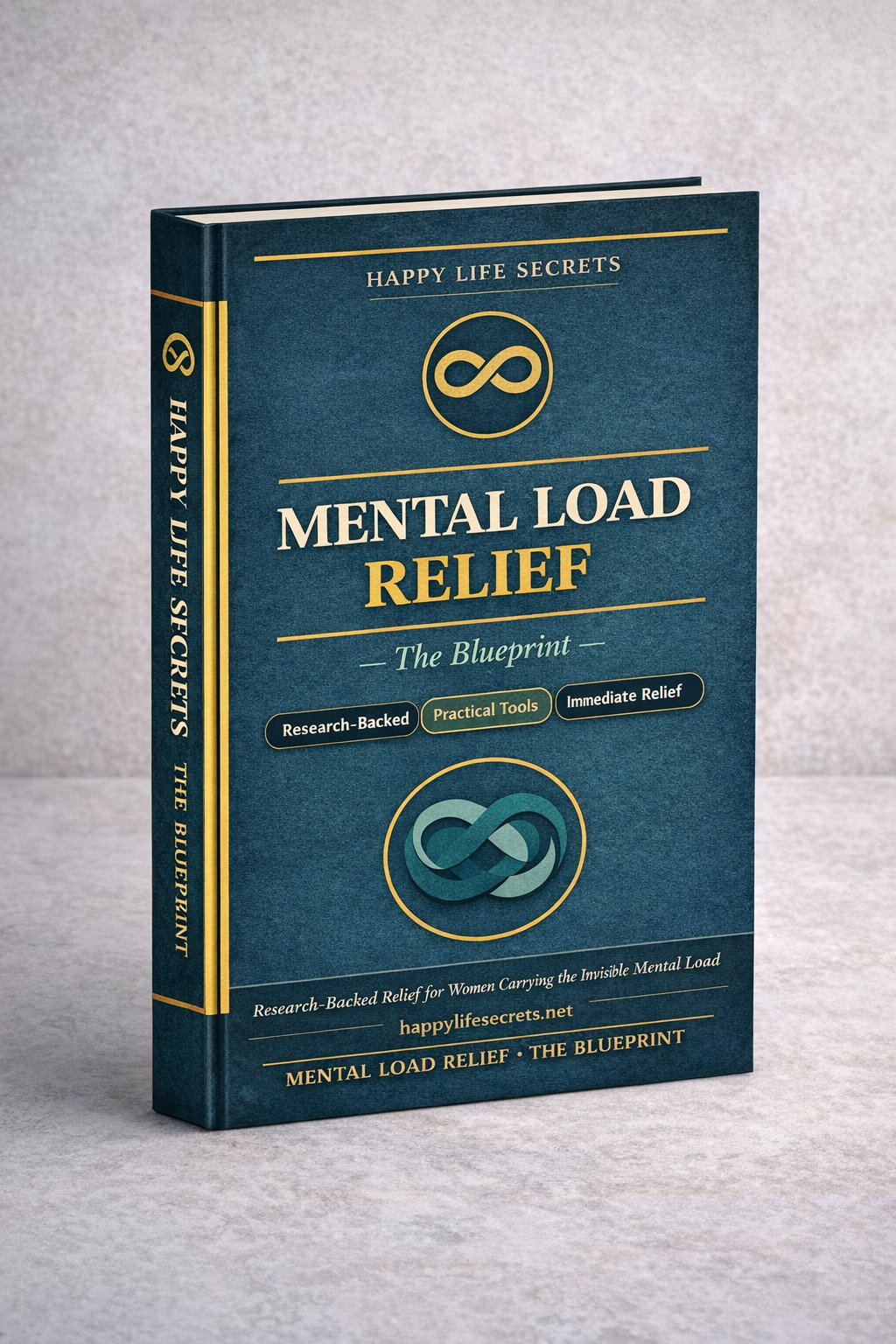
The Mental Load Relief Blueprint gives you the research-backed framework women 25–44 are quietly using to reclaim 2+ hours of mental space daily — without waiting for anyone else to notice how much you're managing.
Instant PDF delivery • Your privacy protected • Unsubscribe anytime
You're Not Overwhelmed Because You Can't Handle It.
You're Overwhelmed Because the Load Was Never Designed to Be Carried by One Person.
Research shows women make up to 35,000 decisions daily while managing invisible work nobody else sees — or names. Here's what that actually looks like from the inside.
You're the Only One Who Remembers Everything
Appointments, school events, grocery needs, everyone's schedules — that mental tab running 24/7 is real cognitive labor. Studies show invisible work creates 40% more mental fatigue than tasks anyone can actually see.
Making 100+ Decisions While Everyone Else Just... Lives
What's for dinner? Who needs what tomorrow? Did that get handled? You're absorbing the weight of these micro-decisions constantly — and research confirms that decision fatigue quietly steals your clarity and energy all day long.
Holding Everyone's Emotional Load Too
Their worries, moods, needs, and fears have somewhere to land — and that place is you. Data shows this emotional carrying costs women 700+ hours annually in unpaid mental labor that nobody else identifies as work.
Your Brain Won't Turn Off at Night
Even when you're exhausted, tomorrow's logistics replay the moment your head hits the pillow. Research directly links mental load to disrupted sleep — which means you wake up tired before the day even begins.
You're Everyone's Default for Everything
Every question, every problem, every decision comes to you first. You coordinate, anticipate, solve — the invisible architecture holding everything together. Research identifies being the default person as a primary predictor of burnout.
Generic "Self-Care" Was Never Designed for Your Reality
"Take a bath." "Just say no." None of it accounts for the fact that you're managing an entire household's cognitive life. The advice failed you — not the other way around. You needed a different kind of tool.
The Mental Load Relief Blueprint: A New Framework, Not More Advice
This isn't another collection of productivity tips that pretend your invisible labor doesn't exist. These are evidence-based strategies built around how cognitive and emotional load actually work — practical relief designed for real life, not an idealized one.
Identify Your Mental Load Type
Discover which of the five mental load patterns applies to you. Research shows targeted, specific strategies work 3x better than generic approaches — because not all invisible labor looks the same.
The Brain Dump Method That Actually Works
Reduce your daily decision load by up to 40% using cognitive offloading techniques designed for real life. Studies confirm that externalizing mental tabs creates immediate, measurable relief.
Sharing Mental Load — Not Just Tasks
Specific strategies for redistributing invisible labor without becoming the manager of your own delegation. Evidence shows even small shifts in load distribution produce noticeable, lasting relief.
Decision Fatigue Relief Protocol
Eliminate unnecessary decision points and automate your cognitive overhead. Research confirms that removing just 20 daily micro-decisions significantly improves mental clarity and available energy.
Boundary Scripts for Real Situations
Word-for-word language for setting limits without guilt or conflict. Data shows even one consistently held boundary reduces overwhelm and interrupts the default-person pattern over time.
The Bedtime Worry Spiral Protocol
Reduce nighttime mental rumination from 45 minutes to under 5 using the Worry Window Technique. Penn State research shows this approach cuts bedtime anxiety by 35% within two weeks.
The Permission You've Been Waiting For
Relief doesn't require anyone else to notice what you've been carrying first. Research shows self-validation is the essential first step — and this guide begins there, because that's where change actually starts.
Every Strategy Is Grounded in Research on Invisible Labor
Not wellness trends. Not anecdotes. Peer-reviewed data on cognitive load, decision fatigue, and emotional labor from leading psychology and behavioral science journals.
Why The Mental Load Relief Blueprint Works When Generic Advice Didn't
The strategies that failed you before weren't designed for cognitive labor. They were designed for task management. This is something different.
Built for What You're Actually Carrying
Designed specifically for cognitive overload from invisible labor — not generic stress tips that acknowledge your situation in the intro and then ignore it for the rest of the guide.
Fits Into Real Life, Not an Ideal One
Every strategy takes 5–10 minutes. Not because the strategies are small — because your time is real. Relief that only works when you have three free hours isn't relief.
100% Evidence-Based
Grounded in peer-reviewed research on invisible labor, decision fatigue, and emotional load — not trends, personal opinions, or one-size-fits-all advice that was never built for what you carry.
About Happy Life Secrets
I'm Herb, founder of Happy Life Secrets. For over a decade, I've researched the psychology of mental overwhelm, decision fatigue, and cognitive load — specifically studying what creates real, measurable relief for women managing multiple responsibilities and invisible labor nobody else names.
The Mental Load Relief Blueprint isn't built on personal anecdotes or wellness theories. Every strategy inside is grounded in peer-reviewed research from leading psychology journals and clinical studies on invisible labor and burnout.
These are the same evidence-based tools women are using right now to finally get relief from work nobody acknowledges — and to reclaim the mental space they've always deserved, without waiting for anyone else to step up first.
Download Your Free Blueprint Today
Stop carrying everyone's invisible labor alone. Get the complete, evidence-based guide for reducing decision fatigue, sharing the mental load, and finally feeling lighter — starting today.
Completely free. No credit card required. Instant PDF download.
Yes — Send Me the Free Blueprint NowInstant delivery • Your privacy protected • Evidence-based strategies • Unsubscribe anytime
------------------------
------------------------



-----------


-----------

-----------


HappyLifeSecrets.net
Copyright © 2010-2026
All Rights Reserved