
Decision Fatigue at Work Is Real — Here's Why It's Hitting Women Harder
It's 2:17 in the afternoon. You haven't taken a real break. Your coffee went cold an hour ago. And yet — somehow — the hardest thing you'll do all day is decide what to order for lunch.
Sound familiar? That foggy, slow-moving feeling that sets in sometime after noon — where even low-stakes decisions feel like you're pushing through wet concrete — has a name. It's called decision fatigue at work, and the research on it is a lot more validating than you might expect.
Here's the thing no one has told you yet: decision fatigue at work doesn't hit everyone the same way. The science shows it accumulates faster, runs deeper, and lingers longer for women — especially women who are managing professional responsibilities on top of an invisible second shift of mental labor most of their colleagues never even see.
This isn't about your capacity. It's not about being "too sensitive" or "not cut out for it." There is documented, peer-reviewed research that explains exactly what's happening inside your brain by midday — and why the standard advice about productivity and focus keeps missing the point entirely.
"Exhausted even on easy days? That's not weakness. That's what decision fatigue at work looks like when the invisible work you're carrying never gets counted."
SECTION 2 — The Research
Your Brain Has a Daily Decision Budget — and It's Already Being Spent
In the late 1990s, psychologist Roy Baumeister began documenting something that has since reshaped how we understand cognitive performance: decision-making is a finite resource. Every choice you make — from what to wear in the morning to how to respond to a colleague's email — draws from the same mental reservoir. The more decisions you make, the more depleted that reservoir becomes. This is decision fatigue.
Baumeister's research found that as decision fatigue sets in, people don't just make worse decisions — they begin avoiding decisions altogether, defaulting to whatever requires the least effort. Sound familiar? That 3pm feeling of "I just can't deal with this right now" isn't laziness. It's your brain's self-protection mechanism kicking in after too many draws on a finite well.
What the research didn't fully account for, at first, was where the withdrawals were coming from before the workday even begins.
The Problem Starts Before You Even Open Your Laptop
In 2019, sociologist Allison Daminger published a landmark study in the American Sociological Review that changed how researchers understand household cognitive labor. Daminger wasn't measuring who did the dishes or who handled drop-off — she was measuring the mental management layer: the anticipating, identifying, deciding, and monitoring that precedes and follows every household task.
Her finding was striking: cognitive labor in households is far more unequally distributed than task labor itself. Even in households where physical tasks were split relatively fairly, the mental management layer concentrated overwhelmingly in one person — and that person was almost always the woman.
What this means for decision fatigue at work is direct and measurable: by the time many women sit down at their desk, they've already made dozens of invisible decisions. Who needs what before school. What's for dinner. Whether someone needs a doctor's appointment. What's running low. What needs to be remembered before Friday.
The cognitive budget has already been drawn from. Decision fatigue at work, for women, frequently starts at home.
What this means for you: the reason you feel depleted by noon — even on days that seem manageable — is that your mental bandwidth was never starting at full. The invisible work you're carrying before 9am is real. The research has finally caught up to what you already knew.
Working Memory Is Finite — and Full
Cognitive scientist John Sweller's foundational research on Cognitive Load Theory established a deceptively simple truth: working memory is measurably limited. When it's overloaded — when there are too many open loops, too many things being tracked simultaneously — performance degrades, creativity flatlines, and even simple tasks become harder than they should be.
For women navigating decision fatigue at work, this isn't abstract theory. It's the experience of trying to focus on a complex project while simultaneously holding a background mental tab open for twelve other things that need attention. Sweller's work helps explain why "just focus" advice consistently fails: focus isn't a mindset. It's a resource. And that resource has a ceiling.
Rest Doesn't Reset the Way You'd Think
One of the more surprising findings to emerge from Default Mode Network research is what actually happens in the brain when you're "resting." The Default Mode Network — the brain's resting state — doesn't produce quiet and recovery for women carrying high cognitive load. Instead, it produces mental replay and anticipatory planning. Rehearsing conversations. Pre-solving tomorrow's logistics. Running through what still needs to happen.
This is why a weekend doesn't always feel restful. Why you wake up already tired. Why taking a break at work doesn't always mean your brain actually takes a break. The cognitive engine doesn't idle for people carrying sustained mental load — it redirects.
Decision fatigue at work, when combined with this kind of non-restorative rest pattern, compounds in ways that standard productivity advice simply isn't built to address.
SECTION 3 — The Framework Connection
Why Decision Fatigue at Work Is Finally Explainable — and What to Do About It
Here's what all of this research points toward: decision fatigue at work isn't a performance problem. It isn't a time management problem. It's a cognitive load distribution problem — and it can't be solved at the surface level, because the source isn't at the surface.
The 6 Types of Mental Load framework was built to make this invisible layer visible for the first time. Not because the load is new — Christine Frederick was documenting the cognitive demands of household management as far back as 1915 — but because the information and language to name it, measure it, and actually address it hasn't been widely available. Until now.
The six types of mental load include the Deciding Load that Baumeister's research directly maps to — the constant stream of decisions large and small that deplete cognitive resources through the day. But Deciding Load is only one layer. The full framework accounts for:
- Anticipating Load — the mental energy spent thinking ahead, planning for contingencies, and tracking what's coming before it arrives
- Monitoring Load — the ongoing background attention required to make sure things are staying on track
- Remembering Load — the active work of keeping important information in mind and ensuring nothing falls through the cracks
- Emotional Load — the labor of managing others' feelings, smoothing tensions, and maintaining relational harmony
- Deciding Load — the accumulated cost of constant decision-making across both professional and personal domains
Daminger's research validates the cognitive layer. Sweller's work validates the bandwidth constraint. Baumeister's findings validate the depletion mechanism. The 6 Types framework gives you the map to see where your load is concentrated — so you can actually begin to address it at the source.
For the first time ever, women experiencing decision fatigue at work have a structured way to understand not just that they're depleted, but which type of cognitive labor is doing the most damage — and what small shifts might actually move the needle.
Small shifts create real change — not because they fix everything at once, but because they start where the actual problem lives.
SECTION 4 — What This Means for You
Decision Fatigue at Work Is Real — and Relief Is Possible
If you've tried every productivity system, every morning routine, every "prioritize your tasks" framework — and still found yourself hitting the wall by early afternoon — this is your explanation. Not a character flaw. Not a lack of discipline. A documented cognitive pattern that was never designed with your full load in mind.
Here's what the science is telling you, in plain language:
- Your brain's decision-making capacity is finite and measurable
- Decision fatigue at work accumulates faster when it starts with home-based cognitive labor already drawn from
- Rest doesn't always reset cognitive load — especially when the Default Mode Network is engaged in mental replay
- Standard productivity advice fails because it addresses output, not the cognitive distribution underneath
What actually helps is making the invisible work visible — naming the types of mental load you're carrying, understanding which ones are heaviest, and creating conditions where that load can be more fairly distributed or more strategically managed.
That's exactly what the 6 Types of Mental Load framework is designed to do. It's not another productivity system layered on top of your existing life. It's access to a way of seeing what was always there — the invisible work you're carrying — so it can finally be part of the conversation.
For the first time ever, decision fatigue at work can be traced back to its actual source. And when you can see the source, you can start to address it. Relief is possible. Not by working harder — but by finally working with an accurate picture of what's actually happening.
You already knew something was wrong with the standard advice. The research just caught up to what your body has been telling you for years.
READY TO SEE YOUR MENTAL LOAD CLEARLY?
The Mental Load Reset shows you exactly which of the 6 types is hitting hardest — and gives you practical tools to shift it. For the first time ever, the invisible work you're carrying gets a name, a structure, and a path forward.
→ Start the Mental Load Reset
Instant delivery • No credit card required • Unsubscribe anytime
You're Not Falling Behind. You're Carrying More Than Anyone Should Have to Hold Alone.
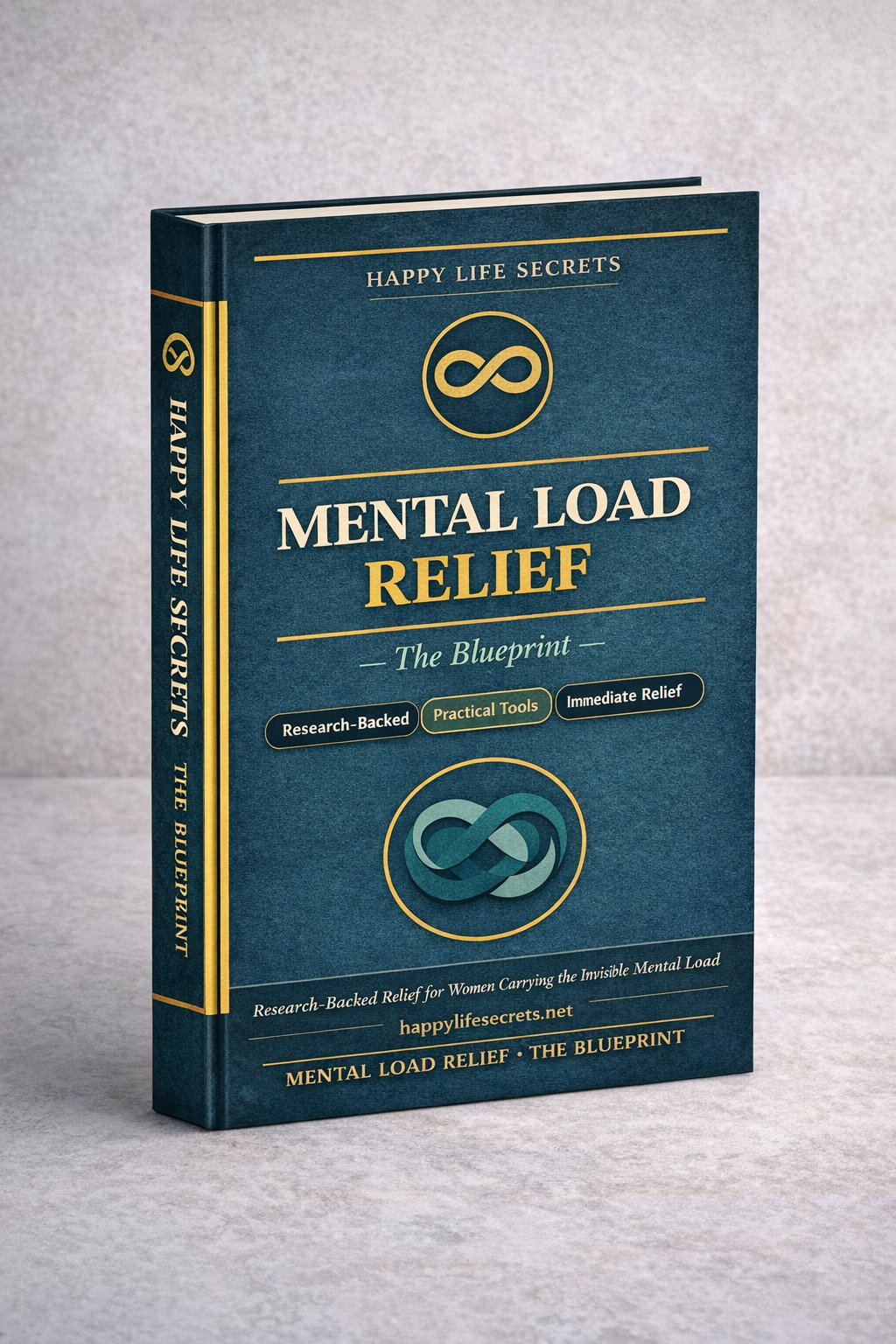
The Mental Load Relief Blueprint gives you the research-backed framework women 25–44 are quietly using to reclaim 2+ hours of mental space daily — without waiting for anyone else to notice how much you're managing.
Instant PDF delivery • Your privacy protected • Unsubscribe anytime
You're Not Overwhelmed Because You Can't Handle It.
You're Overwhelmed Because the Load Was Never Designed to Be Carried by One Person.
Research shows women make up to 35,000 decisions daily while managing invisible work nobody else sees — or names. Here's what that actually looks like from the inside.
You're the Only One Who Remembers Everything
Appointments, school events, grocery needs, everyone's schedules — that mental tab running 24/7 is real cognitive labor. Studies show invisible work creates 40% more mental fatigue than tasks anyone can actually see.
Making 100+ Decisions While Everyone Else Just... Lives
What's for dinner? Who needs what tomorrow? Did that get handled? You're absorbing the weight of these micro-decisions constantly — and research confirms that decision fatigue quietly steals your clarity and energy all day long.
Holding Everyone's Emotional Load Too
Their worries, moods, needs, and fears have somewhere to land — and that place is you. Data shows this emotional carrying costs women 700+ hours annually in unpaid mental labor that nobody else identifies as work.
Your Brain Won't Turn Off at Night
Even when you're exhausted, tomorrow's logistics replay the moment your head hits the pillow. Research directly links mental load to disrupted sleep — which means you wake up tired before the day even begins.
You're Everyone's Default for Everything
Every question, every problem, every decision comes to you first. You coordinate, anticipate, solve — the invisible architecture holding everything together. Research identifies being the default person as a primary predictor of burnout.
Generic "Self-Care" Was Never Designed for Your Reality
"Take a bath." "Just say no." None of it accounts for the fact that you're managing an entire household's cognitive life. The advice failed you — not the other way around. You needed a different kind of tool.
The Mental Load Relief Blueprint: A New Framework, Not More Advice
This isn't another collection of productivity tips that pretend your invisible labor doesn't exist. These are evidence-based strategies built around how cognitive and emotional load actually work — practical relief designed for real life, not an idealized one.
Identify Your Mental Load Type
Discover which of the five mental load patterns applies to you. Research shows targeted, specific strategies work 3x better than generic approaches — because not all invisible labor looks the same.
The Brain Dump Method That Actually Works
Reduce your daily decision load by up to 40% using cognitive offloading techniques designed for real life. Studies confirm that externalizing mental tabs creates immediate, measurable relief.
Sharing Mental Load — Not Just Tasks
Specific strategies for redistributing invisible labor without becoming the manager of your own delegation. Evidence shows even small shifts in load distribution produce noticeable, lasting relief.
Decision Fatigue Relief Protocol
Eliminate unnecessary decision points and automate your cognitive overhead. Research confirms that removing just 20 daily micro-decisions significantly improves mental clarity and available energy.
Boundary Scripts for Real Situations
Word-for-word language for setting limits without guilt or conflict. Data shows even one consistently held boundary reduces overwhelm and interrupts the default-person pattern over time.
The Bedtime Worry Spiral Protocol
Reduce nighttime mental rumination from 45 minutes to under 5 using the Worry Window Technique. Penn State research shows this approach cuts bedtime anxiety by 35% within two weeks.
The Permission You've Been Waiting For
Relief doesn't require anyone else to notice what you've been carrying first. Research shows self-validation is the essential first step — and this guide begins there, because that's where change actually starts.
Every Strategy Is Grounded in Research on Invisible Labor
Not wellness trends. Not anecdotes. Peer-reviewed data on cognitive load, decision fatigue, and emotional labor from leading psychology and behavioral science journals.
Why The Mental Load Relief Blueprint Works When Generic Advice Didn't
The strategies that failed you before weren't designed for cognitive labor. They were designed for task management. This is something different.
Built for What You're Actually Carrying
Designed specifically for cognitive overload from invisible labor — not generic stress tips that acknowledge your situation in the intro and then ignore it for the rest of the guide.
Fits Into Real Life, Not an Ideal One
Every strategy takes 5–10 minutes. Not because the strategies are small — because your time is real. Relief that only works when you have three free hours isn't relief.
100% Evidence-Based
Grounded in peer-reviewed research on invisible labor, decision fatigue, and emotional load — not trends, personal opinions, or one-size-fits-all advice that was never built for what you carry.
About Happy Life Secrets
I'm Herb, founder of Happy Life Secrets. For over a decade, I've researched the psychology of mental overwhelm, decision fatigue, and cognitive load — specifically studying what creates real, measurable relief for women managing multiple responsibilities and invisible labor nobody else names.
The Mental Load Relief Blueprint isn't built on personal anecdotes or wellness theories. Every strategy inside is grounded in peer-reviewed research from leading psychology journals and clinical studies on invisible labor and burnout.
These are the same evidence-based tools women are using right now to finally get relief from work nobody acknowledges — and to reclaim the mental space they've always deserved, without waiting for anyone else to step up first.
Download Your Free Blueprint Today
Stop carrying everyone's invisible labor alone. Get the complete, evidence-based guide for reducing decision fatigue, sharing the mental load, and finally feeling lighter — starting today.
Completely free. No credit card required. Instant PDF download.
Yes — Send Me the Free Blueprint NowInstant delivery • Your privacy protected • Evidence-based strategies • Unsubscribe anytime
------------------------
------------------------



-----------


-----------

-----------


HappyLifeSecrets.net
Copyright © 2010-2026
All Rights Reserved