
Cognitive Load Reduction: Why It's the Only Thing That Actually Works
STAGE 1 — THE PROBLEM (25%)
You Did Everything Right. So Why Are You Still So Tired?
You woke up. Got through the day. Nothing went catastrophically wrong. And yet — by 3pm, you feel like you've run a marathon no one else can see.
You're not behind on anything obvious. The house is holding together. Work is managed. The kids are fed. On paper, everything is fine. But you are exhausted even on easy days, and you can't quite explain it to anyone, because there's nothing specific to point to.
That's not burnout in the traditional sense. It's not stress from one big thing. It's something quieter and more relentless — and it has a name. What you're experiencing is what happens when cognitive load reduction is completely absent from your daily life. When nothing is ever truly set down, handed off, or resolved. When every single thing you manage stays right there, in your head, all the time.
This isn't your fault. And it's not because you're doing it wrong.
STAGE 2 — AGITATION (40%)
The Invisible Weight That Never Gets Put Down
Here's what almost no one explains: cognitive load isn't one thing. It's not just the to-do list in your head. It's an entire category of invisible mental work that runs continuously in the background — and without cognitive load reduction built into your life, it never stops.
There are six distinct types of this invisible work. And the reason you're exhausted is that you're carrying all six, all the time, without a single system designed to help you set any of them down.
1. Remembering
This is the mental archive you maintain alone. Dentist appointments. Which child hates which food this week. When the registration is due. The name of the teacher who needs the permission slip. You are the household memory — and there's no off switch.
2. Anticipating
Before anything happens, you've already run through it. What will go wrong at the birthday party. Who will forget their jacket. Whether there's enough in the account to cover the bill that hits Friday. You're living three steps ahead of everyone else in your home, every single day.
3. Planning
The meals for the week. The logistics of two kids in two directions on the same afternoon. The birthday gift that needs to arrive by Thursday. Someone has to hold all of this architecture in their head — and in most households, that someone is you.
4. Deciding
What to do when the plan falls apart. Which pediatrician to call. Whether to say yes or no to the birthday sleepover. These aren't big decisions, but they are constant — and each one costs cognitive energy that never fully gets replenished.
5. Monitoring
Is the homework done? Has she been quieter than usual this week? Is that friendship going well or not? You track the emotional weather of your entire household. You notice what everyone else misses, because you've made noticing your full-time, unpaid second job.
6. Recovering
When something goes wrong — and something always does — you are the one who figures out how to absorb it, adapt, and still get everyone to where they need to be. The mental labor of recovery is invisible to the people around you. But it costs more than almost anything else on this list.
This is the 3am spiral made visible. You lie awake not because you're anxious, but because six categories of unfinished cognitive work are still processing in the background. Your brain never got the signal that it was safe to stop.
And here is the part that matters most: no productivity system you've ever tried was built for this.
Planners, apps, morning routines, time blocking — these tools assume you have a list of tasks to check off. They were never designed for the invisible, recursive, relational work that makes up the majority of your actual mental load. That's not a failure of your discipline. That's a gap in the available information — until now.
STAGE 3 — SOLUTION (35%)
Cognitive Load Reduction Is Not About Working Harder — It's About Working With Information You've Never Had
Every productivity system you tried failed because no one told you about the 6 types of invisible work. You didn't fail the systems. The systems failed you.
Real cognitive load reduction doesn't start with a new app or a better morning routine. It starts with understanding what you're actually carrying — all six types — and then having a framework specifically built to address each one.
For the first time ever, there's a system designed not for the visible work on your list, but for the invisible work in your head. The Happy Life Secrets framework identifies all six types of mental load and gives you a concrete, repeatable process for reducing each one — not by doing more, but by building structures that hold the weight so you don't have to.
What Cognitive Load Reduction Actually Looks Like
It looks like waking up on a Saturday morning and realizing — for the first time in years — that you don't have a running tally of everything that needs to happen today.
It looks like a household that functions without you being the single point of memory, planning, decision-making, monitoring, anticipation, and recovery.
It looks like sitting down in the evening and actually resting, because the mental architecture of your week isn't stored exclusively in your head anymore.
This is what becomes possible when cognitive load reduction moves from a concept to a daily practice — when you have a framework that was actually designed for the life you're living.
Where to Start
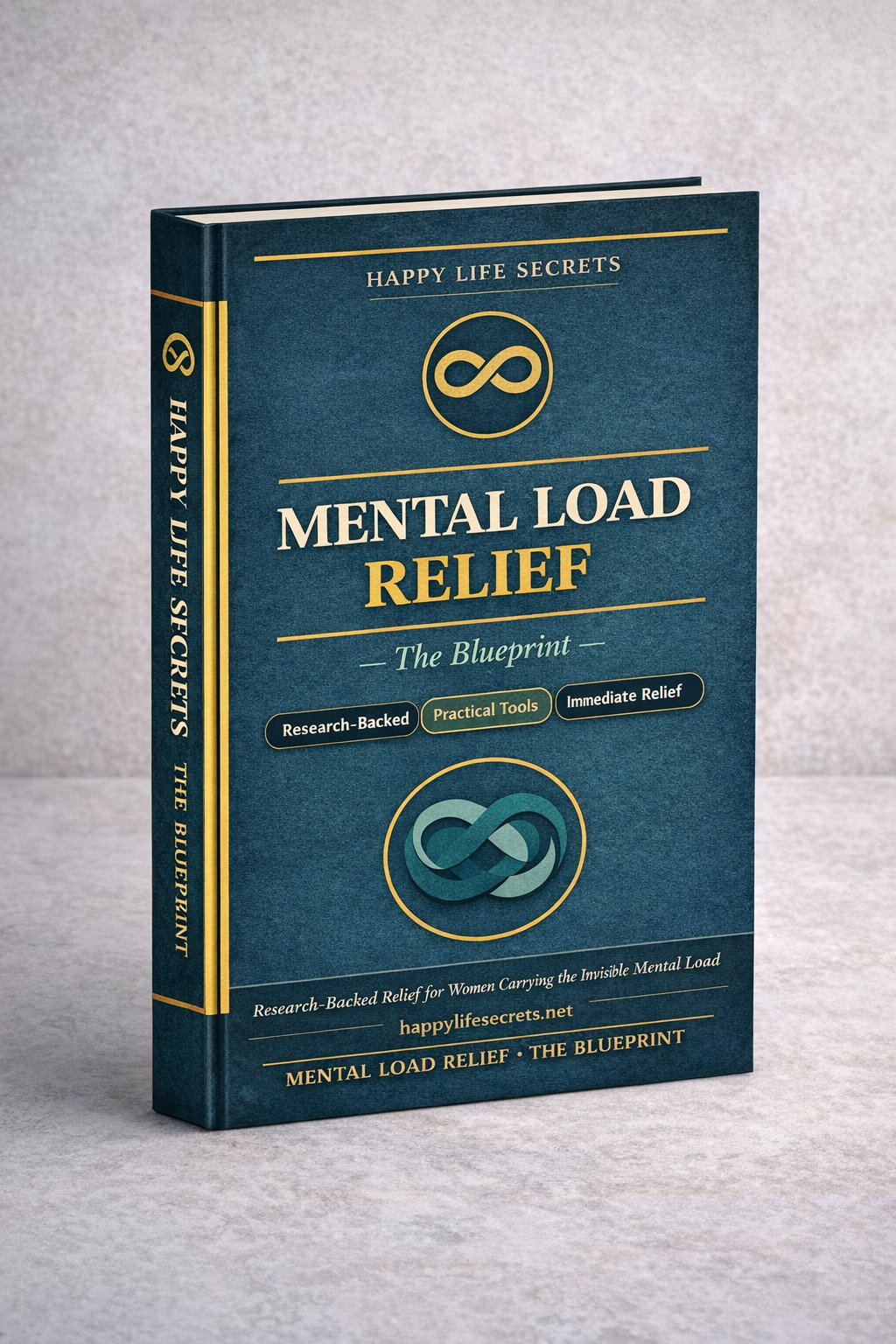
The Mental Load Relief Blueprint walks you through each of the 6 types with specific tools for reducing the invisible weight each one creates. It's not a course. It's not a challenge. It's a structured guide designed to give you real relief — starting with the type of mental load that's costing you the most right now.
You've been carrying this alone for a long time. Not because you were supposed to. Not because you're particularly good at it. But because no one ever handed you anything else.
Relief is possible. Small shifts create real change. And now, for the first time, you have access to a framework that was built for the full picture of what you carry — not just the tasks anyone can see.
Instant delivery • No credit card required • Unsubscribe anytime
You're Not Falling Behind. You're Carrying More Than Anyone Should Have to Hold Alone.
The Mental Load Relief Blueprint gives you the research-backed framework women 25–44 are quietly using to reclaim 2+ hours of mental space daily — without waiting for anyone else to notice how much you're managing.
Instant PDF delivery • Your privacy protected • Unsubscribe anytime
You're Not Overwhelmed Because You Can't Handle It.
You're Overwhelmed Because the Load Was Never Designed to Be Carried by One Person.
Research shows women make up to 35,000 decisions daily while managing invisible work nobody else sees — or names. Here's what that actually looks like from the inside.
You're the Only One Who Remembers Everything
Appointments, school events, grocery needs, everyone's schedules — that mental tab running 24/7 is real cognitive labor. Studies show invisible work creates 40% more mental fatigue than tasks anyone can actually see.
Making 100+ Decisions While Everyone Else Just... Lives
What's for dinner? Who needs what tomorrow? Did that get handled? You're absorbing the weight of these micro-decisions constantly — and research confirms that decision fatigue quietly steals your clarity and energy all day long.
Holding Everyone's Emotional Load Too
Their worries, moods, needs, and fears have somewhere to land — and that place is you. Data shows this emotional carrying costs women 700+ hours annually in unpaid mental labor that nobody else identifies as work.
Your Brain Won't Turn Off at Night
Even when you're exhausted, tomorrow's logistics replay the moment your head hits the pillow. Research directly links mental load to disrupted sleep — which means you wake up tired before the day even begins.
You're Everyone's Default for Everything
Every question, every problem, every decision comes to you first. You coordinate, anticipate, solve — the invisible architecture holding everything together. Research identifies being the default person as a primary predictor of burnout.
Generic "Self-Care" Was Never Designed for Your Reality
"Take a bath." "Just say no." None of it accounts for the fact that you're managing an entire household's cognitive life. The advice failed you — not the other way around. You needed a different kind of tool.
The Mental Load Relief Blueprint: A New Framework, Not More Advice
This isn't another collection of productivity tips that pretend your invisible labor doesn't exist. These are evidence-based strategies built around how cognitive and emotional load actually work — practical relief designed for real life, not an idealized one.
Identify Your Mental Load Type
Discover which of the five mental load patterns applies to you. Research shows targeted, specific strategies work 3x better than generic approaches — because not all invisible labor looks the same.
The Brain Dump Method That Actually Works
Reduce your daily decision load by up to 40% using cognitive offloading techniques designed for real life. Studies confirm that externalizing mental tabs creates immediate, measurable relief.
Sharing Mental Load — Not Just Tasks
Specific strategies for redistributing invisible labor without becoming the manager of your own delegation. Evidence shows even small shifts in load distribution produce noticeable, lasting relief.
Decision Fatigue Relief Protocol
Eliminate unnecessary decision points and automate your cognitive overhead. Research confirms that removing just 20 daily micro-decisions significantly improves mental clarity and available energy.
Boundary Scripts for Real Situations
Word-for-word language for setting limits without guilt or conflict. Data shows even one consistently held boundary reduces overwhelm and interrupts the default-person pattern over time.
The Bedtime Worry Spiral Protocol
Reduce nighttime mental rumination from 45 minutes to under 5 using the Worry Window Technique. Penn State research shows this approach cuts bedtime anxiety by 35% within two weeks.
The Permission You've Been Waiting For
Relief doesn't require anyone else to notice what you've been carrying first. Research shows self-validation is the essential first step — and this guide begins there, because that's where change actually starts.
Every Strategy Is Grounded in Research on Invisible Labor
Not wellness trends. Not anecdotes. Peer-reviewed data on cognitive load, decision fatigue, and emotional labor from leading psychology and behavioral science journals.
Why The Mental Load Relief Blueprint Works When Generic Advice Didn't
The strategies that failed you before weren't designed for cognitive labor. They were designed for task management. This is something different.
Built for What You're Actually Carrying
Designed specifically for cognitive overload from invisible labor — not generic stress tips that acknowledge your situation in the intro and then ignore it for the rest of the guide.
Fits Into Real Life, Not an Ideal One
Every strategy takes 5–10 minutes. Not because the strategies are small — because your time is real. Relief that only works when you have three free hours isn't relief.
100% Evidence-Based
Grounded in peer-reviewed research on invisible labor, decision fatigue, and emotional load — not trends, personal opinions, or one-size-fits-all advice that was never built for what you carry.
About Happy Life Secrets
I'm Herb, founder of Happy Life Secrets. For over a decade, I've researched the psychology of mental overwhelm, decision fatigue, and cognitive load — specifically studying what creates real, measurable relief for women managing multiple responsibilities and invisible labor nobody else names.
The Mental Load Relief Blueprint isn't built on personal anecdotes or wellness theories. Every strategy inside is grounded in peer-reviewed research from leading psychology journals and clinical studies on invisible labor and burnout.
These are the same evidence-based tools women are using right now to finally get relief from work nobody acknowledges — and to reclaim the mental space they've always deserved, without waiting for anyone else to step up first.
Download Your Free Blueprint Today
Stop carrying everyone's invisible labor alone. Get the complete, evidence-based guide for reducing decision fatigue, sharing the mental load, and finally feeling lighter — starting today.
Completely free. No credit card required. Instant PDF download.
Yes — Send Me the Free Blueprint NowInstant delivery • Your privacy protected • Evidence-based strategies • Unsubscribe anytime
------------------------
------------------------



-----------


-----------

-----------


HappyLifeSecrets.net
Copyright © 2010-2026
All Rights Reserved